


New
New
Checking listing possible outcomes
I can systematically list all the possible outcomes for one or more events.


Lesson 1 of 13
New
New
- Year 9
Checking listing possible outcomes
I can systematically list all the possible outcomes for one or more events.
Lesson details
Key learning points
- The possible outcomes for one event can be stated.
- The possible outcomes for two events can be stated.
- The possible outcomes for three events can be stated.
Keywords
Trial - A trial is a single predefined test.
Outcome - An outcome is a result of a trial.
Systematic - When listing outcomes systematically, they are listed in such a way as to ensure all outcomes are recorded.
Common misconception
Pupils may list the possible outcomes in an unsystematic way, potentially causing them to miss or repeat outcomes.
Demonstrate how our system of counting is a systematic method for listing numbers and compare it to some of the listing strategies used in the lesson.
Pupils could be extended further by asking them to list all the possible outcomes when using 4 win/lose spinners. How many outcomes are there? Can they spot how the number of possible outcomes changes each time an additional win/lose spinner is included?

Teacher tip

Licence
This content is © Oak National Academy Limited (2025), licensed on Open Government Licence version 3.0 except where otherwise stated. See Oak's terms & conditions (Collection 2).
Lesson video
Loading...
Prior knowledge starter quiz
6 Questions
Q1.In probability, what is a 'trial'?
In probability, what is a 'trial'?
a representation used to model probability questions
a set of all possible outcomes
a way to list outcomes systematically
Q2.A is all the possible outcomes of a trial.
A is all the possible outcomes of a trial.
event
experiment
likelihood
Q3.Which of these numbers is not on a standard six-sided dice?
Which of these numbers is not on a standard six-sided dice?
3
4
5
6
Q4.Match each trial with its sample space.
Match each trial with its sample space.

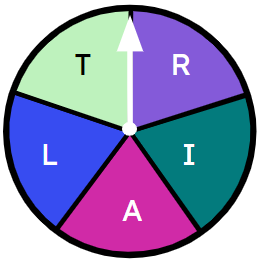
Q5.Complete the following sample space for the outcomes of the spinner. ξ = {A, I, L, T, }.
Complete the following sample space for the outcomes of the spinner. ξ = {A, I, L, T, }.
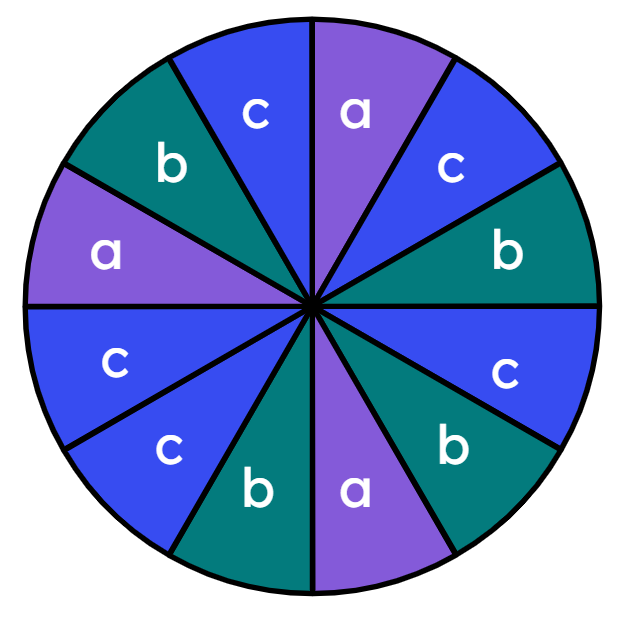
Q6.How many possible outcomes are there on this spinner?
How many possible outcomes are there on this spinner?
Assessment exit quiz
6 Questions
Q1.When listing outcomes , they are listed in such a way as to ensure all outcomes are recorded.
When listing outcomes , they are listed in such a way as to ensure all outcomes are recorded.
haphazardly
randomly
Q2.A coin is flipped twice. Complete the sample space ξ = {HH, HT, TH, }
A coin is flipped twice. Complete the sample space ξ = {HH, HT, TH, }
Q3.A coin is flipped three times. Which outcome is missing from the following sample space? ξ = {HHH, HHT, HTH, HTT, THH, THT, , TTT}
A coin is flipped three times. Which outcome is missing from the following sample space? ξ = {HHH, HHT, HTH, HTT, THH, THT, , TTT}
Q4.A counter is taken from the bag. Its letter is noted and then it is placed back into the bag. A counter is taken from the bag again. Which is a correct sample space for this trial?
A counter is taken from the bag. Its letter is noted and then it is placed back into the bag. A counter is taken from the bag again. Which is a correct sample space for this trial?
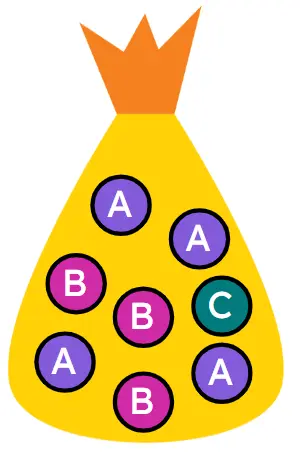
ξ = {AA, AB, BA, BB, BC, CA, CB, CC}
ξ = {AA, AB, AC, BA, BB, BC, BB, CA, CB, CC}
Q5.In a rugby match, a team can either win (W), lose (L) or draw (D). A team plays two matches. Which outcome is missing from the following sample space? ξ = {WW, WL, WD, LW, LL, DW, DL, DD}
In a rugby match, a team can either win (W), lose (L) or draw (D). A team plays two matches. Which outcome is missing from the following sample space? ξ = {WW, WL, WD, LW, LL, DW, DL, DD}
Q6.There are two trials. In Trial 1, a spinner with {A, B, C} is spun twice. In Trial 2, a spinner with {A, B} is spun three times. Which statement is true?
There are two trials. In Trial 1, a spinner with {A, B, C} is spun twice. In Trial 2, a spinner with {A, B} is spun three times. Which statement is true?
The total number of possible outcomes in Trial 1 is less than in Trial 2.
The total number of possible outcomes in Trial 1 is the same are in Trial 2.
