- Year 9
Checking understanding of congruence
I can translate, reflect and rotate a shape.
Lesson details
Key learning points
- Translation, reflection and rotation produce an image congruent to the object.
- Translation involves moving the shape.
- Rotation involves turning the shape about a defined point.
- Reflection involves flipping the shape.
Keywords
Congruent - If one shape can fit exactly on top of another using rotation, reflection or translation, then the shapes are congruent.
Common misconception
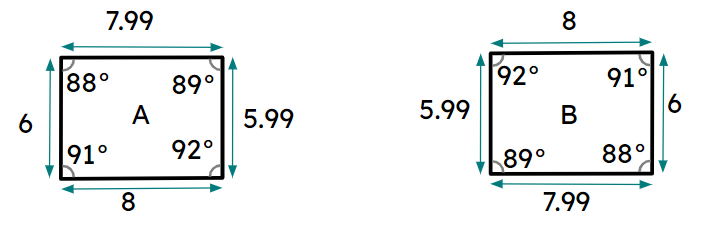
Pupils may find it difficult to match up corresponding measurements on two congruent shapes when they are in different orientations.
Look lengths which are between any pairs of known angles or look for angles which are between pairs of adjacent known lengths. Also, tracing paper could be used to reflect/rotate/translate one shape onto the other.


Licence
Lesson video
Loading...
Prior knowledge starter quiz
6 Questions
Q1.Match each transformation to its description.

enlargement - changing the size of an object while maintaining the same proportions
reflection - flipping an object over a fixed line
rotation - turning an object by a fixed amount and around a fixed point
translation - moving every point of an object by the same distance and direction
Q2.If one shape can fit exactly on top of another using rotation, reflection or translation, then the shapes are __________.
Q3.Which properties of a triangle would remain invariant when it is rotated 90°.
Q4.A square with length 5 cm is enlarged by a scale factor of 1. The length of square in the image is cm.
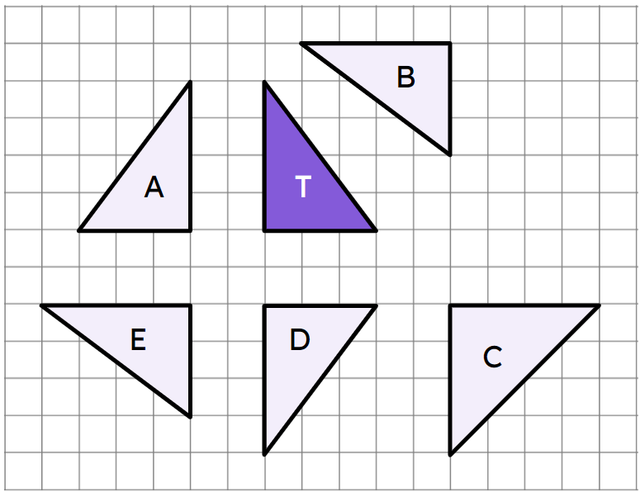
Q5.Which of the triangles can NOT be obtained by reflecting triangle T?
Q6.Triangle A has been reflected over the line of reflection to create triangle B. Match each unknown length from triangle B with its size.
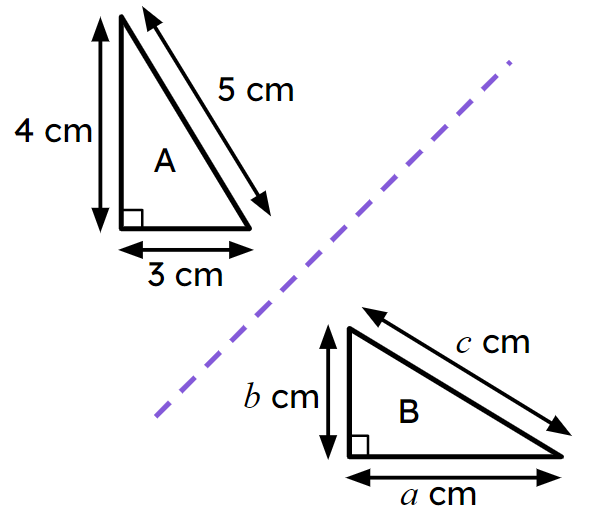
$$a \text{ cm}$$ - 4 cm
$$b\text{ cm}$$ - 3 cm
$$c\text{ cm}$$ - 5 cm
Assessment exit quiz
6 Questions
Q1.Which shape is congruent to rectangle R?
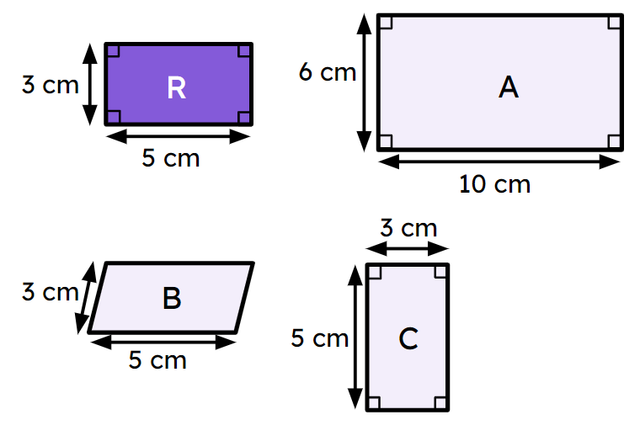
Q2.Which transformation can produce an image that is incongruent to an object?
Q3.Which triangles are congruent to triangle T?
Q4.Shapes A and B are congruent. Match each unknown length from shape B with its size.
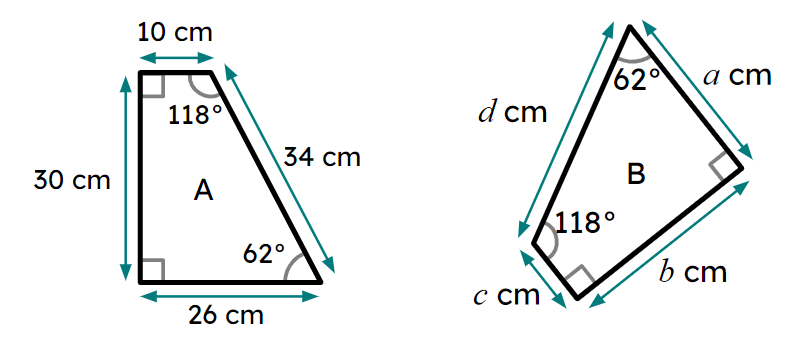
$$a \text{ cm}$$ - 26 cm
$$b \text{ cm}$$ - 30 cm
$$c\text{ cm}$$ - 10 cm
$$d\text{ cm}$$ - 34 cm
Q5.When two shapes are congruent, which property of the shapes may differ?
Q6.The type of transformation that maps shape A onto shape B is a .