Choose efficient approaches when subtracting mixed numbers
I can choose efficient approaches when subtracting mixed numbers.


- Year 4
Choose efficient approaches when subtracting mixed numbers
I can choose efficient approaches when subtracting mixed numbers.
Lesson details
Key learning points
- Partitioning is a strategy that can be used to subtract mixed numbers.
- When partitioning, the whole number part and the fractional part of the minuend must be greater than the subtrahend's.
- Using number-sense can support us to determine the most efficient method to use when subtracting from mixed numbers.
Keywords
Mixed number - A mixed number is a whole number and a fraction combined.
Minuend - The minuend is the first number in a subtraction. The number from which another number is to be subtracted.
Subtrahend - The subtrahend is the number that is to be subtracted. The second number in a subtraction.
Common misconception
When partitioning to subtract, children may partition correctly but then may subtract incorrectly by swapping the order of the fractional parts being subtracted.
Is partitioning efficient for this subtraction where the fractional part of the subtrahend is greater than that of the minuend? It may be more efficient to 'find the difference' by counting on.


Licence
Lesson video
Loading...
Prior knowledge starter quiz
6 Questions
Q1.72 − 34 =

Q2.$$ {4} \over {5}$$ − $$ {3} \over {5}$$ =
Q3.Match the mixed number to their equivalent improper fraction.
$$2{{4} \over {6}}$$ - $$ {16} \over {6}$$
$$3{{4} \over {7}}$$ - $$ {25} \over {7}$$
$$1{{6} \over {7}}$$ - $$ {13} \over {7}$$
$$2{{1} \over {6}}$$ - $$ {13} \over {6}$$
$$5{{3} \over {7}}$$ - $$ {38} \over {7}$$
Q4.Match the improper fractions to their equivalent mixed number.
$$ {10} \over {6}$$ - $$1{{4} \over {6}}$$
$$ {19} \over {6}$$ - $$3{{1} \over {6}}$$
$$ {32} \over {6}$$ - $$5{{2} \over {6}}$$
$$ {35} \over {6}$$ - $$5{{5} \over {6}}$$
$$ {41} \over {6}$$ - $$6{{5} \over {6}}$$
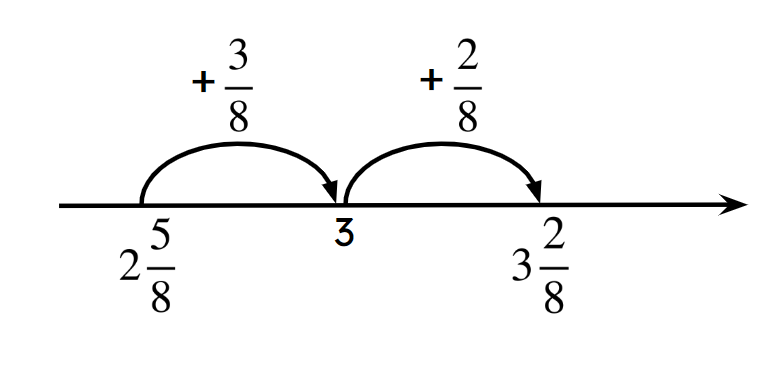
Q5.Use the number line to complete the sentence: the difference between $$3{{2} \over {8}}$$ and $$2{{5} \over {8}}$$ is eighths
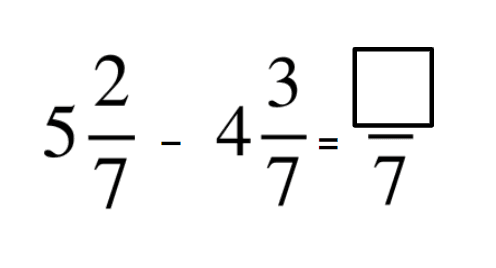
Q6.Complete the missing box to make the equation correct.
Assessment exit quiz
6 Questions
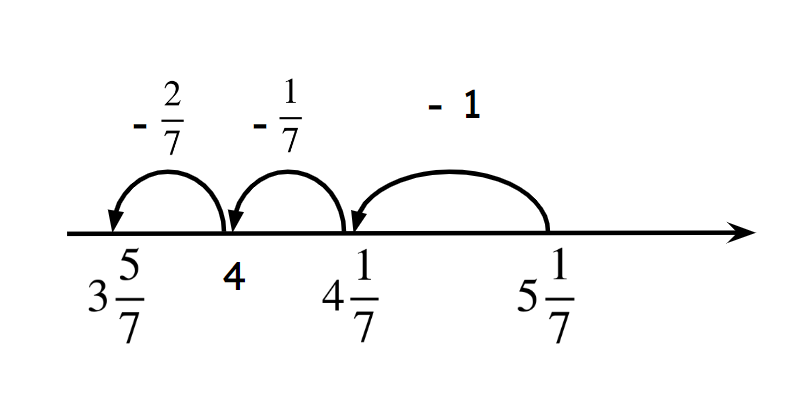
Q1.Use counting back (reduction) to solve the calculation $$5{{1} \over {7}}$$ − $$1{{3} \over {7}}$$ equals three and sevenths
Q2.Use partitioning to solve the calculation $$6{{5} \over {7}}$$ − $$1{{3} \over {7}}$$ equals five and sevenths
Q3.Use ‘finding the difference’ by counting on to solve $$6{{2} \over {7}}$$ − $$5{{5} \over {7}}$$
Q4.By expressing these mixed numbers as improper fractions, calculate this:
$$9{{2} \over {8}}$$ - $$3{{5} \over {8}}$$ =
Q5.In a sequence decreasing by one and one-sixth, what would come next?
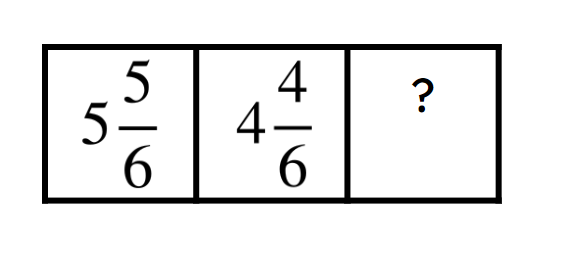
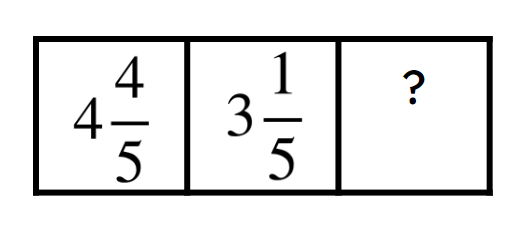
Q6.In a sequence decreasing by one and three-fifths, what would come next?