


New
New
Classifying organisms using a classification key
I can explain how to use a classification key, and the importance of classifying organisms into groups within larger groups.


Lesson 2 of 4
New
New
- Year 8
Classifying organisms using a classification key
I can explain how to use a classification key, and the importance of classifying organisms into groups within larger groups.
Lesson details
Key learning points
- A classification key can be used to find out which groups organisms are classified into.
- A classification key is a series of questions about the features of organisms.
- Classification helps us organise and make sense of biodiversity.
Keywords
Taxonomy - The practice of classifying.
Classification - The process of sorting things into groups.
Classification key - A series of questions about the features of organisms that help us to classify them correctly.
Common misconception
Animals are misclassified based on features that have been incorrectly interpreted, such as wings.
Animals which are often misclassified are included as explicit examples, such as bat, whale and penguin.
Use mini whiteboards or other wipeable surface for students to write their classification questions on. Use a selection of biscuits (be aware of allergies) which are different shapes, some with fillings etc, to practice producing classification keys.

Teacher tip

Licence
This content is © Oak National Academy Limited (2026), licensed on Open Government Licence version 3.0 except where otherwise stated. See Oak's terms & conditions (Collection 2).
Lesson video
Loading...
Prior knowledge starter quiz
6 Questions
Q1.Which classification level has groups called ‘Animals’, ‘Plants’ and ‘Fungi’?
Which classification level has groups called ‘Animals’, ‘Plants’ and ‘Fungi’?
genus
species
Q2.A species is a group of organisms which …
A species is a group of organisms which …
share few similarities with each other.
have a backbone.
Q3.The frog (Rana temporaria) and toad (Bufo bufo) are both animals. Which statement correctly describes the difference between?
The frog (Rana temporaria) and toad (Bufo bufo) are both animals. Which statement correctly describes the difference between?
They are both from the same genus.
They are both from a different kingdom.
Q4.Starting with the largest, sort these groups into order of size.
Starting with the largest, sort these groups into order of size.
Q5.Which option shows the correct way to format the binomial name for a mushroom?
Which option shows the correct way to format the binomial name for a mushroom?
Amanita muscaria
amanita muscaria
amanita muscaria
Q6.Match the classification level with the name of the daisy (Bellis perennis).
Match the classification level with the name of the daisy (Bellis perennis).

Assessment exit quiz
6 Questions
Q1.Match the animal to its correct classification class.
Match the animal to its correct classification class.
Q2.Select the classification level which will have the greatest number of organisms with the most differences between them.
Select the classification level which will have the greatest number of organisms with the most differences between them.
class
genus
species
Q3.Taxonomy is the practice of:
Taxonomy is the practice of:
Identification
Organisation
Q4.We can use a to accurately put organisms into groups based on questions about their characteristics.
We can use a to accurately put organisms into groups based on questions about their characteristics.
Q5.Use the classification key to classify a dolphin.
Use the classification key to classify a dolphin.
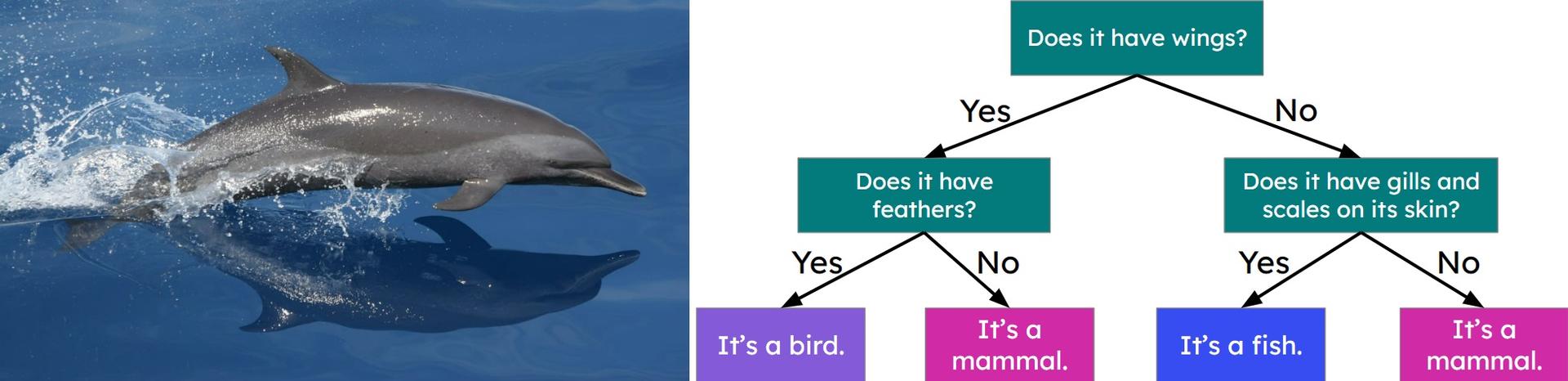
bird
fish
Q6.Which student offers a reason why we classify organisms?
Which student offers a reason why we classify organisms?
Lucas: "Classification keys can be made electronic for use in the field."
Alex: "Classification is quick and simple."
