Comparing materials and their properties
I can compare the properties of glass, clay ceramics, polymers, composites, and metals; and explain how the properties of materials are related to their uses.


- Year 11
- AQA
Comparing materials and their properties
I can compare the properties of glass, clay ceramics, polymers, composites, and metals; and explain how the properties of materials are related to their uses.
Lesson details
Key learning points
- Production processes for industrial materials are under continuous development, with new materials discovered.
- Several factors direct a choice of materials: performance, production processes, cost, aesthetics, and others.
- Composites are mixtures of materials made up of a matrix and a reinforcement.
- Qualitative data describes properties, while quantitative data measures properties numerically.
Keywords
Material - A physical substance that things can be made from.
Composite - A mixture of materials (matrix and reinforcement), combined to produce a material with properties of both.
Matrix - In a composite material, it is the substance that binds the reinforcement material together.
Reinforcement - In a composite material, it is the substance that is bound together by the matrix material.
Quantitative data - Information that can be counted or measured, and given a numerical value.
Common misconception
Students often think: all glass types have the same properties and uses; polyethene types are identical in structure and use; and composites are simple mixtures (not engineered materials).
Clarify that soda-lime and borosilicate glass differ in production and use. Explain the distinct processes and uses of LDPE and HDPE. Describe how composites are engineered to achieve specific properties.


Licence
Lesson video
Loading...
Prior knowledge starter quiz
6 Questions
Q1.Match the keywords to the correct definitions.

Q2.Which picture shows a model of a branched polymer?



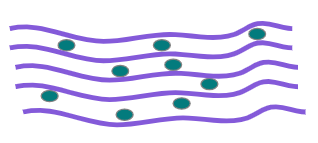
Q3.Which picture shows a model of a polymer with plasticisers?
Q4.A chemical bond is a strong force that holds atoms together in a compound. A chemical bond takes a lot of energy to overcome and break.
Which of the following statements are correct?
Q5.A practical method for scientists to determine the physical properties of materials is by conducting tests. How can you distinguish between plain and reinforced concrete if the pieces look similar?
Q6.Which picture shows a model of a cross-linked polymer?
Assessment exit quiz
6 Questions
Q1.Match these key terms to the correct definitions.
Q2.Soda-lime glass is made from readily available materials. Borosilicate glass requires rarer compounds but its property makes it possible to use in high heat applications such as lab glassware.
Q3.Considering performance, sustainability or aesthetics can lead to discovery of new materials. Composites are typically more expensive than aluminium. What makes carbon fibre better for aircraft wings?
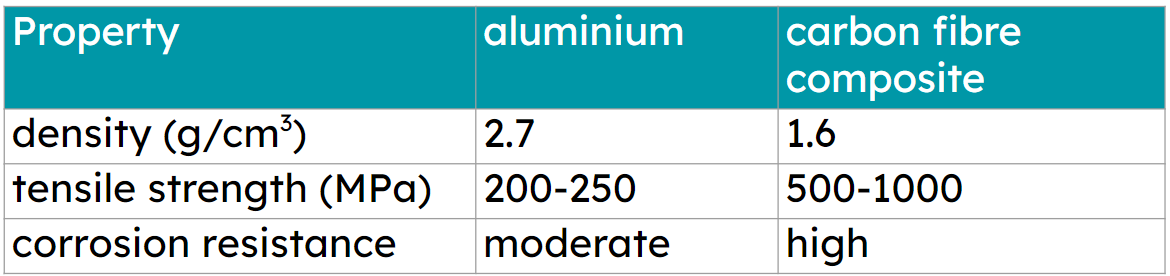
Q4.Quantitative data is essential for precise comparisons and decision-making in material selection. Which of the following properties can provide quantitative data for this?
Q5.Match these terms to the correct descriptions.
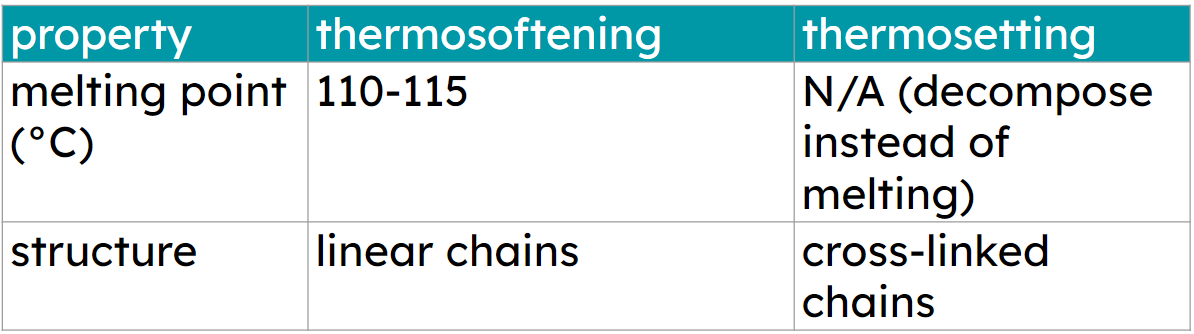
Q6.Thermosoftening polymers can be reheated, melted and reshaped multiple times due to their linear chain structure. Thermosetting polymers decompose instead of melting because of their .