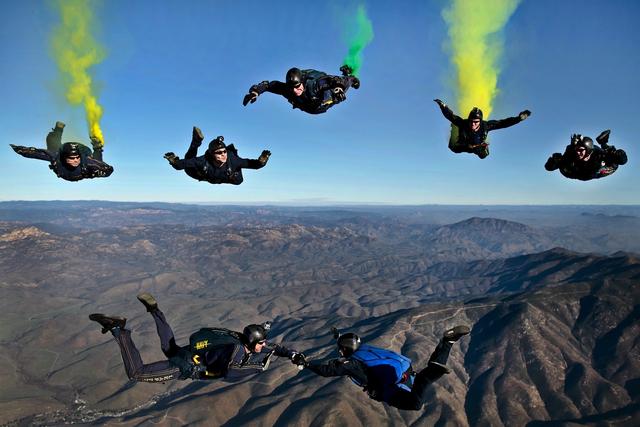
Comparing the speeds of different parachutes
I can explain how the size of a parachute affects its top speed.


- Year 8
Comparing the speeds of different parachutes
I can explain how the size of a parachute affects its top speed.
Lesson details
Key learning points
- The larger the surface of a parachute, the bigger its drag.
- Gravity pulls down with a steady force.
- At top speed the force of drag on a parachute is the same size as the force of gravity on the jumper.
Keywords
Drag - When an object moves through a fluid there is a drag force that opposes the movement.
Parachute - A parachute is used to increase the size of drag forces. This slows down the object it is attached to.
Gravitational force - The gravitational force on something pulls it downwards, towards Earth.
Resultant force - A resultant force is the overall effect of a set of forces on an object, taking their directions into account.
Common misconception
Students may think that all objects fall at the same rate (this is only true in a vacuum).
Use force diagrams to discuss the effect of different sized drag on the parachutes, linking this to resultant force and acceleration.


Content guidance
- Risk assessment required - equipment

Supervision
Adult supervision required

Licence
Lesson video
Loading...
Prior knowledge starter quiz
6 Questions
Q1.Which force causes objects to fall to the ground?
Q2.Why is a force represented by an arrow on a diagram? Choose the best answer.
Q3.Which force opposes movement through liquids?
Q4.At the end of a race a car opens a parachute. Why do they do this?

Q5.A car moving along a flat road has an unbalanced forwards force acting on it for 30 s. What will happen to the car's movement?
Q6.An emergency food parcel is dropped from a plane. Near the ground the parachute opens. What happens to the movement of the food parcel?
Assessment exit quiz
6 Questions
Q1.Match the key words to their explanations.

Q2.When does a falling object reach a steady top speed?
Q3.During a test. a pupil drops paper parachutes with different surface areas but equal weights. Which is the correct prediction about the fall speed?
Q4.In a parachute drop test the times recorded are 1.21 s, 1.24 s, 1.23 s and 1.28 s. What is the mean time?
Q5.A skydiver is falling with their parachute closed. What happens to the size of the forces on them immediately after opening the parachute?