


New
New
Constructing a right-angled triangle given the length of the hypotenuse and one other side length
I can construct a right-angled triangle given the length of the hypotenuse and one other side length.


Lesson 8 of 13
New
New
- Year 11
Constructing a right-angled triangle given the length of the hypotenuse and one other side length
I can construct a right-angled triangle given the length of the hypotenuse and one other side length.
Lesson details
Key learning points
- The shorter side can be drawn accurately with a ruler
- The perpendicular through the end point of the drawn side should be constructed
- The compass should be used to indicate potential positions for the hypotenuse
- All triangles with the same measurements are congruent
Keywords
Pair of compasses - A pair of compasses is a tool which can be used to draw circles and arcs. A pair of compasses is sometimes referred to just as a compass.
Congruent - If one shape can fit exactly on top of another using rotation, reflection or translation, then the shapes are congruent.
Common misconception
Pupils may want to use a protractor to draw a right angle.
Remind pupils that they need to construct the right angle with a pair of compasses and a ruler, using appropriate construction techniques.
This lesson uses a method that involves a circle theorem (angles in a semi-circle), so you may wish to recap circle theorems before this lesson.

Teacher tip

Equipment
Pair of compasses, ruler

Licence
This content is © Oak National Academy Limited (2025), licensed on Open Government Licence version 3.0 except where otherwise stated. See Oak's terms & conditions (Collection 2).
Lesson video
Loading...
Prior knowledge starter quiz
6 Questions
Q1.What equipment should you use to make an accurate construction of this triangle?
What equipment should you use to make an accurate construction of this triangle?

compasses, ruler, protractor and pencil
compasses, protractor and pencil
compasses, ruler and pencil
Q2.The diagram shows part of a protractor measuring an angle. What is the size of the angle?
The diagram shows part of a protractor measuring an angle. What is the size of the angle?

45°
145°
155°
Q3.The diagram shows part of a protractor measuring an angle. What is the size of the angle?
The diagram shows part of a protractor measuring an angle. What is the size of the angle?

73°
113°
127°
Q4.Laura is using GeoGebra to accurately draw a triangle with ∠BAC = 135° and ∠ABC = 32° and side AB = 6 units. Which of these tools should Laura use to draw side BC?
Laura is using GeoGebra to accurately draw a triangle with ∠BAC = 135° and ∠ABC = 32° and side AB = 6 units. Which of these tools should Laura use to draw side BC?
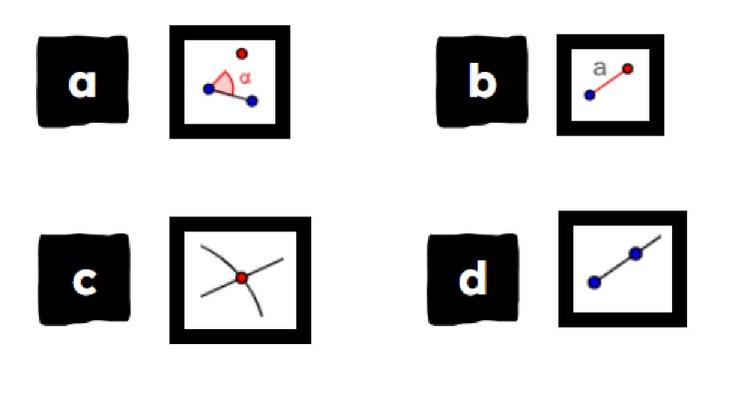
a
b
c
Q5.∠ABC = °.
∠ABC = °.

Q6.Starting with the first step, put these instructions in the correct order to construct triangle ABC.
Starting with the first step, put these instructions in the correct order to construct triangle ABC.

Assessment exit quiz
6 Questions
Q1.A pair of is a tool which can be used to draw circles and arcs.
A pair of is a tool which can be used to draw circles and arcs.
Q2.Which construction should you use to create a right-angle?
Which construction should you use to create a right-angle?
angle bisector
bisector
circle
Q3.Jacob is constructing a right-angled triangle and has drawn a line segment for one of its shorter sides. Which tool can be used to construct a perpendicular line through one of its points?
Jacob is constructing a right-angled triangle and has drawn a line segment for one of its shorter sides. Which tool can be used to construct a perpendicular line through one of its points?
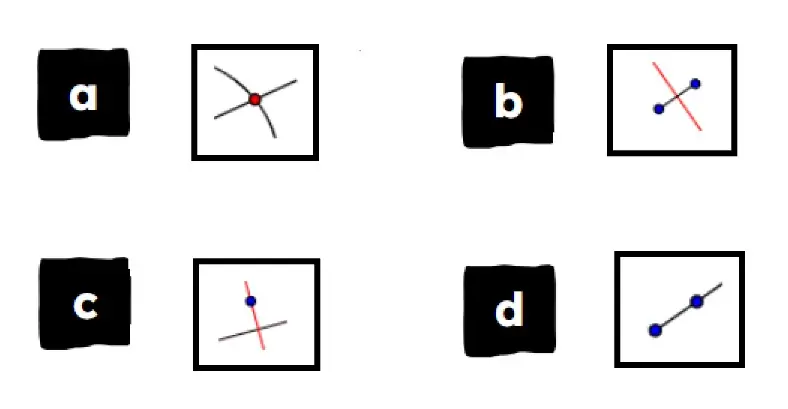
a
b
d
Q4.The diagram shows a right-angled triangle constructed from two circles. The length of the hypotenuse is cm.
The diagram shows a right-angled triangle constructed from two circles. The length of the hypotenuse is cm.

Q5.The diagrams below show constructions for two congruent triangles. What is the radius of each circle in the diagram on the right?
The diagrams below show constructions for two congruent triangles. What is the radius of each circle in the diagram on the right?

Radius of small circle = 4 cm; radius of large circle = 7 cm
Radius of small circle = 4 cm; radius of large circle = 14 cm
Radius of small circle = 8 cm; radius of large circle = 14 cm
Radius of small circle = 14 cm; radius of large circle = 16 cm
Q6.Starting with the first step, put these instructions in the correct order to construct the triangle ABC where the hypotenuse, AB, is 5 cm and BC is 3 cm.
Starting with the first step, put these instructions in the correct order to construct the triangle ABC where the hypotenuse, AB, is 5 cm and BC is 3 cm.

