


- Year 11
Constructing angles of 90° and 45°
I can construct angles of 90° and 45°.
Lesson details
Key learning points
- When constructing the perpendicular, you are constructing a 90° angle
- Bisecting a 90° angle results in two angles, each measuring 45°
Keywords
Bisect - To bisect means to cut or divide an object into two equal parts.
Complementary angles - Complementary angles are a pair of angles that sum to 90°.
Supplementary angles - Supplementary angles are a pair of angles that sum to 180°.
Conjugate angles - Conjugate angles are a pair of angles that sum to 360°.
Common misconception
Pupils may use a protractor rather than a pair of compasses.
Remind pupils that a construction is done using a pair of compasses and ruler.


Equipment
Pair of compasses, protractor, ruler.

Licence
Lesson video
Loading...
Prior knowledge starter quiz
6 Questions
Q1.Andeep constructs the bisector of an angle of 104°. Andeep has made angles of °.

Q2.The diagram shows two congruent isosceles triangles put together to form a rhombus. Match each angle to its size.
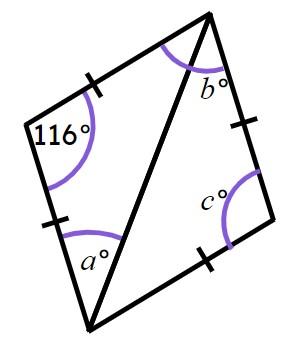
$$a$$° - 32°
$$b$$° - 64°
$$c$$° - 116°
Not a marked angle - 44°
Q3.Here are the steps to construct a rhombus given the legs of an angle. Match each step to the correct instruction.
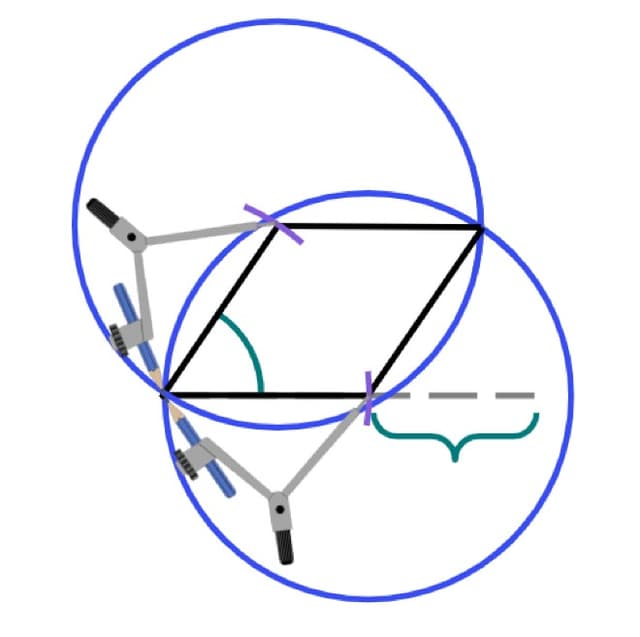
Step 1 - Set your compasses to a width equal to the shorter of the two legs.
Step 2 - Place your compass needle on the vertex of the angle.
Step 3 - Make an arc on each leg, then place the compass needle on one arc.
Step 4 - Place the pencil on the vertex of the angle. Draw a circle.
Step 5 - Repeat on the open endpoint of the other leg.
Step 6 - Draw lines with a ruler to connect the points to form a rhombus.
Q4.Jacob wants to construct a rhombus using an angle with leg lengths of 10 cm and 15 cm. The maximum radius of each circle in the construction of this rhombus is cm.
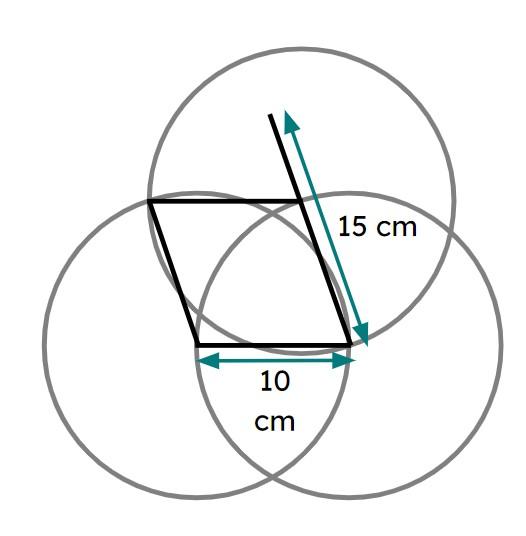
Q5.Lucas begins construction of a rhombus from this angle. Which point is the final vertex of the rhombus?
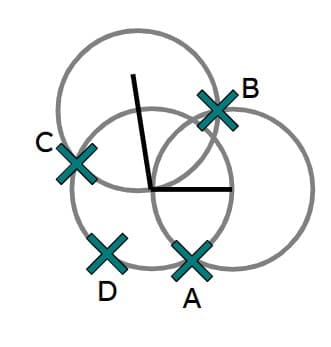
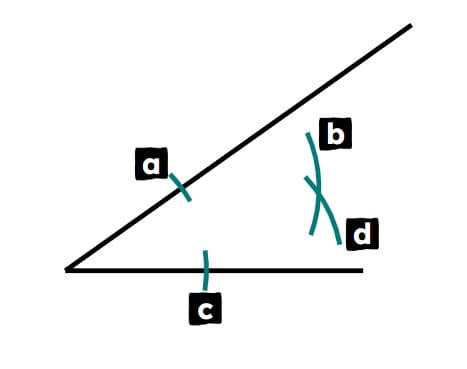
Q6.Jun is constructing an angle bisector. Here are the construction marks. Which two arcs did Jun draw first?
Assessment exit quiz
6 Questions
Q1.Complementary angles are a pair of angles that sum to °.
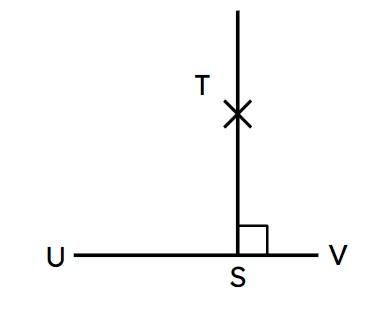
Q2.The diagram shows the perpendicular to UV that passes through the point T. The perpendicular intersects UV at point S. Which of these constructions will produce a 45° angle?
Q3.EC is a perpendicular to BD. The angle BOE is bisected. Match each angle to its size.
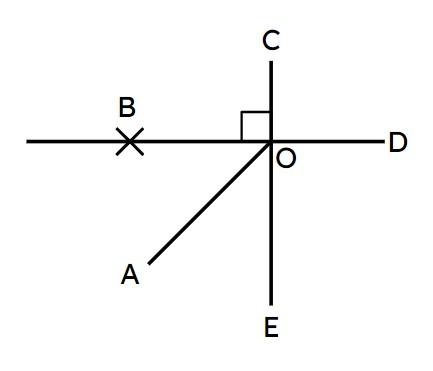
Angle BOC - 90°
Angle AOE - 45°
Angle AOD - 135°
Reflex angle AOE - 315°
Reflex angle AOD - 225°
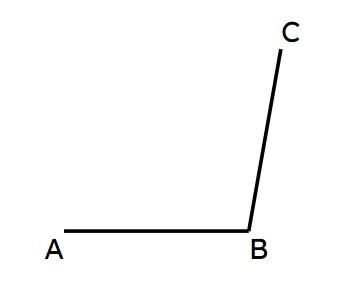
Q4.The line segments AB and BC form an angle of 110°. Which of these constructions creates a 55° angle?
Q5.Line segments AB and BC are the legs of a 124° angle. The diagram shows the two constructions that are applied to ABC. The angle $$x$$° is °.
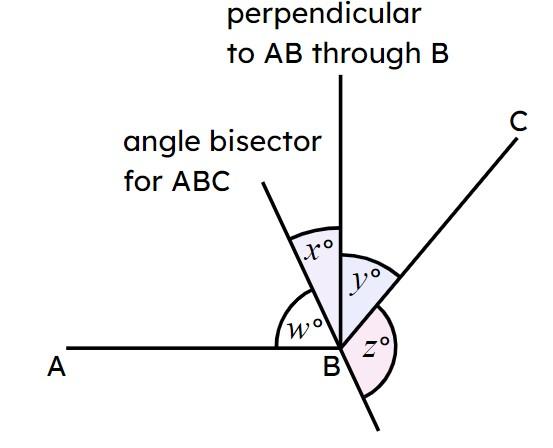
Q6.Line segments AB and BC are the legs of a 124° angle. The diagram shows the two constructions that are applied to ABC. The angle $$z$$° is °.
