Determining ionic formulae
I can deduce the formulae of ionic compounds (including oxides, hydroxides, halides, nitrates, carbonates and sulfates) given the formulae of the constituent ions.


- Year 10
- Edexcel
Determining ionic formulae
I can deduce the formulae of ionic compounds (including oxides, hydroxides, halides, nitrates, carbonates and sulfates) given the formulae of the constituent ions.
Lesson details
Key learning points
- An empirical formula is the simplest whole number ratio of atoms of each element in a compound.
- The formula of an ionic compound is an empirical formula, as there is no definite quantity of each ion.
- Ionic compounds ending with "–ide" only contain a metal and a non–metal ion.
- Polyatomic ions are ions that are made up of more than one type of atom.
- Ionic compounds ending with "–ate" always contain at least three elements, one of which is oxygen.
Keywords
Empirical formula - The simplest whole number ratio of atoms of each element in a compound.
Polyatomic ions - Ions that are made up of more than one type of atom.
"–ide" - The name ending for a compound with a metal and non–metal present, for example, potassium iodide (KI).
"–ate" - The name ending for a compound with three or more elements present (one of which is oxygen), for example, potassium sulfate (K₂SO₄).
Common misconception
Using ionic charges to determine the empirical formulae, especially with polyatomic ions. Standard notation is difficult and confusing, e.g. when to use superscripts, subscripts or brackets.
At this stage, pupils will need to just learn the the formulae of the polyatomic ions and accept that a full explanation will come later in their chemistry learning. Provide pupils with plenty of practice of writing and using ionic formulae.


Equipment
None required.

Licence
Lesson video
Loading...
Prior knowledge starter quiz
6 Questions
Q1.Ions form through the loss or gain of ...
Q2.When a nitrate ion forms, it gains one electron. What charge does a nitrate ion have?
Q3.True or false? Non–metal atoms gain electrons to become more stable, negatively charged ions.
Q4.Which of the following statements about ammonium nitrate, NH₄NO₃, are correct?
Q5.Match the following terms to the correct definitions.

Q6.Magnesium chloride is an ionic compound. Which of the following statements does not describe magnesium chloride?
Assessment exit quiz
6 Questions
Q1.Match the following key terms to the correct definition.
Q2.The molecular formula for hydrogen peroxide is H₂O₂. What is its empirical formula?
Q3.Which of the following are examples of ionic compounds with names ending with –ide?
Q4.Which of the following are examples of polyatomic ions?
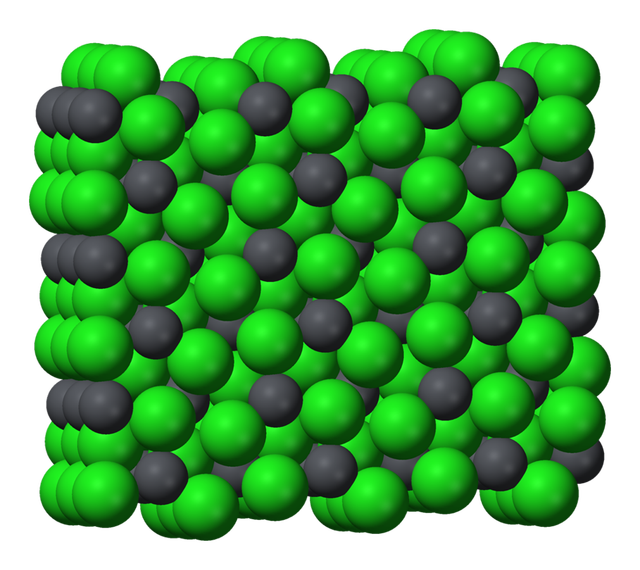
Q5.The image shows the ionic compound lead(II) chloride. What is the empirical formula for lead(II) chloride?