Distillation: fractional distillation
I can explain how fractional distillation works and how it differs from simple distillation in separating mixtures of fluids.


- Year 10
- OCR
Distillation: fractional distillation
I can explain how fractional distillation works and how it differs from simple distillation in separating mixtures of fluids.
Lesson details
Key learning points
- Fractional distillation is an extension of simple distillation, and is mostly used to separate mixtures of liquids.
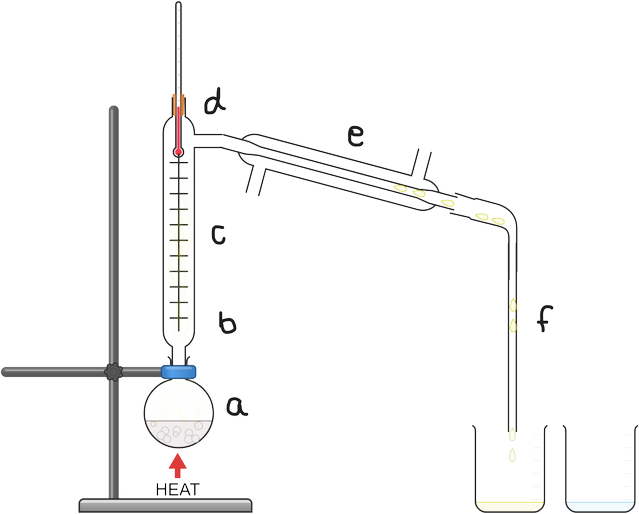
- A main distinction between fractional and simple distillation is that the former uses a fractionating column.
- Fractional distillation has multiple real-world examples, including the fractional distillation of air.
- Fractional distillation produces fractions; these can be pure or mixtures of chemicals with very similar boiling points.
Keywords
Fraction - A fraction is a component of a mixture that has been separated by fractional distillation.
Fractional distillation - Fractional distillation is a method used to separate miscible fluids (liquids or gases) with different boiling points into individual components (fractions).
Miscible - Fluids that dissolve in another fluid are described as miscible in that fluid.
Boiling point - The temperature at which a substance changes between a liquid state and a gas state is known as its boiling point.
Fractionating column - A fractionating column is a piece of apparatus within which a temperature gradient develops. It is used during fractional distillation.
Common misconception
Pupils sometimes think that heating a substance strongly and for extended periods will improve the quality of separation via distillation.
Stress that distillation is a skill which requires careful control of heating so only one substance is in the condenser at a time. Understanding the link between application of heat to the mixture, boiling point and reading a thermometer is essential


Equipment

Content guidance
- Depiction or discussion of sensitive content

Supervision
Adult supervision recommended

Licence
Lesson video
Loading...
Prior knowledge starter quiz
6 Questions
Q1.A mixture is a substance which is made up from more than one element and/or compound which are ...
Q2. is the process by which a gas is cooled into a liquid.
Q3.Air is an example of ...
Q4.Match the following statements to make complete sentences about pure substances and mixtures.

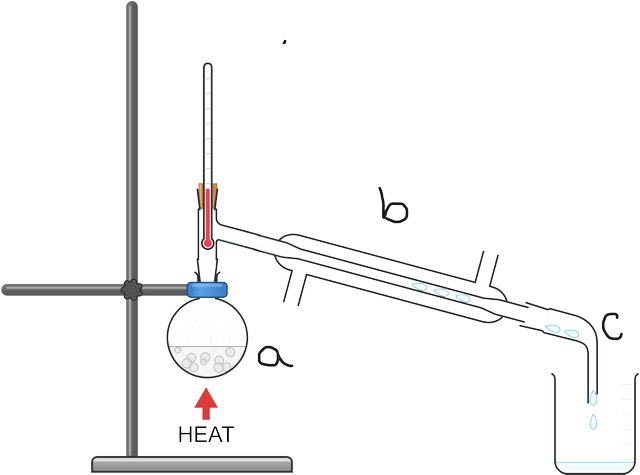
Q5.Simple distillation can be used to separate solutions. Order the following processes that occur during simple distillation.
Q6.In the diagram below, give the letters in order for where forces between the particles are overcome or where they are being reformed.
Assessment exit quiz
6 Questions
Q1.What are miscible fluids?
Q2. are produced by fractional distillation. They may be pure, i.e. contain one component, or a mixture containing multiple components with similar boiling points.
Q3.What is the purpose of fractional distillation?
Q4.Match the following statements to make complete sentences related to distillation:
Q5.A mixture of liquid fractions; X (b.p. 40 - 100°C), Y (b.p. 120 - 160°C) and Z (b.p. 180 - 200°C) was heated quickly to 150°C. What would be found in the distillate?
Q6.Match the letter with the correct statement concerning the steps occurring during fractional distillation.