New
New
Divide a 2-digit by a 1-digit number using partitioning (with regrouping)
I can divide a 2-digit by a 1-digit number using partitioning and representations (with regrouping).


Lesson 2 of 15
New
New
- Year 5
Divide a 2-digit by a 1-digit number using partitioning (with regrouping)
I can divide a 2-digit by a 1-digit number using partitioning and representations (with regrouping).
Lesson details
Key learning points
- Partitioning the dividend into tens and ones helps when dividing a 2-digit by a 1-digit number.
- If the dividend is not a multiple of the divisor, there will be a remainder.
- If the remainder is a number of tens, you can regroup the tens for ones and continue to divide.
Keywords
Remainder - An amount left over after division.
Partition / partitioning - Splitting a number into smaller parts.
Regroup / regrouping - The process of unitising and exchanging between place values.
Common misconception
Pupils not being able to regroup when dividing.
Use concrete resources to highlight regrouping of tens. Ask children 'What is the highest multiple you know?' to support with partitioning.
Draw special attention to the '10s' digit and ask children if that is a multiple of the divisor. Children are to understand the generalisation '10s' digit in the dividend is not a multiple of the divisor, they will have to regroup.

Teacher tip

Licence
This content is © Oak National Academy Limited (2025), licensed on Open Government Licence version 3.0 except where otherwise stated. See Oak's terms & conditions (Collection 2).
Lesson video
Loading...
Prior knowledge starter quiz
6 Questions
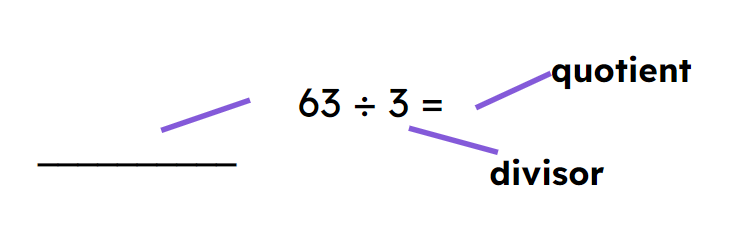
Q1.Look at the image. 63 is the ________ because it is the number we are dividing up.
Look at the image. 63 is the ________ because it is the number we are dividing up.
addend
answer
product
Q2.Andeep is working out: 56 ÷ 7. He can skip count in ___.
Andeep is working out: 56 ÷ 7. He can skip count in ___.
56
8
2
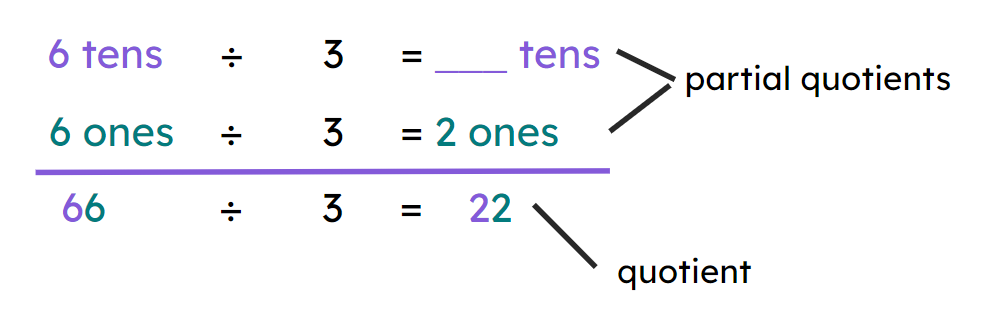
Q3.Look at the image. Fill in the gap in the partial quotients.
Look at the image. Fill in the gap in the partial quotients.
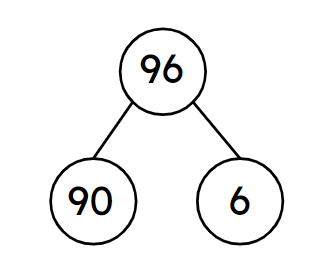
Q4.Select the correct partial quotients for this division equation: 96 ÷ 3 Use the part whole model to help you.
Select the correct partial quotients for this division equation: 96 ÷ 3 Use the part whole model to help you.
3 + 2
90 + 6
Q5.Look at the part whole models. Which is the least helpful way to partition 42 when dividing by 2?
Look at the part whole models. Which is the least helpful way to partition 42 when dividing by 2?
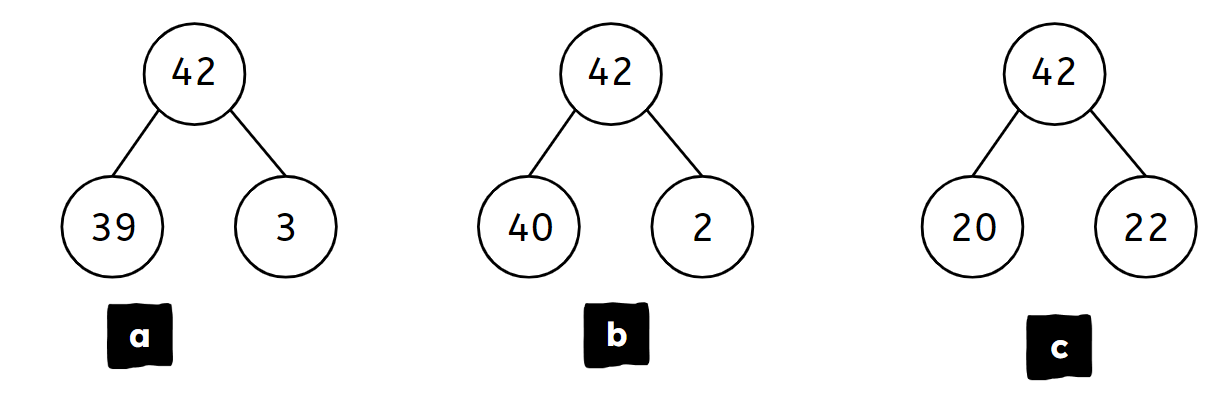
B
C
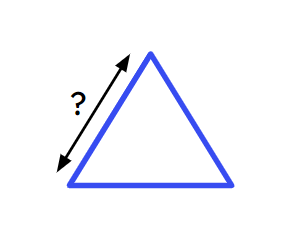
Q6.An equilateral triangle has a total perimeter of 69 cm. What is the length of one side? cm
An equilateral triangle has a total perimeter of 69 cm. What is the length of one side? cm
Assessment exit quiz
6 Questions
Q1.33 ÷ 3 = 11 In this equation, 33 is the __________ because it is the number we are dividing into groups.
33 ÷ 3 = 11 In this equation, 33 is the __________ because it is the number we are dividing into groups.
quotient
divisor
Q2.I can make ___ groups of 6 ones from the dividend 54.
I can make ___ groups of 6 ones from the dividend 54.
7
8
10
Q3.Look at the picture. Izzy is calculating 42 ÷ 3. What should Izzy do next?
Look at the picture. Izzy is calculating 42 ÷ 3. What should Izzy do next?
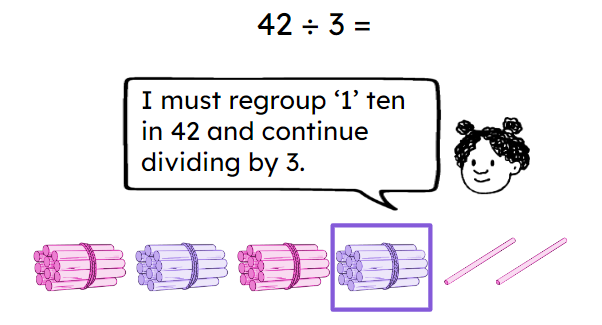
10 ones - 2 ones = 8 one
10 ones ÷ 3
10 ones + 3 tens
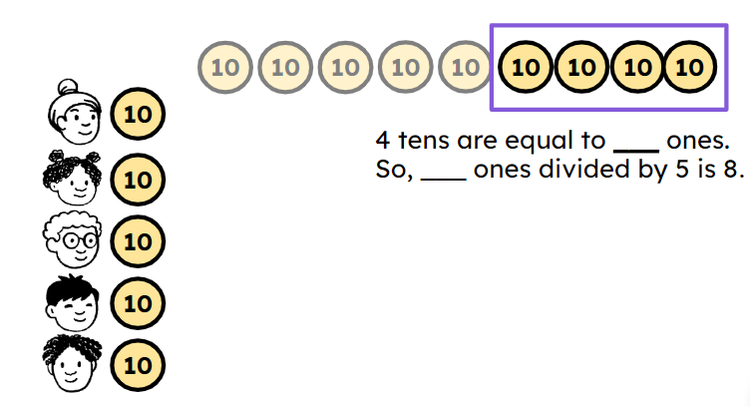
Q4.Fill in the blank in the image which shows 90 ÷ 5. Write your answer in numeral form.
Fill in the blank in the image which shows 90 ÷ 5. Write your answer in numeral form.
Q5.Match the division equations to the correct instances of regrouping.
Match the division equations to the correct instances of regrouping.

Q6.Solve the following question: 92 ÷ 4. Record your calculation using an informal written method. Write your answer in numeral form.
Solve the following question: 92 ÷ 4. Record your calculation using an informal written method. Write your answer in numeral form.