Divide a 3-digit by a 1-digit number using partitioning and representations (no remainders)
I can divide a 3-digit by a 1-digit number using partitioning and representations (no remainders).


- Year 5
Divide a 3-digit by a 1-digit number using partitioning and representations (no remainders)
I can divide a 3-digit by a 1-digit number using partitioning and representations (no remainders).
Lesson details
Key learning points
- Partitioning the dividend into hundreds, tens and ones helps when dividing a 3-digit by a 1-digit number.
- Use times tables and unitising to divide the hundreds, tens and ones by the divisor.
- Place value resources can represent the division.
Keywords
Dividend - The dividend is the amount that you want to divide.
Divisor - A divisor is the number we divide by.
Partial quotient - A partial quotient is seen when the dividend is partitioned.
Partition - Partition means splitting an object or value down into smaller parts.
Quotient - A quotient is the result after division has taken place.
Common misconception
Lack of understanding of place value may lead to the rise of incorrect partial quotients.
Encourage children to identify what each digit represents. If misconceptions persist - use place value counters to divide by skip counting.


Licence
Lesson video
Loading...
Prior knowledge starter quiz
6 Questions
Q1.Identify the multiples of 9

Q2.Izzy is working out: 84 ÷ 4. She can skip count in ___s.
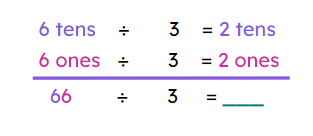
Q3.Fill in the gap. Write your answer in numeral form.
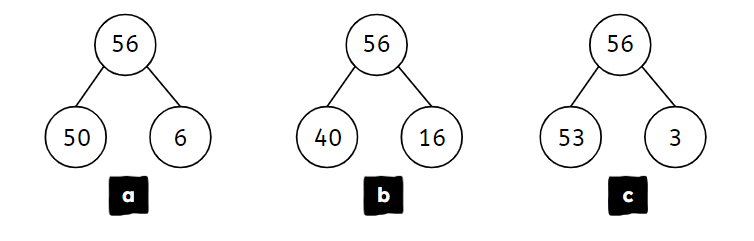
Q4.Which partitioning of 56 shown would be most efficient to solve: 56 ÷ 4?
Q5.Use the partitioning strategy to solve: 42 ÷ 3. Write your answer in numeral form.
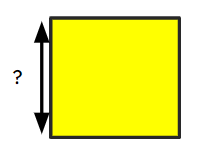
Q6.Use the partitioning strategy to solve this question: A square has a total perimeter of 80 cm. What is the length of one side ? Write your answer in numeral form.
Assessment exit quiz
6 Questions
Q1.Identify the multiples of 6.
Q2.Izzy is working out: 669 ÷ 3. She can skip count in s.
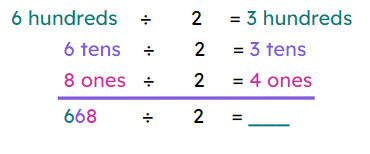
Q3.Fill in the gap in this layout for division.
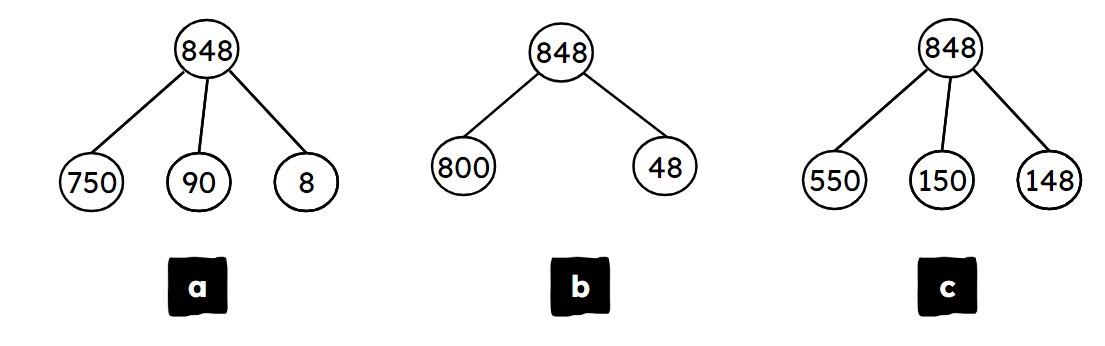
Q4.Which partitioning would be most efficient to solve: 848 ÷ 4?
Q5.Use the partitioning strategy to solve: 636 ÷ 3
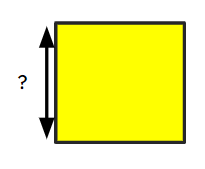
Q6.A square has a total perimeter of 884 cm. What is the length of one side?