New
New
Dividing by a 2-digit divisor including using long division
I can divide by a 2-digit divisor including using long division.


Lesson 10 of 15
New
New
- Year 6
Dividing by a 2-digit divisor including using long division
I can divide by a 2-digit divisor including using long division.
Lesson details
Key learning points
- Different strategies can be used to solve division problems.
- Multiplication facts are really useful in solving division problems.
- Known facts and place value can help to estimate the answer to a long division.
Keywords
Estimate - Estimate means to find a value that is close enough to the right answer, usually with some thought or calculation involved.
Long division - Long division is a method used for dividing large numbers by breaking the number down into smaller groups.
Remainder - A remainder is an amount left after a division.
Common misconception
Pupils may struggle to set out the long division algorithm correctly.
Use the modelling from the lesson to focus on this, especially when writing multiples of the divisor (e.g. 3 tens × 17 = 51 tens) and subtracting this from the dividend.
In this lesson, pupils will be dividing a 3-digit number by a 2-digit number outside of multiplication tables. However, they can use known or easily derived facts to help them (e.g. 2×, 4×, 5× and 10×). Discuss with pupils methods for multiplying by 30 or 40 (e.g. ×4 then ×10 or ×10 then ×4).

Teacher tip

Equipment

Licence
This content is © Oak National Academy Limited (2025), licensed on Open Government Licence version 3.0 except where otherwise stated. See Oak's terms & conditions (Collection 2).
Lesson video
Loading...
Prior knowledge starter quiz
6 Questions
Q1.Match the multiplication equations to related division facts.
Match the multiplication equations to related division facts.

Q2.Match the division expressions to their quotients.
Match the division expressions to their quotients.
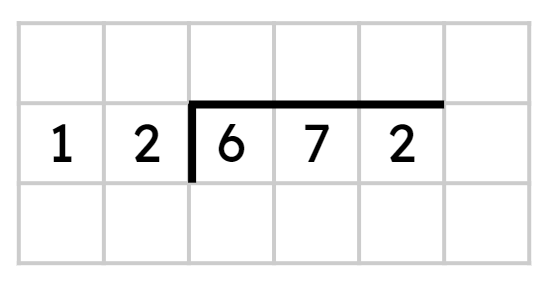
Q3.Complete the following equation using short division. 672 ÷ 12 =
Complete the following equation using short division. 672 ÷ 12 =
Q4.What is the missing working from this algorithm?
What is the missing working from this algorithm?
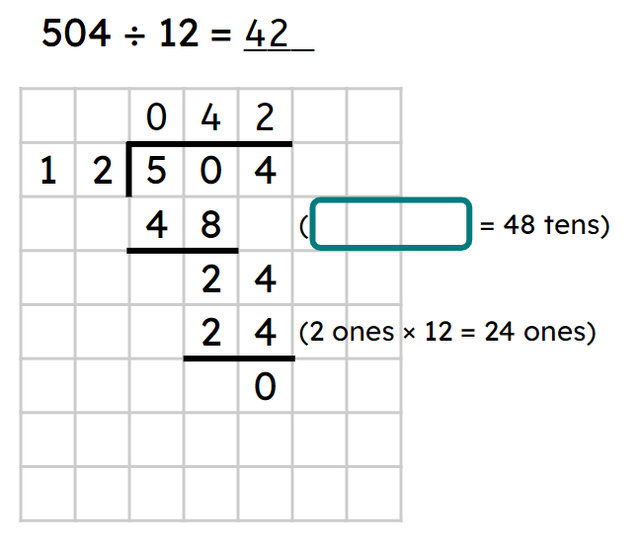
8 tens × 12
4 ones × 12
12 ones × 4
12 tens × 4
Q5.Which of the following is a reasonable estimate for the following equation 432 ÷ 12 =
Which of the following is a reasonable estimate for the following equation 432 ÷ 12 =
30
40
20
25
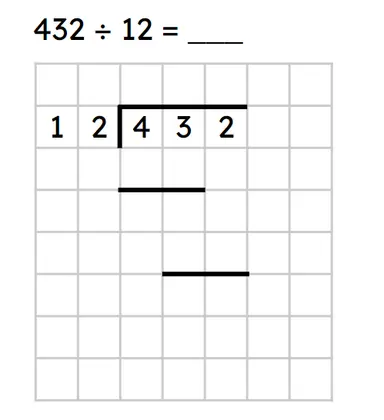
Q6.Calculate the equation using long division. 432 ÷ 12 = ___
Calculate the equation using long division. 432 ÷ 12 = ___
Assessment exit quiz
6 Questions
Q1.Use the multiplication facts in the table to derive 40 × 13 =
Use the multiplication facts in the table to derive 40 × 13 =
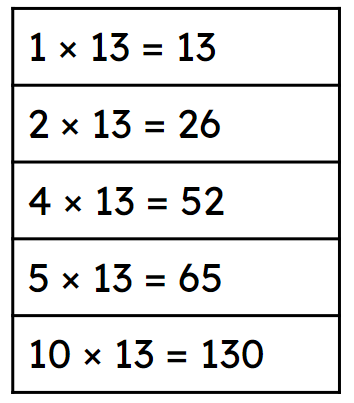
Q2.Use the multiplication facts in the table to derive 15 x 13 =
Use the multiplication facts in the table to derive 15 x 13 =
Q3.Match the equations to their products.
Match the equations to their products.
Q4.If I know 17 × 5 = 85, I also know that 17 × 50 =
If I know 17 × 5 = 85, I also know that 17 × 50 =
Q5.Which of the following is a reasonable estimate for the following equation 918 ÷ 17 =
Which of the following is a reasonable estimate for the following equation 918 ÷ 17 =
50
65
60
45
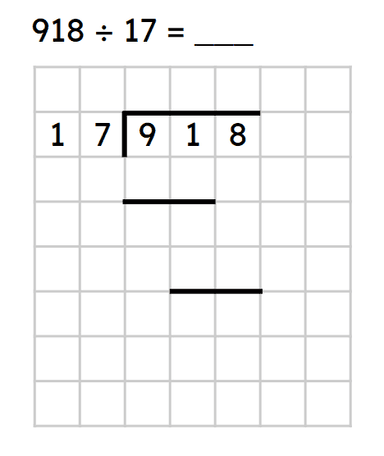
Q6.Calculate the equation using long division. 918 ÷ 17 =
Calculate the equation using long division. 918 ÷ 17 =