


New
New
Experiments to determine how likely an outcome is
I can determine the likelihood of an outcome by designing and carrying out an experiment.


Lesson 4 of 14
New
New
- Year 9
Experiments to determine how likely an outcome is
I can determine the likelihood of an outcome by designing and carrying out an experiment.
Lesson details
Key learning points
- An experiment can be designed to determine how likely an outcome is.
- An experiment can be carried out and the outcomes recorded.
- The outcomes can be considered and the likelihood of each outcome stated.
Keywords
Experiment - An experiment is a repetition of a trial multiple times in order to observe how often each outcome occurs.
Common misconception
A small number of trials in an experiment is enough to provide conclusive findings.
Even in situations where we know that the different outcomes of a trial are equally likely happen, one outcome may happen more often than the others. E.g. when we flip a coin 10 times, we don't always get the exact same number of heads and tails.
The links to Desmos files simulate experiments with large numbers of trials. Move the sliders to see results from different experiments. This can show that repeating experiments does not always produce the same results and that experiments with more trials are more likely to have consistent results.

Teacher tip

Licence
This content is © Oak National Academy Limited (2026), licensed on Open Government Licence version 3.0 except where otherwise stated. See Oak's terms & conditions (Collection 2).
Lesson video
Loading...
Prior knowledge starter quiz
6 Questions
Q1.__________ is a single predefined test.
__________ is a single predefined test.
An event
An outcome
A sample space
Q2.The likelihood of an outcome can be described as __________ if its likelihood of happening is the same as its likelihood of not happening.
The likelihood of an outcome can be described as __________ if its likelihood of happening is the same as its likelihood of not happening.
certain
impossible
likely
unlikely
Q3.Which statement describes the meaning of 'unlikely'?
Which statement describes the meaning of 'unlikely'?
An outcome has the same chance of happening as not happening.
An outcome has a greater chance of happening than not happening.
Q4.Which term belongs at point E on the scale of likelihoods?
Which term belongs at point E on the scale of likelihoods?

even chance
impossible
likely
unlikely
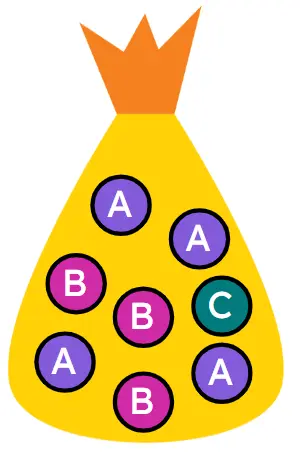
Q5.A bag contains counters that are each labelled with a letter from A to C. One counter is chosen at random from the bag. Which term describes the likelihood of choosing the letter 'B'?
A bag contains counters that are each labelled with a letter from A to C. One counter is chosen at random from the bag. Which term describes the likelihood of choosing the letter 'B'?
impossible
even chance
likely
certain
Q6.A regular six-sided dice is rolled. Match the events with the term that describes their likelihood of happening.
A regular six-sided dice is rolled. Match the events with the term that describes their likelihood of happening.

Assessment exit quiz
6 Questions
Q1.__________ is a repetition of a trial multiple times in order to observe how often each outcome occurs.
__________ is a repetition of a trial multiple times in order to observe how often each outcome occurs.
An event
A sample space
Q2.The __________ an experiment contains, the more confident you can be about any conclusions made based on its results.
The __________ an experiment contains, the more confident you can be about any conclusions made based on its results.
fewer trials
more possible outcomes
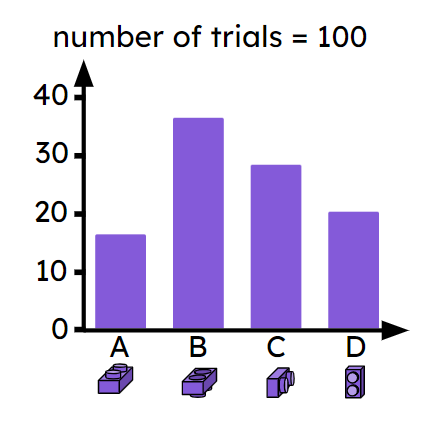
Q3.During an experiment, a toy brick is dropped 100 times and its landing position is noted. Based on the results in the bar chart, which way is the brick least likely to land when it is dropped?
During an experiment, a toy brick is dropped 100 times and its landing position is noted. Based on the results in the bar chart, which way is the brick least likely to land when it is dropped?
B - with connectors down
C - on one of its long faces
D - on one of its short faces
Q4.Sofia is planning experiment involving dropping slices of buttered toast to see which way around it is most likely to land. Which number of trials would produce the most reliable conclusion?
Sofia is planning experiment involving dropping slices of buttered toast to see which way around it is most likely to land. Which number of trials would produce the most reliable conclusion?
1
2
10
50
Q5.Jacob conducts an experiment where he flips a coin 10 times to check whether landing 'heads' is equally likely as landing 'tails'. How could this experiment be improved?
Jacob conducts an experiment where he flips a coin 10 times to check whether landing 'heads' is equally likely as landing 'tails'. How could this experiment be improved?
use a fewer number of trials
asking someone else to flip the coin
the experiment can not be improved
Q6.Jacob flips a coin 10 times. It lands 'heads' 3 times and 'tails' 7 times. Which statement is true?
Jacob flips a coin 10 times. It lands 'heads' 3 times and 'tails' 7 times. Which statement is true?
The coin is definitely biased because it landed on tails more than heads.
The coin is definitely not biased because results can differ due to chance.
