Explain how the distributive law applies to multiplication expressions with a common factor
I can explain how the distributive law can help to solve multiplication problems more efficiently, and write equations that show this.


- Year 6
Explain how the distributive law applies to multiplication expressions with a common factor
I can explain how the distributive law can help to solve multiplication problems more efficiently, and write equations that show this.
Lesson details
Key learning points
- 2 groups of ___ plus 3 groups of ___ is equal to 5 groups of ___
- Where there is a common factor within expressions, the uncommon factors can be added or subtracted before multiplying.
- The distributive law can be very useful for solving problems where there is a common factor.
- You can use brackets in an equation to show that you have used the distributive law.
Keywords
Distributive law - The distributive law says that multiplying a number by a group of numbers added together is the same as doing each multiplication separately.
Common - Common can mean that something is the same as something else. For example, when multiplication expressions each have one factor that is the same, they are said be common factors.
Common misconception
Children may add or subtract the common factors together rather than the uncommon factors.
Use unitising counters or other physical resources to represent each problem and manipulate these to demonstrate the distributive law before showing children the equation that represents it.


Licence
Lesson video
Loading...
Prior knowledge starter quiz
6 Questions
Q1.Compare the expressions using >, < or = 3 × 8 ___ 9 × 8
Q2.Use >, < or = to make this correct. 5 x 3 ___ 3 x 5 - 1 x 5
Q3.Look at the equation. What is the common factor in each expression? 8 × 3 = 5 × 3 + 3 × 3
Q4.Look at the equation. What is the common factor in each expression? 3 × 4 + 1 × 4 = 4 × 4 The common factor is .
Q5.Match each equation to the correct solution.

Q6.Sam’s book has 150 pages. She reads 11 pages each day for 8 days. How many more pages does she have left to read? pages.
Assessment exit quiz
6 Questions
Q1.Look for a common factor to help you match the expressions that are equal in value.
Q2.Using the distributive law, which expression is equal in value to this expression?
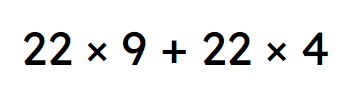
Q3.Compare the two expressions using < > or =

Q4.What could the missing number be?