


New
New
Explain how to divide a unit fraction by a whole number
I can explain how to divide a unit fraction by a whole number.


Lesson 3 of 5
New
New
- Year 6
Explain how to divide a unit fraction by a whole number
I can explain how to divide a unit fraction by a whole number.
Lesson details
Key learning points
- The partitive structure means you can think of dividing a fraction by a whole number as sharing.
- If a unit fraction is divided by a whole number the quotient is smaller than the dividend so the denominator increases.
- Dividing a number by 2 is the same as finding half of the number and this can be applied to other fractions.
Keywords
Represent - To represent something means to show something in a different way.
Dividend - The dividend is what we are dividing.
Common misconception
Pupils change the division symbol to a multiplication symbol and then multiply the fraction by a whole number.
The act of dividing the fraction part is highlighted within the representations provided. Ensure pupils are given time to explore how the area model represents the division and encourage pupils to create their own examples.
Understanding the division can also be represented as multiplication by a unit fraction of the divisor is essential for pupils as they move towards their later mathematics education. Ensure pupils spend time exploring the relationship first before concerning pupils with the value of the product.

Teacher tip

Licence
This content is © Oak National Academy Limited (2025), licensed on Open Government Licence version 3.0 except where otherwise stated. See Oak's terms & conditions (Collection 2).
Lesson video
Loading...
Prior knowledge starter quiz
6 Questions
Q1.Which expressions could represent one-third of one-fifth?
Which expressions could represent one-third of one-fifth?

Correct answer: $$ {1} \over {3}$$ × $$ {1} \over {5}$$
$$ {1} \over {3}$$ × $$ {1} \over {5}$$
$$ {1} \over {3}$$ + $$ {1} \over {5}$$
Correct answer: $$ {1} \over {5}$$ × $$ {1} \over {3}$$
$$ {1} \over {5}$$ × $$ {1} \over {3}$$
$$ {1} \over {5}$$ + $$ {1} \over {3}$$
Q2.Tick the equations that could represent this image.
Tick the equations that could represent this image.
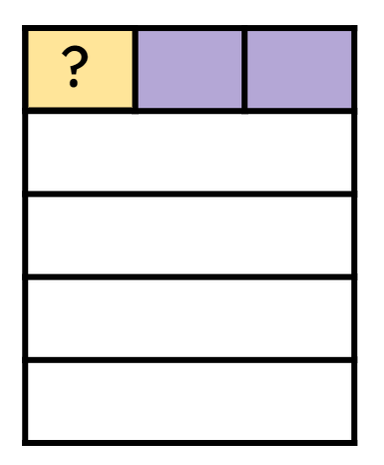
$$ {1} \over {3}$$ × $$ {1} \over {5}$$ = $$ {1} \over {5}$$
$$ {1} \over {15}$$ × $$ {1} \over {3}$$ = $$ {1} \over {5}$$
Correct answer: $$ {1} \over {5}$$ × $$ {1} \over {3}$$ = $$ {1} \over {15}$$
$$ {1} \over {5}$$ × $$ {1} \over {3}$$ = $$ {1} \over {15}$$
Correct answer: $$ {1} \over {3}$$ x $$ {1} \over {5}$$ = $$ {1} \over {15}$$
$$ {1} \over {3}$$ x $$ {1} \over {5}$$ = $$ {1} \over {15}$$
Q3.To find the product of two unit fractions, you can _________.
To find the product of two unit fractions, you can _________.
multiply the numerators
add the numerators
Correct answer: multiply the denominators
multiply the denominators
add the denominators
multiply the numerators and the denominators
Q4.Tick the product of $$ {1} \over {8}$$ × $$ {1} \over {2}$$
Tick the product of $$ {1} \over {8}$$ × $$ {1} \over {2}$$
Correct answer: $$ {1} \over {16}$$
$$ {1} \over {16}$$
$$ {1} \over {10}$$
$$ {2} \over {10}$$
$$ {2} \over {16}$$
Q5.What is the missing denominator which would make this equation correct?
What is the missing denominator which would make this equation correct?
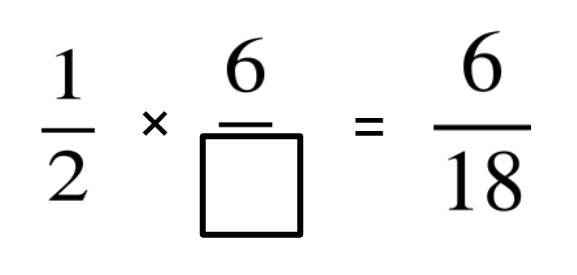
Correct Answer: 9
9
Q6.What could the missing digits be?
What could the missing digits be?
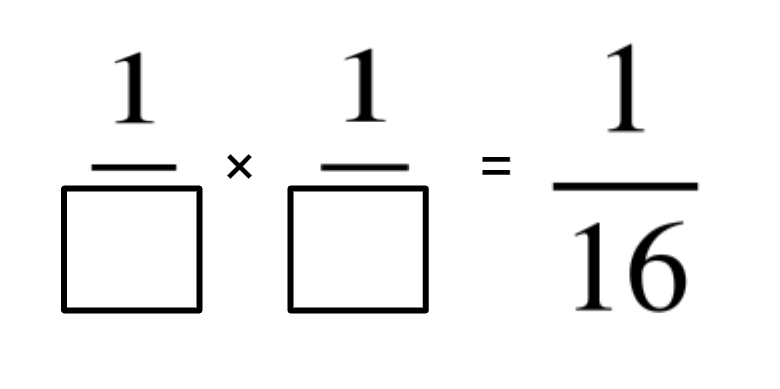
3 and 4
Correct answer: 4 and 4
4 and 4
2 and 6
Correct answer: 2 and 8
2 and 8
12 and 4
Assessment exit quiz
6 Questions
Q1.Tick the equivalent division equation for $$ {1} \over {5}$$ × $$ {1} \over {2}$$ = $$ {1} \over {10}$$
Tick the equivalent division equation for $$ {1} \over {5}$$ × $$ {1} \over {2}$$ = $$ {1} \over {10}$$
Correct answer: $$ {1} \over {5}$$ ÷ 2 = $$ {1} \over {10}$$
$$ {1} \over {5}$$ ÷ 2 = $$ {1} \over {10}$$
$$ {1} \over {2}$$ ÷ 2 = $$ {1} \over {10}$$
$$ {1} \over {10}$$ ÷ 2 = $$ {1} \over {5}$$
$$ {1} \over {10}$$ ÷ 5 = $$ {1} \over {2}$$
Q2.Use this equation to find the missing denominator: $$ {1} \over {2}$$ ÷ 6 = $$ {1} \over {12}$$
Use this equation to find the missing denominator: $$ {1} \over {2}$$ ÷ 6 = $$ {1} \over {12}$$
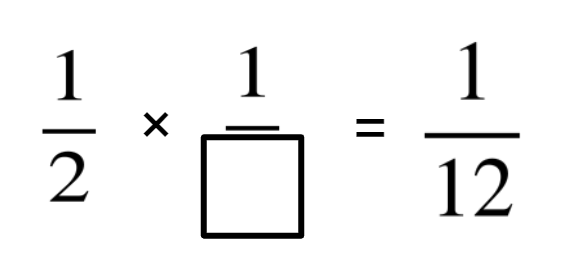
Correct Answer: 6
6
Q3.Tick the equivalent multiplication expression for $$ {1} \over {8}$$ ÷ 4 =
Tick the equivalent multiplication expression for $$ {1} \over {8}$$ ÷ 4 =
Correct answer: $$ {1} \over {8}$$ × $$ {1} \over {4}$$
$$ {1} \over {8}$$ × $$ {1} \over {4}$$
$$ {1} \over {8}$$ × 4
8 × $$ {1} \over {4}$$
8 × 4
Q4.Tick the correct answer to the calculation: $$ {1} \over {2}$$ ÷ 7 =
Tick the correct answer to the calculation: $$ {1} \over {2}$$ ÷ 7 =
$$ {1} \over {7}$$
Correct answer: $$ {1} \over {14}$$
$$ {1} \over {14}$$
14
$$ {7} \over {2}$$
Q5.Write down the missing denominator to make this equation correct.
Write down the missing denominator to make this equation correct.
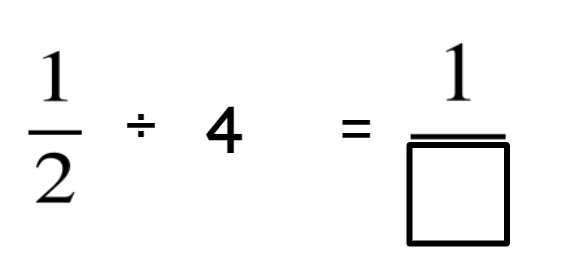
Correct Answer: 8
8
Q6.Tick the possible pairs of numbers that would make this equation correct:
Tick the possible pairs of numbers that would make this equation correct:
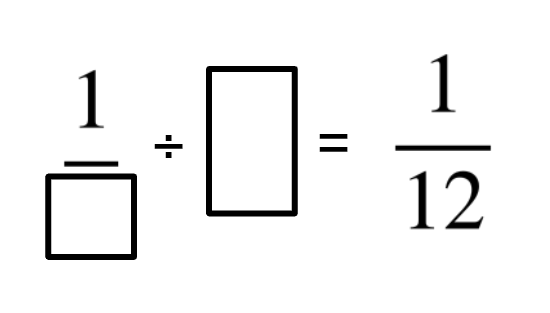
2 and 3
Correct answer: 3 and 4
3 and 4
4 and 2
Correct answer: 2 and 6
2 and 6
8 and 4
