


New
New
Explain how to solve problems where the percentage part and size is known but the whole is unknown
I can solve problems where a percentage part is known but the whole is unknown.


Lesson 8 of 10
New
New
- Year 6
Explain how to solve problems where the percentage part and size is known but the whole is unknown
I can solve problems where a percentage part is known but the whole is unknown.
Lesson details
Key learning points
- If I know about a part, I can work out the whole from that part.
- If I know what 10% is, I can multiply by 10 to calculate 100%.
- If the part is a factor of 100, I can multiply the part by the other factor to calculate the whole.
Keywords
Percentage - A percentage is a proportion of a whole.
Common misconception
Pupils may not always instantly recognise that a percentage part is a factor of 100
Discuss factors of 100 with the pupils, for example, as factor pairs. Allow them to keep these displayed to refer to throughout the lesson if needed to help make this connection.
To access this lesson, pupils must have familiarity with working out percentages of numbers. Pupils may find bar models and ratio tables helpful. Bar models help in understanding the structure of each problem. Ratio tables help in clearly setting the information out to see what needs calculating.

Teacher tip

Licence
This content is © Oak National Academy Limited (2025), licensed on Open Government Licence version 3.0 except where otherwise stated. See Oak's terms & conditions (Collection 2).
Lesson video
Loading...
Prior knowledge starter quiz
6 Questions
Q1.If 100% of an amount is 320 km, find these percentages.
If 100% of an amount is 320 km, find these percentages.

Q2.10% of a race is 1.5 km Calculate these percentages of the race.
10% of a race is 1.5 km Calculate these percentages of the race.
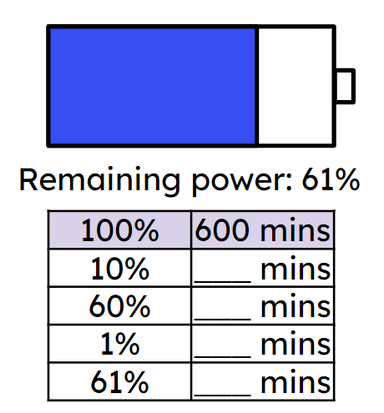
Q3.Aisha’s battery has 61% of 600 minutes left. Complete each step of the table to calculate 61% of 600 minutes. minutes
Aisha’s battery has 61% of 600 minutes left. Complete each step of the table to calculate 61% of 600 minutes. minutes
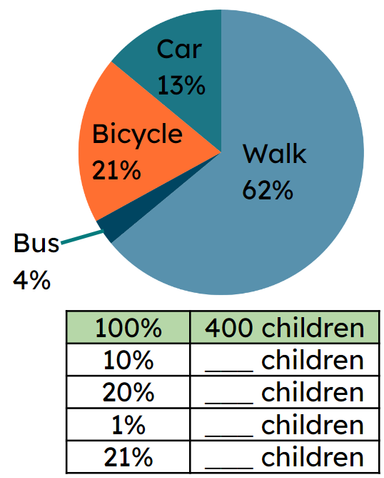
Q4.Lucas needs to find the number of children who cycled to school. Look at the pie chart and complete each step of the table to calculate 21% of 400 children
Lucas needs to find the number of children who cycled to school. Look at the pie chart and complete each step of the table to calculate 21% of 400 children
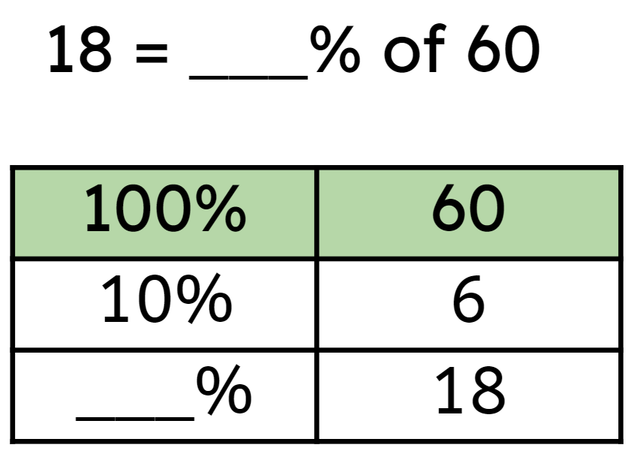
Q5.Look at the table and find the missing percentage. 18 = % of 60
Look at the table and find the missing percentage. 18 = % of 60
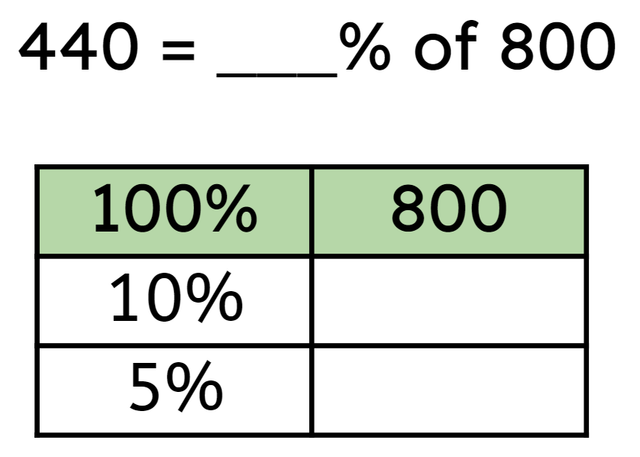
Q6.Use the table to calculate the missing percentage. 440 = % of 800
Use the table to calculate the missing percentage. 440 = % of 800
Assessment exit quiz
6 Questions
Q1.If I know a part, I can work out the whole. Match the parts of the sentence correctly.
If I know a part, I can work out the whole. Match the parts of the sentence correctly.
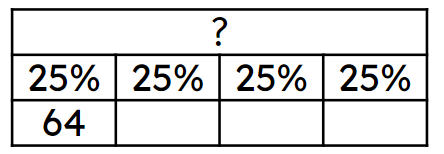
Q2.Lucas has read 25% of his book. He has read 64 pages. His book is pages long.
Lucas has read 25% of his book. He has read 64 pages. His book is pages long.
Q3.Aisha thinks of a number. 20% of her number is 104 What is her number?
Aisha thinks of a number. 20% of her number is 104 What is her number?
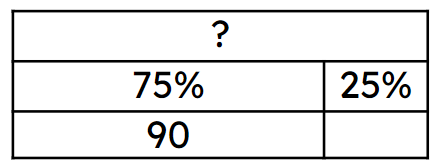
Q4.Lucas has read 75% of his book. This is 90 pages. How many pages are in his book? pages
Lucas has read 75% of his book. This is 90 pages. How many pages are in his book? pages
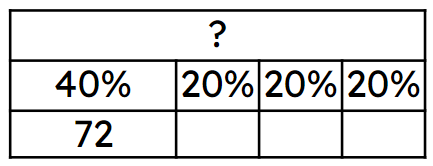
Q5.Aisha thinks of a number. 40% of her number is 72 What number is Aisha thinking of?
Aisha thinks of a number. 40% of her number is 72 What number is Aisha thinking of?
Q6.Lucas takes part in a race. He has run 30% of the race which is 600 m What is the distance of the whole race? m
Lucas takes part in a race. He has run 30% of the race which is 600 m What is the distance of the whole race? m
