


Explain how to use the factor pairs of 100 to solve calculations efficiently
I can explain how to use the factor pairs of 100 to solve calculations efficiently.


- Year 5
Explain how to use the factor pairs of 100 to solve calculations efficiently
I can explain how to use the factor pairs of 100 to solve calculations efficiently.
Lesson details
Key learning points
- Scales are often marked in factors of 100
- Rearranging calculations to make use of factors of 100 can simplify them
Keywords
Factor - Factors are whole numbers which exactly divide another whole number.
Commutative - The commutative law states that you can write the values of a calculation in a different order without changing the calculation; the result is the same. It applies for addition and multiplication.
Associative - The associative law states that it doesn't matter how you group or pair values (i.e. which we calculate first), the result is still the same. It applies for addition and multiplication.
Common misconception
Pupils decompose the wrong factor therefore find it difficult to find a pair of factors that are equal to 100
Scaffold pupil's thinking when they begin to tackle a 2 digit by 2 digit calculation. Encourage them to ask questions of the numbers, for example: 'Is one of the numbers I have to start with a factor of 100?'


Licence
Lesson video
Loading...
Prior knowledge starter quiz
6 Questions
Q1.A factor is:
Q2.Write down the missing factor from this factor bug.
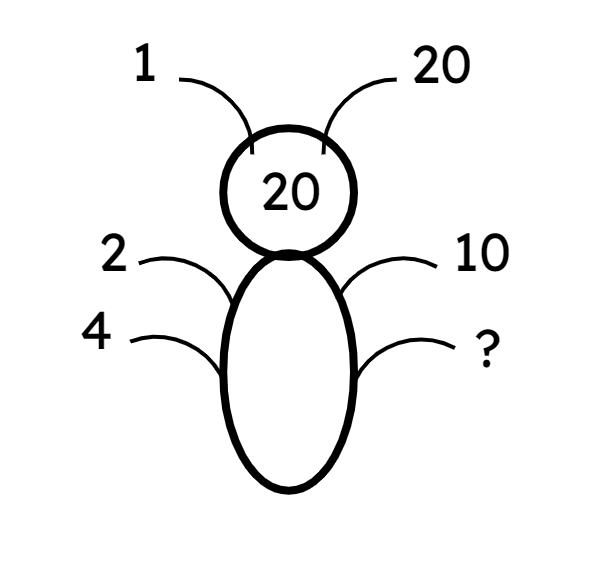
Q3.Which parts of a division equation can represent factors?
Q4.Tick the equations that are true.
Q5.Apply the associative law to complete this calculation. 36 × 2 × 5 =
Q6.Tick the calculation that could be represented as 5 × 2 × 31
Assessment exit quiz
6 Questions
Q1.Tick the factor pairs of 100
Q2.Write down the missing factor in this factor bug.
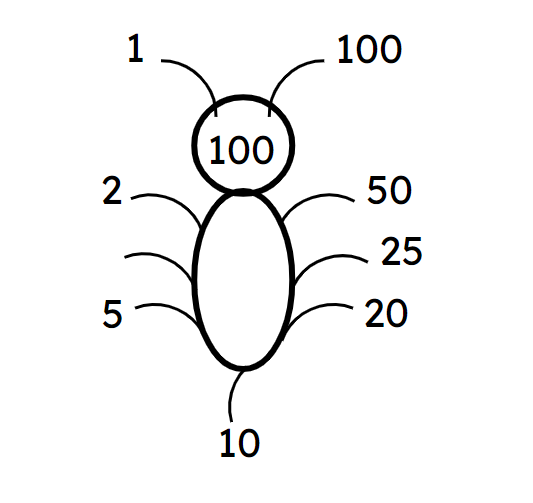
Q3.What is the temperature shown on the thermometer?

Q4.Match the equation to the factors pairs that would be best used to help solve the calculations.

