


New
New
Explain that decimal numbers with hundredths can be partitioned in different ways
I can explain that decimal numbers with hundredths can be partitioned in different ways.


Lesson 5 of 5
New
New
- Year 5
Explain that decimal numbers with hundredths can be partitioned in different ways
I can explain that decimal numbers with hundredths can be partitioned in different ways.
Lesson details
Key learning points
- Place value resources can help you to partition decimal numbers with hundredths in different ways.
- Decimal numbers with hundredths can be partitioned into a whole number, a number of tenths and a number of hundredths.
- Part-part-whole models can be used to partition decimal numbers with hundredths into two parts in different ways.
- Decimal numbers with hundredths can be written as multiplication equations with a factor of 0.01
Keywords
Partitioning - The act of splitting an object or value down into smaller parts.
Decimal numbers - A number with a decimal point followed by digits that show the fractional part.
Common misconception
Pupils write subtraction equations incorrectly for example: 7.42 = 7 − 0.4 − 0.02
Create the number using place value counters and subtract parts whilst drawing a part-whole model and writing the equation alongside.
Encourage pupils to be as flexible as they can with their partitioning. Also ensure pupils are regularly reasoning about where the numbers in their equations represent each time - particularly when combining both addition and multiplication.

Teacher tip

Licence
This content is © Oak National Academy Limited (2025), licensed on Open Government Licence version 3.0 except where otherwise stated. See Oak's terms & conditions (Collection 2).
Lesson video
Loading...
Prior knowledge starter quiz
6 Questions
Q1.Breaking an object of value down into smaller parts is known as:
Breaking an object of value down into smaller parts is known as:
adding
combining
Q2.Tick the correct number for the missing part.
Tick the correct number for the missing part.
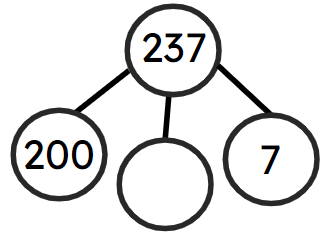
3
37
Q3.Write in the missing number for this part-part-whole model.
Write in the missing number for this part-part-whole model.
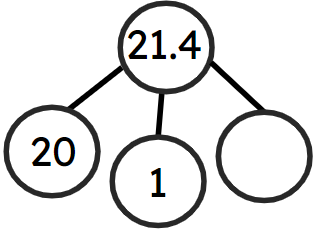
Q4.Tick the expression that would represent this image.
Tick the expression that would represent this image.
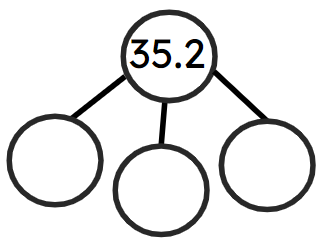
30 + 5 + 2
30 + 0.5 + 2
3 + 5 + 2
30 + 0.5 + 0.02
Q5.Tick the decimal number that has been partitioned.
Tick the decimal number that has been partitioned.
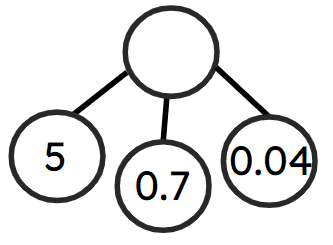
4.75
7.54
5.47
Q6.6.42 has been partitioned into three parts. Tick the options that the two remaining parts could be.
6.42 has been partitioned into three parts. Tick the options that the two remaining parts could be.
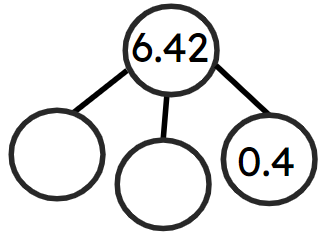
6 and 0.2
4.2 + 2.01
0.6 + 0.02
Assessment exit quiz
6 Questions
Q1.Write in the missing number from the part-part-whole model.
Write in the missing number from the part-part-whole model.
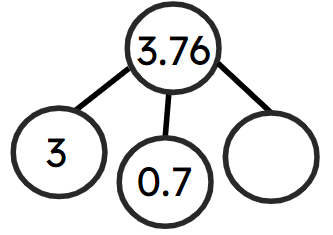
Q2.Tick the equations that could be written based on this part-part-whole model.
Tick the equations that could be written based on this part-part-whole model.
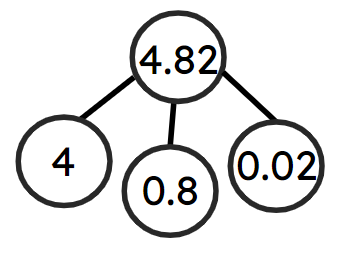
4 + 8 + 0.2 = 4.82
0.8 = 4 + 0.02
Q3.Match the correct expression to each sum.
Match the correct expression to each sum.

Q4.Fill in the missing number of this equation: 1 x 6 + x 3 + 0.01 x 4 = 6.34
Fill in the missing number of this equation: 1 x 6 + x 3 + 0.01 x 4 = 6.34
Q5.Tick the expressions that sum to 3.52
Tick the expressions that sum to 3.52
3 + 5 x 0.1 + 2 x 0.1
3 + 5 + 0.1 x 2
Q6.Tick the partitioned equation that would not sum to 7.36
Tick the partitioned equation that would not sum to 7.36
7 + 0.3 + 0.06
3.3 + 4.06
3.35 + 4.01
7.0 + 0.36
