


New
New
Explain that different lengths can be composed additively and multiplicatively
I can explain that different lengths can be represented as addition and multiplication.


Lesson 2 of 10
New
New
- Year 5
Explain that different lengths can be composed additively and multiplicatively
I can explain that different lengths can be represented as addition and multiplication.
Lesson details
Key learning points
- Partitioning 100 in different ways can be used to compose lengths.
- There are four 25s in 100 so there are four 25cm lengths in 1m.
- 1m divided into four equal parts is 25cm or 0.25m.
- 1m divided into five equal parts is 20cm or 0.2m.
Keywords
Common - Something is common when it is frequently used or it occurs regularly.
Compose - Larger numbers can be composed of smaller numbers.
Partition - The act of splitting an object or value down into smaller parts.
Common misconception
Pupils think that when a whole is divided into x parts, they need to have x interval markers.
Encourage pupils to make connections between the bar model and the number line, drawing attention to where each whole has been divided.
Be sure to give time to pupils linking the numbers within an equation to the corresponding image that it represents. Asking 'what does each number represent?' can be a helpful way to assess understanding of how the image and equation connect.

Teacher tip

Licence
This content is © Oak National Academy Limited (2025), licensed on Open Government Licence version 3.0 except where otherwise stated. See Oak's terms & conditions (Collection 2).
Lesson video
Loading...
Prior knowledge starter quiz
6 Questions
Q1.Convert 2.5 metres into centimetres. cm
Convert 2.5 metres into centimetres. cm
Q2.Match the descriptions.
Match the descriptions.

Q3.What is the missing number on the number line?
What is the missing number on the number line?

Q4.Complete: 0.1 is __________ of 10
Complete: 0.1 is __________ of 10
one tenth the size
one hundred times the size
ten times the size
Q5.Which equations represent this bar model?
Which equations represent this bar model?
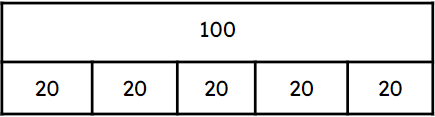
20 + 20 + 20 + 20 = 100
Q6.What is the missing number in this equation? 25 × = 175
What is the missing number in this equation? 25 × = 175
Assessment exit quiz
6 Questions
Q1.Match the descriptions.
Match the descriptions.
Q2.Look at the number line. Which letter is pointing to 75 cm?
Look at the number line. Which letter is pointing to 75 cm?
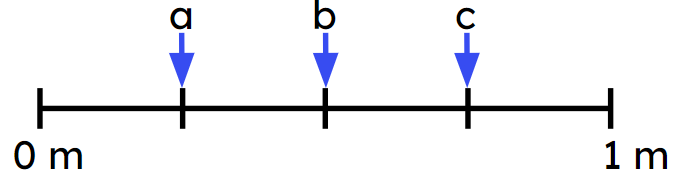
a
b
d
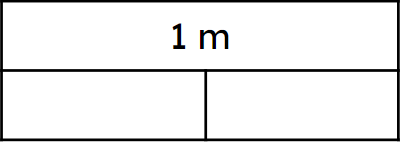
Q3.In metres, what is the value of each of the partitioned parts? m
In metres, what is the value of each of the partitioned parts? m
Q4.Tick the equations that could represent this number line.
Tick the equations that could represent this number line.
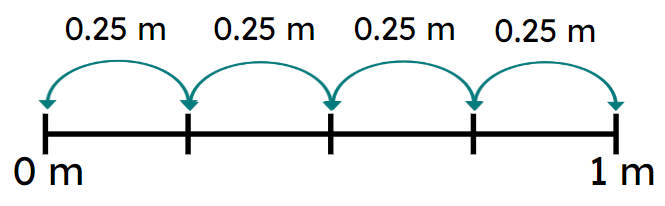
1 m ÷ 4 = 25 m
0.25 m + 0.25 m + 0.25 m = 1 m
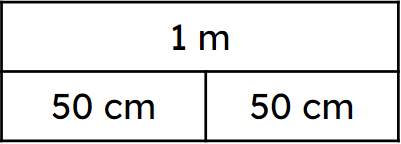
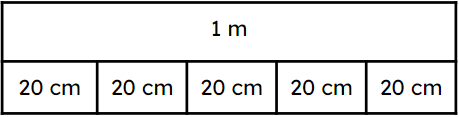
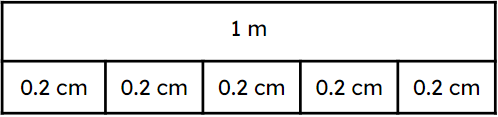
Q5.Tick the image that represents the equation: 0.2 m × 5 = 1 m
Tick the image that represents the equation: 0.2 m × 5 = 1 m
Q6.1.4 m is composed of:
1.4 m is composed of:
4 lots of 0.2 m plus 4 lots of 0.2 m
