


New
New
Explain the effect on the product when scaling the factors up and down by the same amount
I can scale factors up and down by the same amount and explain the effect.


Lesson 2 of 5
New
New
- Year 6
Explain the effect on the product when scaling the factors up and down by the same amount
I can scale factors up and down by the same amount and explain the effect.
Lesson details
Key learning points
- When one factor is scaled and the other is scaled down by the same amount, the product remains the same.
- Arrays can represent the product staying the same when one factor is scaled up and the other down by the same amount.
- Scaling one factor up and the other down by the same amount maintains equivalence.
Keywords
Equivalent - Equivalent means having the same value.
Factor - A factor is a number which exactly divides another whole number.
Product - The product is the result of two or more numbers multiplied together.
Common misconception
Pupils may not select efficient ways of scaling numbers to calculate the product.
Discuss possible solutions, encouraging pupils to think about whether they can use known facts (e.g. times tables, multiples of 10) to calculate products after scaling.
If needed, use more examples of arrays and area models with the pupils so that they understand how scaling each factor, multiplying one and dividing the other by the same number, does not change the product. Look at tests of divisibility with the pupils. Are the factors divisible by 3, 4 or 5?

Teacher tip

Licence
This content is © Oak National Academy Limited (2025), licensed on Open Government Licence version 3.0 except where otherwise stated. See Oak's terms & conditions (Collection 2).
Lesson video
Loading...
Prior knowledge starter quiz
6 Questions
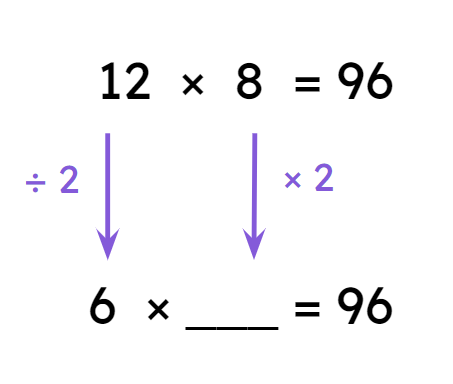
Q1.What is the missing factor in the equation in the diagram?
What is the missing factor in the equation in the diagram?

Q2.What is the missing number in this equation? 14 × 5 = × 10
What is the missing number in this equation? 14 × 5 = × 10
Q3.What is the missing number in this equation? 15 × 28 = 30 ×
What is the missing number in this equation? 15 × 28 = 30 ×
Q4. Which expressions are equal to 16 × 42?
Which expressions are equal to 16 × 42?
8 × 21
16 × 84
Q5.Use scaling to help you find the product: 5 × 62 =
Use scaling to help you find the product: 5 × 62 =
Q6.Use scaling to help you find the product: 250 × 16 =
Use scaling to help you find the product: 250 × 16 =
Assessment exit quiz
6 Questions
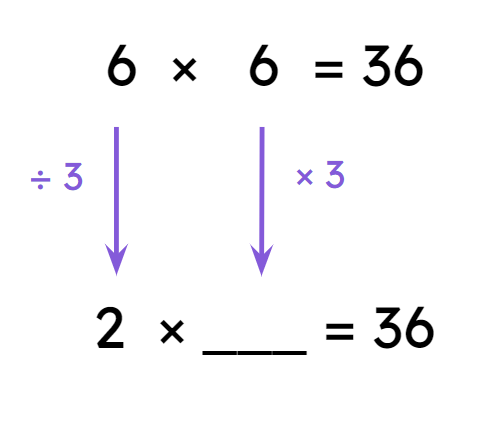
Q1.What is the missing factor in the equation in the diagram?
What is the missing factor in the equation in the diagram?
Q2.What is the missing number in this equation? 10 × 25 = × 5
What is the missing number in this equation? 10 × 25 = × 5
Q3.What is the missing number in this equation? 20 × 12 = 80 ×
What is the missing number in this equation? 20 × 12 = 80 ×
Q4. Andeep scales the equation 22 × 40 = to make it easier to answer. Which of these equations is the most sensible and efficient choice?
Andeep scales the equation 22 × 40 = to make it easier to answer. Which of these equations is the most sensible and efficient choice?
110 × 8 =
44 × 20 =
11 × 80 =
Q5.Laura is trying to find the product of 35 × 20 and writes some possible equations. Which is correct and will help her find the product?
Laura is trying to find the product of 35 × 20 and writes some possible equations. Which is correct and will help her find the product?
350 × 10 = 3,500
70 × 20 = 1,400
5 × 120 = 600
Q6.Use scaling to help you find the product: 250 × 32 =
Use scaling to help you find the product: 250 × 32 =
