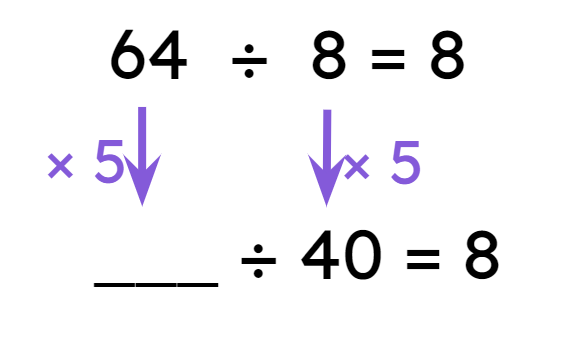
Explain the effect on the quotient when scaling the dividend and the divisor by the same amount
I can explain the effect on the quotient when scaling the dividend and the divisor by the same amount.


- Year 6
Explain the effect on the quotient when scaling the dividend and the divisor by the same amount
I can explain the effect on the quotient when scaling the dividend and the divisor by the same amount.
Lesson details
Key learning points
- If the dividend and divisor are both scaled by the same amount, the quotient will remain the same.
- Unitising helps to explain the effect on the quotient when scaling the dividend and divisor by the same amount.
- If 6 divided by 3 is equal to 2 then 6 twos divided by 3 twos is equal to 2
Keywords
Dividend - The dividend is the amount that you want to divide.
Divisor - A divisor is the number we divide by.
Quotient - A quotient is the result after division has taken place. It is the whole number part.
Common misconception
Be aware of pupils describing scaling using division as 'making three times smaller'. This language can cause misconceptions around the nature of division and should be avoided.
Encourage pupils to describe relationships using division by a whole number (divided by 3) or through the use of fractional language (one-third the size).


Licence
Lesson video
Loading...
Prior knowledge starter quiz
6 Questions
Q1.Match each number in the equation to the correct keyword: 63 ÷ 7 = 9

Q2.Look at the diagram. What is the missing divisor?
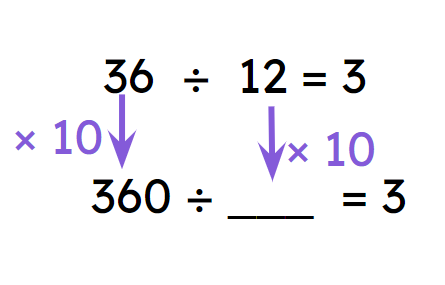
Q3.What is the missing number in this equation? 24 ÷ 6 = 240 ÷
Q4.What is the missing number in this equation? 60 ÷ 12 = ÷ 120
Q5.320 ÷ 80 =
Q6.1,080 ÷ 90 =
Assessment exit quiz
6 Questions
Q1.Match each number in the equation to the correct keyword: 240 ÷ 60 = 4
Q2.What is the missing dividend in the second equation shown here?