New
New
Explain the relationship between multiplying a number by 100 and multiples of 100
I can explain the relationship between multiplying a number by 100 and multiples of 100
Lesson 6 of 15
New
New
- Year 4
Explain the relationship between multiplying a number by 100 and multiples of 100
I can explain the relationship between multiplying a number by 100 and multiples of 100
Lesson details
Key learning points
- Finding one hundred times as many is the same as multiplying by 100
- When a number is multiplied by one hundred the product is a multiple of one hundred.
- Multiples of 100 have zero in the tens and ones column.
- Multiplying by one hundred moves all the digits two columns to the left making the digits one hundred times the size.
Keywords
Multiple - A multiple is the result of multiplying a number by another whole number.
Digit - A digit is one of the symbols of a number system. In our number system we use the digits 0, 1, 2, 3, 4, 5, 6, 7, 8 and 9
Placeholder - A placeholder is where we use the digit zero to hold a place in a number and maintain place value.
Common misconception
Pupils may start talking of 'adding 2 zeros' to multiply by 100
Don't dismiss this as it is disguising an understanding of a pattern but reassure the pupils that this will be explained later through place value discussions in the coming lessons.
Use countable objects here. If you don't have anything that comes in 100s, then label some opaque boxes or jars accordingly. Ensure that children use the correct language of placeholders to describe what is happening when multiplying by 100
Teacher tip
Licence
This content is © Oak National Academy Limited (2025), licensed on Open Government Licence version 3.0 except where otherwise stated. See Oak's terms & conditions (Collection 2).
Prior knowledge starter quiz
6 Questions
Q1.What number is being shown on the Gattegno chart?
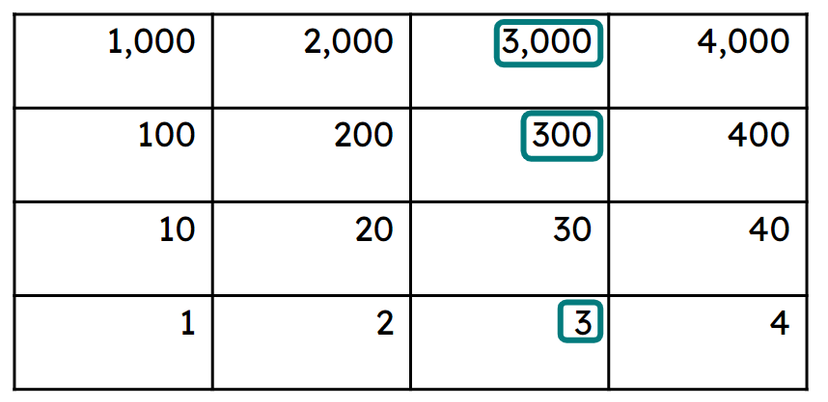
What number is being shown on the Gattegno chart?

333
3,330
Q2.What is twice the size of 120?
What is twice the size of 120?
Q3.Which of these numbers is a multiple of 10?
Which of these numbers is a multiple of 10?
405
99
Q4.What is the missing number in the following equation? 23 = ÷ 10
What is the missing number in the following equation? 23 = ÷ 10
Q5.Packs of pencils contain 10 pencils. There are 11 packs. Which equation shows how many pencils there are?
Packs of pencils contain 10 pencils. There are 11 packs. Which equation shows how many pencils there are?
11 + 10 = 21
11 × 11 = 132
Q6.True or false: To find one-tenth times the size, divide by ten.
True or false: To find one-tenth times the size, divide by ten.
False
Assessment exit quiz
6 Questions
Q1.What is the missing factor in the equation?
× 100 = 800
What is the missing factor in the equation?
× 100 = 800
Q2.All multiples of one hundred have both a tens and ones digit of zero. True or False?
All multiples of one hundred have both a tens and ones digit of zero. True or False?
False
Q3.Jars of marbles contain 100 marbles altogether. There are 4 jars in the classroom. Which equation shows how many marbles are in the classroom altogether?
Jars of marbles contain 100 marbles altogether. There are 4 jars in the classroom. Which equation shows how many marbles are in the classroom altogether?
4 + 100 = 104
4 × 4 × 100 = 1,600
Q4.Tick the numbers that are multiples of 100
Tick the numbers that are multiples of 100
460
250
108
Q5.Tick the numbers that are multiples of 100
Tick the numbers that are multiples of 100
3,860
1,020
2,001
Q6.True or false: All multiples of one-hundred have a digit greater than zero in the hundreds.
True or false: All multiples of one-hundred have a digit greater than zero in the hundreds.
True