


New
New
Explain why the product stays the same when one factor is doubled and the other is halved
I can explain why the product stays the same when one factor is doubled and the other is halved.


Lesson 1 of 5
New
New
- Year 6
Explain why the product stays the same when one factor is doubled and the other is halved
I can explain why the product stays the same when one factor is doubled and the other is halved.
Lesson details
Key learning points
- When one factor is doubled and the other is halved, the product remains the same.
- Arrays can be rearranged to represent the product staying the same when one factor is doubled and the other halved.
- Doubling one factor and halving the other maintains equivalence.
Keywords
Equivalent - Equivalent means having the same value.
Factor - A factor is a number which exactly divides another whole number.
Product - The product is the result of two or more numbers multiplied together.
Common misconception
Pupils may double or halve both factors, instead of doubling one and halving the other.
Spend time exploring arrays and the area models (from Cycle B of the lesson). Model these misconceptions, showing why they are incorrect (e.g. show how 4 x 8 cannot be equivalent to 8 x 16).
To ensure that pupils understand this, spend time exploring this concept using numbers facts that they are familiar with (e.g. numbers within the times tables that they already know). Use arrays and area models to show equivalence, getting pupils to manipulate these.

Teacher tip

Licence
This content is © Oak National Academy Limited (2025), licensed on Open Government Licence version 3.0 except where otherwise stated. See Oak's terms & conditions (Collection 2).
Lesson video
Loading...
Prior knowledge starter quiz
6 Questions
Q1.What multiplication fact is represented by the array?
What multiplication fact is represented by the array?
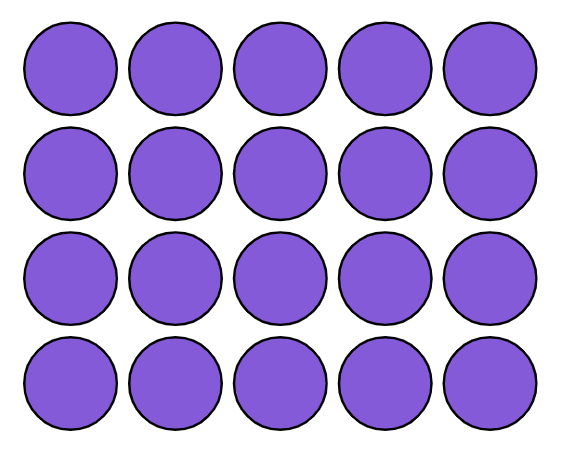
4 × 4 = 16

4 × 6 = 24
5 × 5 = 25
Q2.What is 7 × 6 =
What is 7 × 6 =
Q3.What is double 27?
What is double 27?
Q4.What is half of 70?
What is half of 70?
Q5.What is the missing number in this equation? 6 × = 72
What is the missing number in this equation? 6 × = 72
Q6.What is the missing number in this equation? 11 × = 220
What is the missing number in this equation? 11 × = 220
Assessment exit quiz
6 Questions
Q1.What is the missing factor in the equation in this diagram?
What is the missing factor in the equation in this diagram?
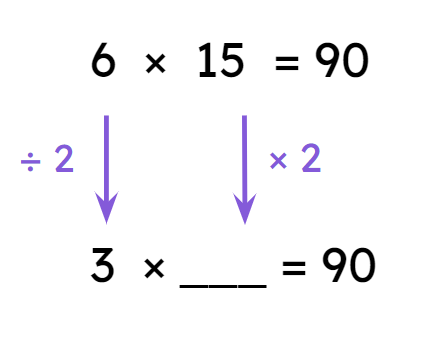
Q2.What is the missing number in this equation? 8 × 10 = × 20
What is the missing number in this equation? 8 × 10 = × 20
Q3.What is the missing number in this equation? 6 × 13 = 26 ×
What is the missing number in this equation? 6 × 13 = 26 ×
Q4. Which expressions are equal to 34 × 24?
Which expressions are equal to 34 × 24?
17 × 12
68 × 48
Q5.Use scaling to help you find the product: 5 × 46 =
Use scaling to help you find the product: 5 × 46 =
Q6.Use scaling to help you find the product: 50 × 36 =
Use scaling to help you find the product: 50 × 36 =
