


New
New


Lesson 3 of 10
New
New
- Year 9
Features of geometric sequences
I can appreciate the features of a geometric sequence.
Lesson details
Key learning points
- Arithmetic sequences are not the only type of sequence.
- In a geometric sequence, there is still a first term.
- Instead of a common difference, there is a common multiplier.
- This common multiplier is referred to as the common ratio.
Keywords
Geometric sequence - A geometric sequence is a sequence with a constant multiplicative relationship between successive terms.
Common ratio - A common ratio is a key feature of a geometric sequence. The constant multiplier between successive terms is called the common ratio.
Common misconception
After becoming very familiar with arithmetic sequences pupils can find the difference between the first two terms and just assume the sequence is arithmetic.
Explore a large number of geometric and arithmetic sequences and see if pupils can articulate how they check if a sequence is geometric. They might say the terms of the sequence grow more quickly (for some geometric sequences).
Explore the link between the way pupils have explored ratios in the past with what is meant by a common ratio in geometric sequences. This lesson explores this in two ways, as a multiplier and a constant ratio between terms.

Teacher tip

Licence
This content is © Oak National Academy Limited (2025), licensed on Open Government Licence version 3.0 except where otherwise stated. See Oak's terms & conditions (Collection 2).
Lesson video
Loading...
Prior knowledge starter quiz
6 Questions
Q1.If a numerical sequence does not have a common additive difference then you can say it is ...
If a numerical sequence does not have a common additive difference then you can say it is ...
linear
negative

Correct answer: non-linear
non-linear
Correct answer: not arithmetic
not arithmetic
quadratic
Q2.Which of these sequences are not arithmetic sequences?
Which of these sequences are not arithmetic sequences?
$$2, 4, 6, 8, ...$$
Correct answer: $$2, 4, 8, 16, ...$$
$$2, 4, 8, 16, ...$$
$$10, 30, 50, 70, ...$$
Correct answer: $$10, 30, 90, 270, ...$$
$$10, 30, 90, 270, ...$$
$$2, 8, 14, 20, 26, ...$$
Q3.What is the result when you multiply $$3$$ by $$5$$ four times? You can use a calculator.
What is the result when you multiply $$3$$ by $$5$$ four times? You can use a calculator.
$$15$$
$$60$$
$$625$$
Correct answer: $$1875$$
$$1875$$
$$50 625$$
Q4.Use your calculator to halve $$80$$ then find half of your result and then halve it again. The result is .
Use your calculator to halve $$80$$ then find half of your result and then halve it again. The result is .
Correct Answer: 10, ten
10, ten
Q5.What number should be written in the box in these equivalent ratios? .
What number should be written in the box in these equivalent ratios? .
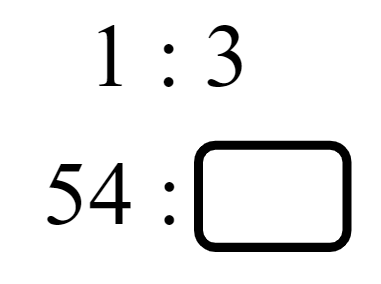
Correct Answer: 162, one hundred and sixty two
162, one hundred and sixty two
Q6.What number should be written in the box in these equivalent ratios? .
What number should be written in the box in these equivalent ratios? .
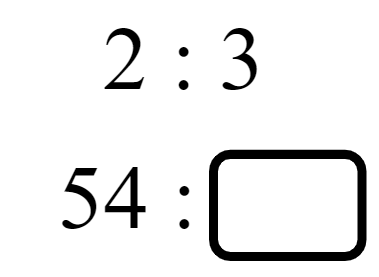
Correct Answer: 81, eighty one
81, eighty one
Assessment exit quiz
6 Questions
Q1.A geometric sequence is a sequence with a constant __________ relationship between successive terms.
A geometric sequence is a sequence with a constant __________ relationship between successive terms.
additive
decreasing
increasing
Correct answer: multiplicative
multiplicative
Q2.The next term in this geometric sequence 7, 14, 28, ... is .
The next term in this geometric sequence 7, 14, 28, ... is .
Correct Answer: 56, fifty six, fifty-six
56, fifty six, fifty-six
Q3.Which of these are geometric sequences?
Which of these are geometric sequences?
3, 6, 9, 12, ...
Correct answer: 3, 6, 12, 24, ...
3, 6, 12, 24, ...
3, 6, 10, 15, ...
3, 9, 15, 21, ...
Correct answer: 3, 9, 27, 81, ...
3, 9, 27, 81, ...
Q4.Which of these numbers will be a term in the geometric sequence: "Start on 2 and use a common multiplier of 5"?
Which of these numbers will be a term in the geometric sequence: "Start on 2 and use a common multiplier of 5"?
Correct answer: 10
10
Correct answer: 50
50
100
500
Correct answer: 1250
1250
Q5.Which of these numbers will be terms of the geometric sequence: "Start on $$432$$ and use a common multiplier of $$1\over2$$"?
Which of these numbers will be terms of the geometric sequence: "Start on $$432$$ and use a common multiplier of $$1\over2$$"?
$$864$$
Correct answer: $$108$$
$$108$$
$$72$$
Correct answer: $$27$$
$$27$$
Correct answer: $$27\over2$$
$$27\over2$$
Q6.The $$1^{\text{st}}$$ term of a geometric sequence is not zero and the common ratio is negative. Which of these statements is true about this sequence?
The $$1^{\text{st}}$$ term of a geometric sequence is not zero and the common ratio is negative. Which of these statements is true about this sequence?
It decreases.
It decreases but never reaches zero.
Correct answer: The terms will oscillate between positive and negative.
The terms will oscillate between positive and negative.
All of the terms will be negative.
