


New
New
Floating, mass and shape
I can explain how the density of an object determines how well it floats.


Lesson 8 of 10
New
New
- Year 9
Floating, mass and shape
I can explain how the density of an object determines how well it floats.
Lesson details
Key learning points
- The whole of an object is floating on water if part of it is above the surface.
- How well an object floats in a liquid does not depend on the depth of the liquid.
- An object floats in water if its shape can push its own mass of water out of the way without going under.
Keywords
Upthrust - A force acting upwards due to pressure is an upthrust.
Displaced - Water is displaced (moved) when an object floats on it or sinks in it.
Displacement can - A displacement can is used to find the volume of water displaced by objects when they float or sink.
Density - If the density of an object is less than the density of water, it will float.
Common misconception
Pupils may think that all light objects float and that all heavy objects sink.
Explore how mass and volume (determined by shape) affect whether objects float or sink - before discussing density.
Using video footage of deep sea diving vessels will help demonstrate the extreme pressures. Similar videos of aeroplane decompression can be used but these are often exaggerated so use with care.

Teacher tip

Licence
This content is © Oak National Academy Limited (2026), licensed on Open Government Licence version 3.0 except where otherwise stated. See Oak's terms & conditions (Collection 2).
Lesson video
Loading...
Prior knowledge starter quiz
6 Questions
Q1.Which is the best definition of the weight of an object?
Which is the best definition of the weight of an object?
the amount of material it contains
the space the object takes up
the resultant force acting on the object
Q2.Which is the best definition of the mass of an object?
Which is the best definition of the mass of an object?
the force pulling down on it
the total number of atoms inside it
the amount of space it takes up
Q3.The figure shows two forces acting on a toy boat on the surface of water. Which statements are correct?
The figure shows two forces acting on a toy boat on the surface of water. Which statements are correct?
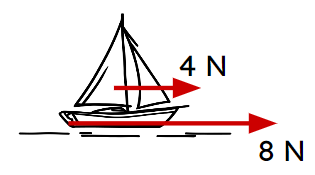
the boat will be at a steady speed
the boat will be slowing down
Q4.A balance is used to measure the mass of a sample of water. If the mass of the water is 320 g, what is this mass in kilograms?
A balance is used to measure the mass of a sample of water. If the mass of the water is 320 g, what is this mass in kilograms?
320 kg
32.0 kg
3.2 kg
0.032 kg
Q5.A sample of water has a mass of 0.5 kg. What is its approximate weight on Earth?
A sample of water has a mass of 0.5 kg. What is its approximate weight on Earth?
0.05 N
0.5 N
50 N
500 N
Q6.A cruise ship is stationary and floating on the surface of the water. Which statements are correct?
A cruise ship is stationary and floating on the surface of the water. Which statements are correct?
There are no vertical forces acting on the ship.
There is a resultant force acting on the ship.
The ship has no weight.
Assessment exit quiz
6 Questions
Q1.Match the key words to the explanations
Match the key words to the explanations

Q2.A cargo ship is travelling on water. Which of these statements is correct?
A cargo ship is travelling on water. Which of these statements is correct?
only the part of the ship above the water is floating
only the part of the ship below the water is floating
none of the ship is floating
Q3.A wooden boat floats in shallow water. Which of these describes what will happen when it is placed in deeper water?
A wooden boat floats in shallow water. Which of these describes what will happen when it is placed in deeper water?
The boat will sink
The boat will float higher in the water
The boat will float lower in the water
Q4.Which of these is the correct condition for something to be able to float?
Which of these is the correct condition for something to be able to float?
there is no upthrust acting on it
its weight is greater than the uptrust
it pushes less than its own mass of water out of the way.
Q5.The table shows the mass of objects and the mass of water they displace. Which objects float?
The table shows the mass of objects and the mass of water they displace. Which objects float?

Object A
Object D
Object E
Q6.A pupil makes a boat from aluminium foil. It floats on water. When they scrunch it up into a ball it sinks. Why?
A pupil makes a boat from aluminium foil. It floats on water. When they scrunch it up into a ball it sinks. Why?
The foil boat floats because aluminium is less dense than water.
The foil boat floats because aluminium is more dense than water.
The ball sinks because its density is lower than that of water.
