


Formal angle notation
I can use conventional terms and notations for lines, rays, segments and angles.


- Year 8
Formal angle notation
I can use conventional terms and notations for lines, rays, segments and angles.
Lesson details
Key learning points
- It is important to use and understand the mathematical word line.
- It is important to use and understand the mathematical word ray.
- It is important to use and understand the mathematical phrase line segment.
- It is important to use and understand the mathematical word angle.
Keywords
Line - A line is a straight 1D figure that does not have a thickness, and it extends forever in both directions.
Ray - A ray is a part of a line with a fixed starting point that extends forever in one direction.
Line segment - A line segment is a part of a line with a fixed start point and a distinct fixed end point.
Common misconception
I can draw a 7 cm line with my ruler.
A line is a linear path that continues forever in both directions. We can draw line segments with a ruler, which have distinct endpoints.


Licence
Lesson video
Loading...
Prior knowledge starter quiz
6 Questions
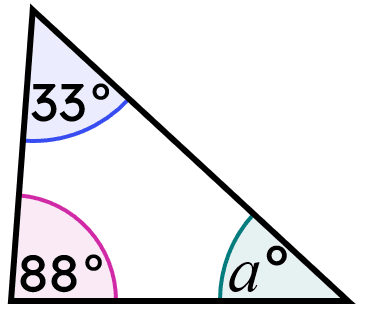
Q1.Which of these statements are true about this triangle?

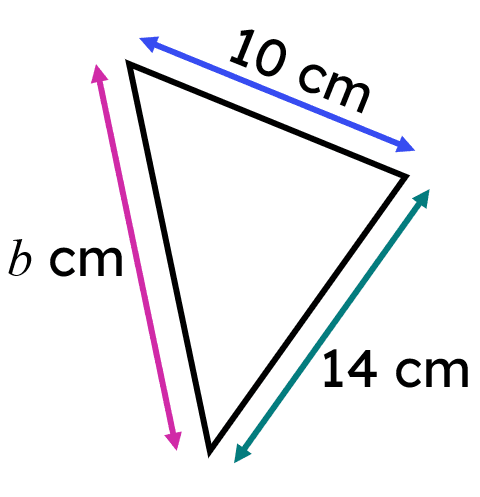
Q2.This triangle is scalene. Which of these are possible values of $$b$$?
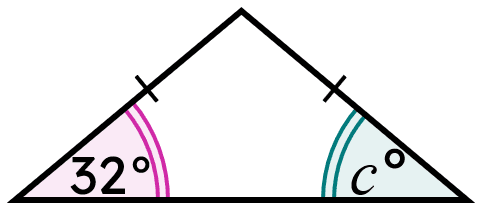
Q3.Which of these statements are correct for this triangle?
Q4.This diagram shows two intersecting line segments. Match each angle or justification for the size of angles $$d$$° and $$e$$° to the correct value or statement.
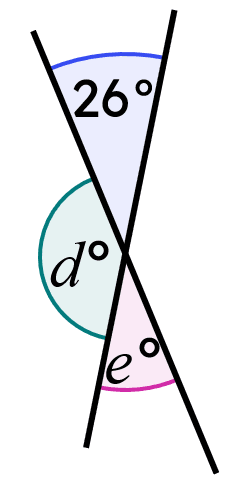
size of angle $$\text{ }d$$° - 154°
size of angle $$\text{ }e$$° - 26°
justification for size of angle $$d$$ - angles about a point on a straight line sum to 180°
justification for size of angle $$e$$° - vertically opposite angles are equal
not an angle on this diagram - 52°
Q5.PQ and RS are straight line segments. Match each angle or justification for the size of angles $$g$$° and $$h$$° to the correct statement.
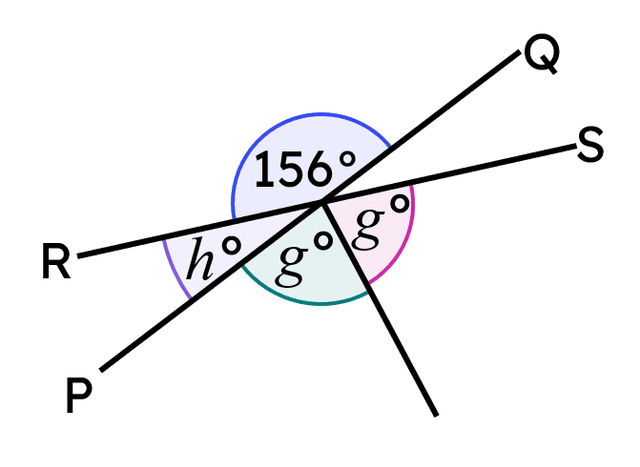
size of angle $$\text{ }g$$° - 78°
size of angle $$\text{ }h$$° - 24°
justification for angle $$g$$° - half of the angle that is vertically opposite 156°
justification for angle $$h$$° - angles about a point on a straight line sum to 180°
not a complete justification - vertically opposite angles are equal
not angle $$\text{ }g° \text{or }h°$$ - 156°
Q6.Three different triangles each have an angle of 40°. Match the name of each triangle to their possible angles.
isosceles - another angle of 40° and one 100°
scalene - one angle of 82° and another of 58°
right-angled scalene - an angle of 90° and one of 50°
equilateral - impossible to have this triangle with an angle of 40°
Assessment exit quiz
6 Questions
Q1.Match each linear path to its name.
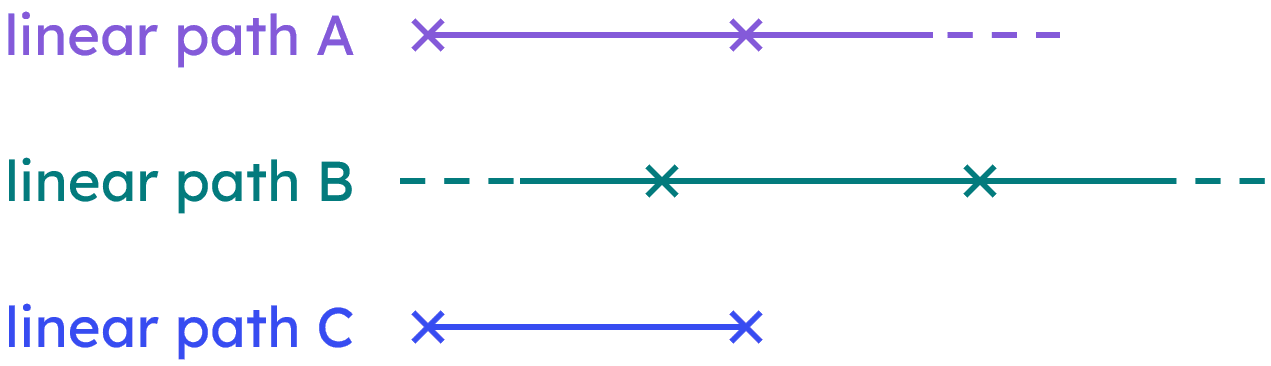
linear path A - ray
linear path B - line
linear path C - line segment
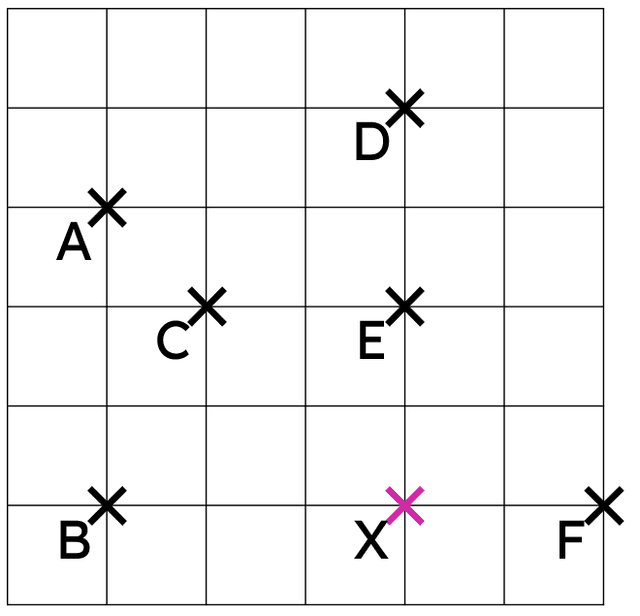
Q2.Which of these linear paths will pass through point X?
Q3.Match each angle given in three-point notation to the angle represented by a letter.
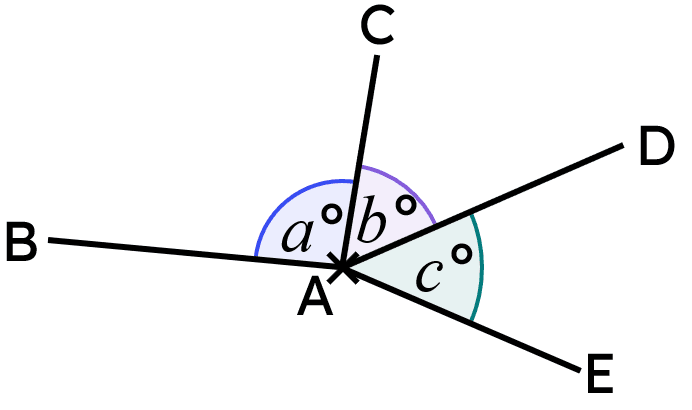
∠CAD - $$b$$°
∠EAD - $$c$$°
∠BAC - $$a$$°
∠BAD - $$(a + b)$$°
Q4.Match each angle given in three-point notation to its size.
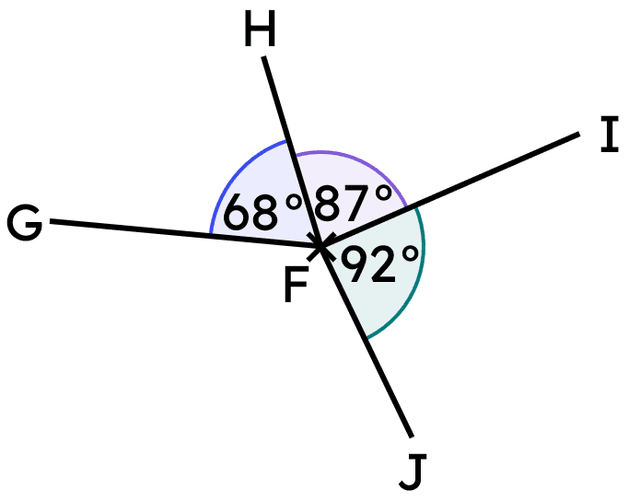
∠HFI - 87°
∠GFI - 155°
∠HFJ - 179°
∠GFJ - 113°
reflex ∠GFJ - 247°
Q5.$$\theta$$° = 87°. Match each type of angle to a correct angle from the diagram.
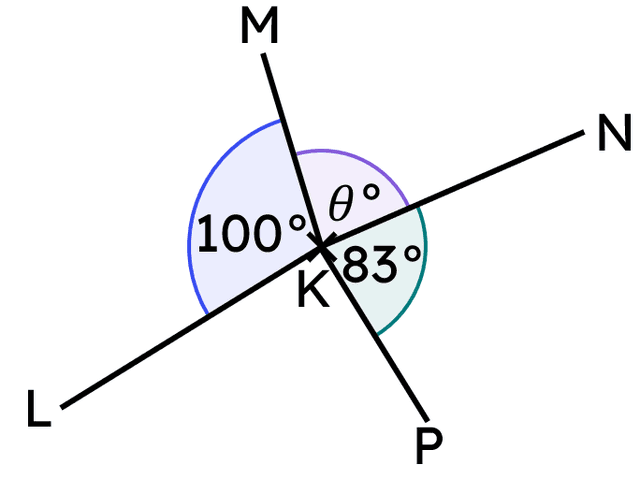
acute - ∠MKN
right angle - ∠LKP
obtuse - ∠MKP
reflex - 100° + $$\theta$$°
Q6.Each square on this grid is one unit in length. Match the line segment to the correct description.
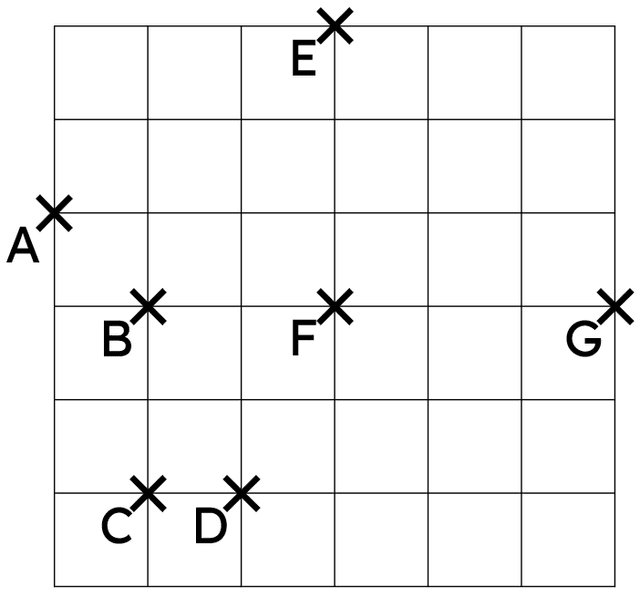
CD - Line segment parallel to BF
EF - Line segment perpendicular to CD
BG - Line segment with a length of 5 units
EG - Line segment parallel to AB
