


New
New
Investigate lines of symmetry in 2D shapes by folding
I can use folding to investigate lines of symmetry in different 2D shapes.


Lesson 5 of 10
New
New
- Year 4
Investigate lines of symmetry in 2D shapes by folding
I can use folding to investigate lines of symmetry in different 2D shapes.
Lesson details
Key learning points
- When you fold a shape on a line of symmetry, the two halves will match exactly.
- A line of symmetry is not always horizontal or vertical.
- Some quadrilaterals, such as a parallelogram, have no lines of symmetry.
- Others, such as a kite, have one line of symmetry. Others, such as a rectangle, can have more than one line of symmetry.
Keywords
Kite - A quadrilateral with two pairs of adjacent, equal sides.
Line of symmetry - If you were to fold a shape on its line of symmetry, both halves would match exactly.
Common misconception
Children may not recognise a line of symmetry when it is neither horizontal nor vertical.
Allow opportunities for exploring lines of symmetry practically by folding cut outs of lots of different shapes. Encourage children to view and describe these in different orientations to help them see that a line of symmetry can be in any direction.
This lesson explores the properties of a kite and how some kites could be described using other shape names. Ensure children are confident with this concept already, for example knowing that some rectangles can also be described as squares.

Teacher tip

Licence
This content is © Oak National Academy Limited (2025), licensed on Open Government Licence version 3.0 except where otherwise stated. See Oak's terms & conditions (Collection 2).
Lesson video
Loading...
Prior knowledge starter quiz
6 Questions
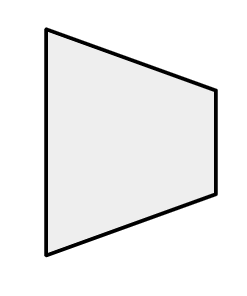
Q1.Complete the sentence. This quadrilateral has pair(s) of parallel sides.
Complete the sentence. This quadrilateral has pair(s) of parallel sides.
Q2.Which statements are true for all polygons?
Which statements are true for all polygons?
They are 3D shapes.
Q3.Match the polygon with the number of vertices that it has.
Match the polygon with the number of vertices that it has.

Q4.How many lines of symmetry does this shape have?
How many lines of symmetry does this shape have?

1
0
Q5.Which of these statements are true for all rectangles?
Which of these statements are true for all rectangles?
They have only one line of symmetry.
They have four sides the same length.
Q6.How many vertices do all quadrilaterals have? vertices
How many vertices do all quadrilaterals have? vertices
Assessment exit quiz
6 Questions
Q1.A __________ is a quadrilateral with two pairs of adjacent, equal sides.
A __________ is a quadrilateral with two pairs of adjacent, equal sides.
trapezium
parallelogram
Q2.A kite has two pairs of sides that are equal in length. These pairs are adjacent sides. What does adjacent mean?
A kite has two pairs of sides that are equal in length. These pairs are adjacent sides. What does adjacent mean?
opposite
join at right angles
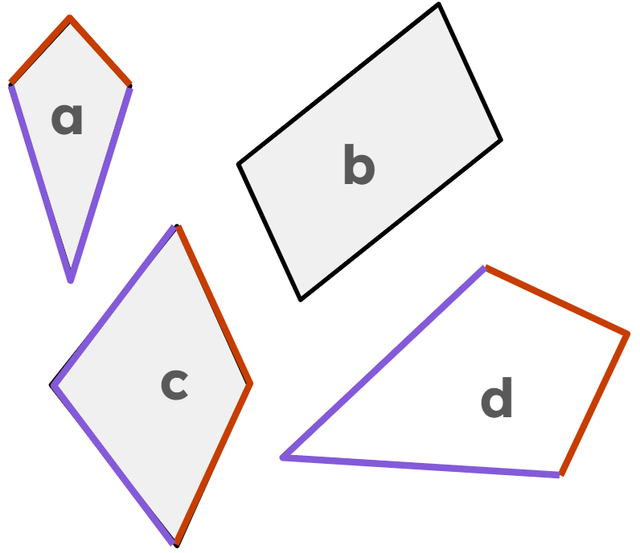
Q3.Which of these quadrilaterals are also kites?
Which of these quadrilaterals are also kites?
b
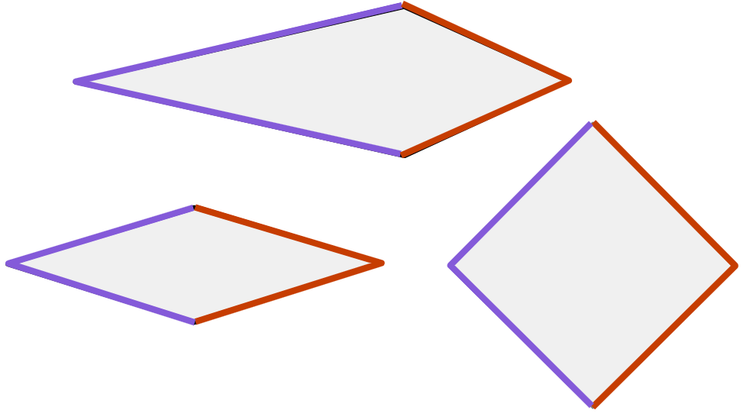
Q4.True or false. A kite can also be a rhombus or a square.
True or false. A kite can also be a rhombus or a square.
False
Q5.Which of these shapes has four lines of symmetry?
Which of these shapes has four lines of symmetry?
rectangle
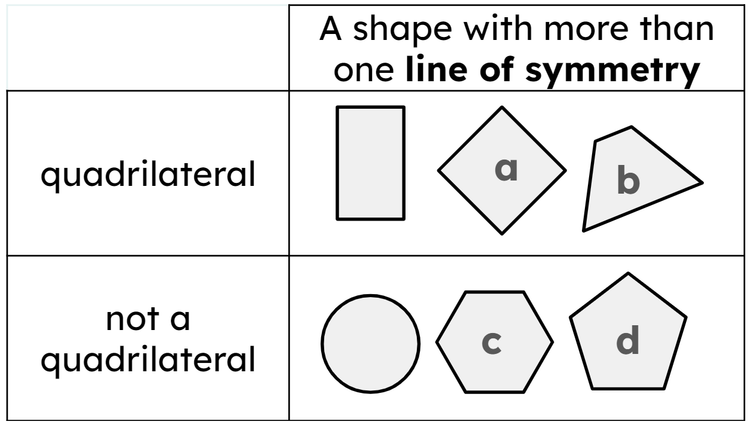
Q6.Which shape has been incorrectly sorted?
Which shape has been incorrectly sorted?
a
c
d
