


Length of a wire
I can explain why longer wires have a higher resistance than shorter wires.


- Year 9
Length of a wire
I can explain why longer wires have a higher resistance than shorter wires.
Lesson details
Key learning points
- The longer a wire, the greater its resistance.
- Electric current in a wire is a flow of electrons moving through the spaces between ‘atoms’ (metal ions).
- Doubling the length of a wire doubles its resistance.
- Doubling the length of a wire doubles the number of ‘atoms’ (metal ions) in the way of the flow of electrons.
- The resistance of a (uniform) wire is proportional to its length.
Keywords
Resistance - Resistance is a measure of how hard it is for current to flow.
Metal ion - A metal ion is formed when a metal atom loses one or more electrons and has a positive charge.
Electron - Electrons are the charges in conductors that flow to give an electric current.
Proportional - Two variables are proportional if one changes as a multiple of the other.
Common misconception
Many pupils are likely to still use the terms current, voltage and resistance interchangeably.
Repeatedly question pupils about each term and challenge them to use each one correctly throughout their explanations, both written and verbal.


Equipment
Constantan, or nichrome wire, SWG 30-40, metre rules, crocodile clips, electrical leads, ammeters capable of measuring current in milliamps, 3V batteries, wire cutters.

Content guidance
- Risk assessment required - equipment

Supervision
Adult supervision required

Licence
Lesson video
Loading...
Prior knowledge starter quiz
6 Questions
Q1.Which of the following particles are the moving charges in a metal?

Q2.Which of the following statements explain what happens if a bare copper wire is folded in half and doubled back on itself?
Q3.Which of the following statements explain what we mean when we say two variables are proportional?
Q4.Which of the following statements describe the role of the plastic insulation around the copper wires in the cable shown?

Q5.The two wires shown are made from the same material.
Which of the following resistances is the resistance of the thin wire?

Q6.A wire with a cross–sectional area of 1 mm$$^2$$ allows a current of 0.2 A to flow through it.
What current will flow in a wire of the same material with a cross–sectional area of 4 mm$$^2$$?
Assessment exit quiz
6 Questions
Q1.Which of the following statements describes the cause of resistance in metal wires?
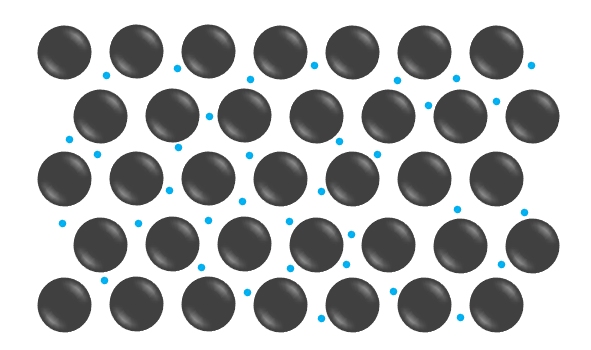
Q2.The image shown is a representation of the arrangment of the particles in a metal.
Which of the following particles do the black spheres represent?
Q3.A metal wire has a resistance of 6 $$\Omega$$.
Which of the following resistances is the new resistance of the wire if its length is increased by three times?
Q4.Which of the following resistances is the total resistance of the combination of resistors shown?

Q5.A current of 0.4 A flows through a resistance cable which is 12 m long.
What current will flow through 3 m of the same resistance cable?
Q6.The cross–sectional area of a wire is doubled and the length is halved.
Which of the following statements describes what will happen to the resistance of the wire?
