


New
New
Make and draw shapes with and without parallel and perpendicular sides
I can make and draw compound shapes with and without parallel and perpendicular sides.


Lesson 5 of 10
New
New
- Year 3
Make and draw shapes with and without parallel and perpendicular sides
I can make and draw compound shapes with and without parallel and perpendicular sides.
Lesson details
Key learning points
- The properties must match the shape you have created.
- Lines are not perpendicular when they are not at right angles to each other.
- Lines are not parallel because they are not always the same distance apart.
Keywords
Compound - A compound shape is one created using two or more basic shapes.
Vertex / vertices - A vertex is the point where two lines meet. The plural is vertices.
Common misconception
Pupils may find it challenging to recognise that the properties of composed shapes may be different from the shapes they are composed of.
Drawing around compound shapes can really support children thinking about this as a 'new' shape with new properties.
In the first cycle of the lesson the focus is on manipulating shapes to make compound shapes before drawing. Ensure pupils have sufficient time to explore practically before they move on to drawing.

Teacher tip

Licence
This content is © Oak National Academy Limited (2026), licensed on Open Government Licence version 3.0 except where otherwise stated. See Oak's terms & conditions (Collection 2).
Lesson video
Loading...
Prior knowledge starter quiz
6 Questions
Q1.Select the correct name for this shape.
Select the correct name for this shape.
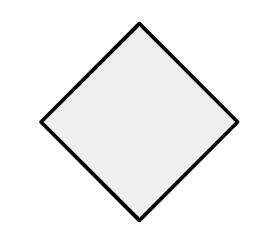
diamond
trapezium
Q2.Match the shape name to the number of vertices it has.
Match the shape name to the number of vertices it has.

Q3.Tick the shapes with at least one pair of perpendicular sides.
Tick the shapes with at least one pair of perpendicular sides.


Q4.Complete the sentence. This quadrilateral has pair(s) of parallel sides.
Complete the sentence. This quadrilateral has pair(s) of parallel sides.
Q5.Complete the sentence. This polygon has pair(s) of perpendicular sides.
Complete the sentence. This polygon has pair(s) of perpendicular sides.

Q6.True or false? Triangles cannot have any sides that are perpendicular.
True or false? Triangles cannot have any sides that are perpendicular.
True
Assessment exit quiz
6 Questions
Q1.This is an example of a compound shape. What is a compound shape?
This is an example of a compound shape. What is a compound shape?

Two rectangles joined together
A polygon with six sides
Q2.Lucas composes a shape from two polygons. Name one of the polygons the new shape is composed of.
Lucas composes a shape from two polygons. Name one of the polygons the new shape is composed of.

Q3.Lucas composes a shape from two polygons How many pairs of perpendicular sides does his new shape have? pair(s)
Lucas composes a shape from two polygons How many pairs of perpendicular sides does his new shape have? pair(s)
Q4.Lucas composes a shape from two polygons How many pairs of parallel sides does his new shape have?
Lucas composes a shape from two polygons How many pairs of parallel sides does his new shape have?
None
Exactly one pair
Q5.Lucas draws this shape on dotted paper. Name the shape Lucas has drawn.
Lucas draws this shape on dotted paper. Name the shape Lucas has drawn.

Q6.True or false? This shape has no pairs of parallel sides and no pairs of perpendicular sides.
True or false? This shape has no pairs of parallel sides and no pairs of perpendicular sides.
False
