Models of single-gene inheritance: Punnett squares
I can interpret and construct Punnet squares to show the inheritance of alleles of a single gene.


- Year 10
- AQA
Models of single-gene inheritance: Punnett squares
I can interpret and construct Punnet squares to show the inheritance of alleles of a single gene.
Lesson details
Key learning points
- Most characteristics are influenced by multiple genes, but some are determined by just one.
- An individual will inherit two alleles for each gene, the alleles for a gene may be dominant or recessive.
- A Punnett square models inheritance of alleles showing possible genotypes of offspring as homozygous or heterozygous.
- Punnett squares are used to predict proportion of genotypes/phenotypes, or probability of occurrence in the offspring.
- Each instance of sexual reproduction is independent, so does not affect the probability for subsequent offspring.
Keywords
Punnett square - A model used to show the inheritance of alleles from parents to offspring.
Gamete - A sex cell (i.e. sperm and egg) that carries half the genetic information required for an individual organism.
Genotype - The combination of alleles that an individual has for each gene.
Ratio - Shows hows how much of one value there is compared to another.
Probability - A measure of the chance or likelihood of an event occurring.
Common misconception
A gamete has two alleles, Punnett square has too many alleles for gametes. Also that only four offspring are produced and therefore each will definitely have the genotype and phenotype shown.
Model the alleles within gametes so it is clear. Refer to half the gametes having each version, moving away from the idea of divisions of 4.


Licence
Lesson video
Loading...
Prior knowledge starter quiz
6 Questions
Q1.Which is the genetic code?
Q2.Which statement best describes the relationship between phenotype and genotype?
Q3.Horse body cells have 64 chromosomes. How many chromosomes will there be in a horse's unfertilised egg cell?
Q4.True or false? Offspring inherit different genes from each parent.
Q5.In humans the CF protein affects the stickiness of mucus. There are two alleles F and f. Individuals with the genotype ff have very sticky mucus. Which allele is dominant?
Q6.Plants produce either red pigmented flowers or white flowers with no pigment. The RR or Rr genotypes have red flowers. Plants with rr genotype have white flowers. Order the statements to explain how.
Assessment exit quiz
6 Questions
Q1.Match the word to its meaning.

Q2.The nucleus of a chimpanzee body cell contains 48 chromosomes. How many chromosomes will there be in the nucleus of a chimpanzee zygote?
Q3.A woman is heterozygous (Ff) for the gene that codes for a protein. What genotypes can her eggs have?
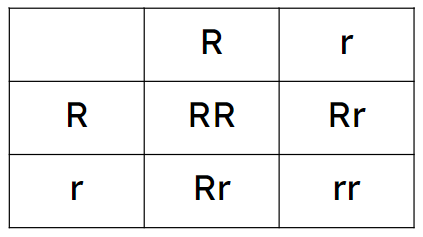
Q4.Two heterozygous (Rr) red flowered plants cross pollinate each other. Use the Punnett square to work out the ratio of red : white flowering offspring.
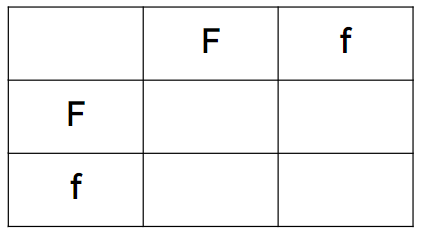
Q5.A couple who are both heterozygous (Ff) for the A gene want to have a child. Use the incomplete Punnett square to work out the probability that the child will be homozygous recessive.