


New
New


Lesson 5 of 17
New
New
- Year 7
Multiplicative relationships
I can calculate the multiplier for any two given numbers.
Lesson details
Key learning points
- Any value divided by itself is equal to one.
- One is the multiplicative identity.
- There exists a multiplier for any pair of values.
Keywords
Reciprocal - Reciprocal is the multiplicative inverse of any non-zero number. Any non-zero number multiplied by its reciprocal is equal to 1
Common misconception
Using additive strategies instead of multiplicative.
Emphasise that proportional relationships maintain a constant multiplier so we are looking for a multiplicative relationship.
Embed the understanding that there exists a multiplier for any pair of values. Randomly pick a pupil to say a number, then ask another pupil to give a number. Ask the class to find the multiplier. Repeat for all types of numbers.

Teacher tip

Licence
This content is © Oak National Academy Limited (2025), licensed on Open Government Licence version 3.0 except where otherwise stated. See Oak's terms & conditions (Collection 2).
Lesson video
Loading...
Prior knowledge starter quiz
6 Questions
Q1.A ____________ is the multiplicative inverse of any non-zero number. Any non-zero number multiplied by its __________ is equal to 1
A ____________ is the multiplicative inverse of any non-zero number. Any non-zero number multiplied by its __________ is equal to 1
integer

Correct answer: reciprocal
reciprocal
common factor
proportion
ratio
Q2.What is the additive relationship between the numbers shown?
What is the additive relationship between the numbers shown?
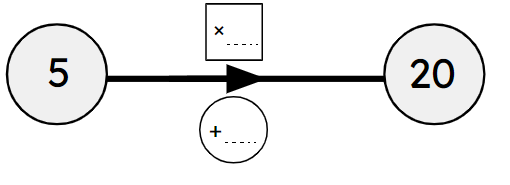
Correct answer: add 15
add 15
subtract 15
multiply by 4
divide by 4
Q3.Using the function machine, what is the multiplicative relationship between the numbers?
Using the function machine, what is the multiplicative relationship between the numbers?
add 15
subtract 15
Correct answer: multiply by 4
multiply by 4
divide by 4
Q4.Match the numbers with their reciprocal.
Match the numbers with their reciprocal.
Correct Answer:2,$$\frac{1}{2}$$
2 - $$\frac{1}{2}$$
Correct Answer:3,$$\frac{1}{3}$$
3 - $$\frac{1}{3}$$
Correct Answer:$$\frac{3}{2}$$,$$\frac{2}{3}$$
$$\frac{3}{2}$$ - $$\frac{2}{3}$$
Correct Answer:-3,$$\left(-\frac{1}{3}\right)$$
-3 - $$\left(-\frac{1}{3}\right)$$
Correct Answer:-2,$$\left(-\frac{1}{2}\right)$$
-2 - $$\left(-\frac{1}{2}\right)$$
Correct Answer:$$\left(-\frac{5}{2}\right)$$,$$\left(-\frac{2}{5}\right)$$
$$\left(-\frac{5}{2}\right)$$ - $$\left(-\frac{2}{5}\right)$$
Q5.Which of these operations could connect these two numbers?
Which of these operations could connect these two numbers?
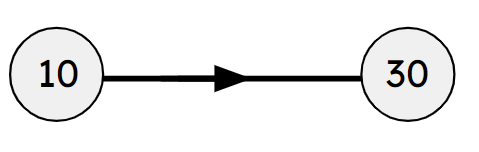
Correct answer: plus 20
plus 20
Correct answer: minus (-20)
minus (-20)
plus (-20)
Correct answer: multiply by 3
multiply by 3
Correct answer: divide by $$\frac{1}{3}
divide by $$\frac{1}{3}
Q6.Which of these would fit the multiplicative relationship?
Which of these would fit the multiplicative relationship?
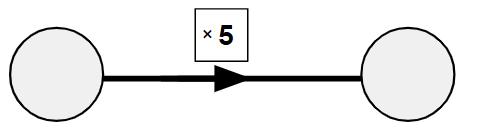
Correct answer: 1 to 5
1 to 5
$$\frac{5}{3}$$ to $$\frac{25}{15}$$
Correct answer: 6 to 30
6 to 30
Correct answer: $$\frac{3}{10}$$ to $$\frac{3}{2}$$
$$\frac{3}{10}$$ to $$\frac{3}{2}$$
Correct answer: $$\frac{1}{5}$$ to 1
$$\frac{1}{5}$$ to 1
Assessment exit quiz
6 Questions
Q1.Only using one step, what is the additive relationship for the connection of these numbers?
Only using one step, what is the additive relationship for the connection of these numbers?

add 2
Correct answer: add (-2)
add (-2)
add $$\frac{1}{2}$$
Q2.What two steps can be applied here for the connection of these numbers?
What two steps can be applied here for the connection of these numbers?
Correct answer: subtract 10 then add 8
subtract 10 then add 8
Correct answer: add (-10) then add 8
add (-10) then add 8
Correct answer: divide by 6 then multiply by 5
divide by 6 then multiply by 5
Correct answer: add 8 then subtract 10
add 8 then subtract 10
divide by 5 then multiply by 6
Q3.Using the function machine, what is the multiplicative relationship between the numbers?
Using the function machine, what is the multiplicative relationship between the numbers?
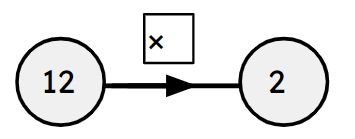
There is none as it is division not multiplication
Multiply by 6
Add 6
Correct answer: Multiply by $$\frac{1}{6}$$
Multiply by $$\frac{1}{6}$$
Subtract 6
Q4.What is the single additive step that connects these numbers?
What is the single additive step that connects these numbers?
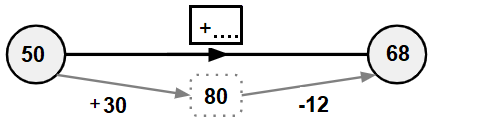
Correct answer: add 18
add 18
add (-18)
add 42
add (-42)
Q5.Using the values in the table, match the following.
Using the values in the table, match the following.
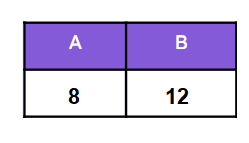
Correct Answer:The additive step from A to B,4
The additive step from A to B - 4
Correct Answer:The additive step from B to A,(-4)
The additive step from B to A - (-4)
Correct Answer:The multiplier from A to B,$$\frac{3}{2}$$
The multiplier from A to B - $$\frac{3}{2}$$
Correct Answer:The multiplier from B to A,$$\frac{2}{3}$$
The multiplier from B to A - $$\frac{2}{3}$$
Q6.What is the single multiplier?
What is the single multiplier?
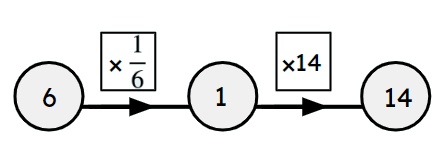
Correct answer: $$\frac{7}{3}$$
$$\frac{7}{3}$$
$$\frac{6}{14}$$
$$\frac{3}{7}$$
2.5
