


New
New
Multiplying and dividing a number by 10, 100 and 1,000
I can explain the effect of multiplying and dividing a number by 10, 100 and 1,000


Lesson 1 of 15
New
New
- Year 5
Multiplying and dividing a number by 10, 100 and 1,000
I can explain the effect of multiplying and dividing a number by 10, 100 and 1,000
Lesson details
Key learning points
- To multiply a number by 1,000 move the digits three places to the left - this makes the number 1,000 times the size.
- To divide a number by 1,000 move the digits three places to the right - this makes the numbers 1,000th times the size.
- A place value chart can be used to explain how the digits move when you multiply or divide by 10, 100 and 1,000.
- Use a Gattengo chart can be used to explain how the digits move when you multiply divide by 10, 100 and 1,000.
- Dividing by 10, 100 or 1,000 is equivalent to multiplying by 0.1, 0.01 or 0.001 respectively.
Keywords
Thousandth - One-thousandth is one part in one thousand equal parts.
Equivalent - If something is equivalent, it has the same value. For example, £1 is equivalent to 100 p - they have the same value.
Common misconception
Children may confuse use of the Base 10 equipment. They may also confuse the equivalence between dividing by 10/100/1,000 and multiplying by 0.1/0.01/0.001.
The large cube now represents one whole. The smaller blocks represent decimal fraction numbers. Use stem sentences to support common mistakes: when a number is divided by ___, it is the same as multiplying by ___
Use Base 10 equipment alongside both place value charts and Gattegno charts to support children to make connections. We talk about moving the digits moving rather than the decimal point moving - although these actions are equivalent, we will refer to the digits moving rather than the decimal point.

Teacher tip

Licence
This content is © Oak National Academy Limited (2025), licensed on Open Government Licence version 3.0 except where otherwise stated. See Oak's terms & conditions (Collection 2).
Lesson video
Loading...
Prior knowledge starter quiz
6 Questions
Q1.Match the factors to their product.
Match the factors to their product.

Q2.Match the equation to the correct product or quotient.
Match the equation to the correct product or quotient.
Q3.Look at the images of base 10 blocks and complete the sentence. There are tenths in one whole.
Look at the images of base 10 blocks and complete the sentence. There are tenths in one whole.

Q4.Look at the images of base 10 blocks and complete the sentence. There are hundredths in one whole.
Look at the images of base 10 blocks and complete the sentence. There are hundredths in one whole.

Q5.Look at the images of base 10 blocks and complete the sentence. There are hundredths in one tenth.
Look at the images of base 10 blocks and complete the sentence. There are hundredths in one tenth.
Q6.Dividing by 10 is the same as multiplying by
Dividing by 10 is the same as multiplying by
Assessment exit quiz
6 Questions
Q1.One-thousandth is composed of parts of one-hundredth.
One-thousandth is composed of parts of one-hundredth.
Q2.Which equations can be formed from this statement?
One tenth has been divided into 100 equal parts. Each part is one thousandth of the whole.
Which equations can be formed from this statement?
One tenth has been divided into 100 equal parts. Each part is one thousandth of the whole.
0.1 ÷ 10 = 0.01
1 × 0.001 = 0.001
0.1 ÷ 100 = 0.01
Q3.When a number is multiplied by 1,000, the digits move places to the left.
When a number is multiplied by 1,000, the digits move places to the left.
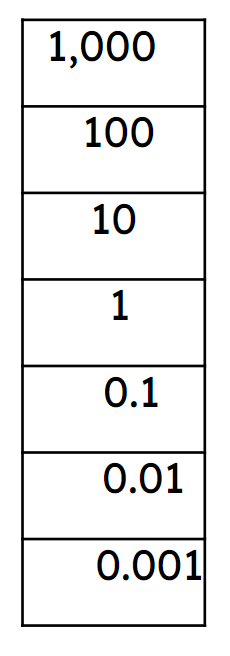
Q4.Use the Gattegno chart to complete the sentence. 0.001 is times smaller than 0.1
Use the Gattegno chart to complete the sentence. 0.001 is times smaller than 0.1
1
10
1,000
Q5.Match the division expression to its equivalent multiplication expression.
Match the division expression to its equivalent multiplication expression.
Q6.Match the equations to their product.
Match the equations to their product.
