


New
New


Lesson 8 of 9
New
New
- Year 8
Naming compounds
I can name compounds from their chemical formulae.
Lesson details
Key learning points
- The name of a simple metal–non-metal compound ends '-ide' to indicate bonding has occurred.
- Some common groups of compounds are metal carbonates, metal sulfates and metal nitrates.
- Compounds of metal atoms bonded to -CO₃ are called metal carbonates.
- Compounds of metal atoms bonded to -SO₄ are called metal sulfates.
- Compounds of metal atoms bonded to -NO₃ are called metal nitrates.
Keywords
Metal sulfate - Compound is made of a metal bonded to a sulfate group. The sulphate group is -SO₄.
Metal carbonate - Compound is made of a metal bonded to a carbonate group. The carbonate group is -CO₃.
Metal nitrate - Compound is made of a metal bonded to a nitrate group. The nitrate group is -NO₃.
Common misconception
Students often forget to change the non-metal name to either -ide or -ate.
Emphasise when the non-metal reacts with a metal it changes its name to -ide. It is -ate if the non-metal is also bonded to oxygen.
Use many examples and each time stress that the non-metal changes its name and why.

Teacher tip

Licence
This content is © Oak National Academy Limited (2026), licensed on Open Government Licence version 3.0 except where otherwise stated. See Oak's terms & conditions (Collection 2).
Lesson video
Loading...
Prior knowledge starter quiz
6 Questions
Q1.Complete this sentence: An element is made up of ...
Complete this sentence: An element is made up of ...
one atom.
different types of atoms.
Q2.There are three types of elements; metals, non-metals and ...
There are three types of elements; metals, non-metals and ...
Q3.On the periodic table, most elements are in which state at room temperature?
On the periodic table, most elements are in which state at room temperature?
liquid
gas
Q4.Match the word with the definition.
Match the word with the definition.

Q5.Which of the following are examples of compounds?
Which of the following are examples of compounds?
O₂
Mg
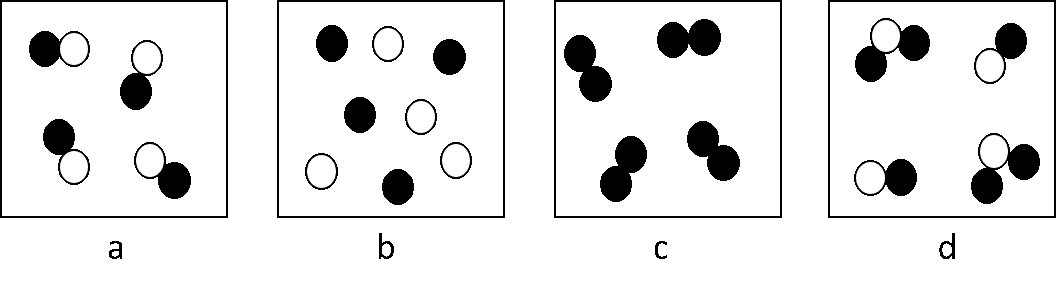
Q6.Correctly order the description of the particle diagram from a to d.
Correctly order the description of the particle diagram from a to d.
Assessment exit quiz
6 Questions
Q1.What is the ending used when naming a compound formed from two different elements bonded together?
What is the ending used when naming a compound formed from two different elements bonded together?
-ice
-ate
-ite
Q2.Compounds with names ending in '-ate' are made up of a metal, a non-metal and bonded together.
Compounds with names ending in '-ate' are made up of a metal, a non-metal and bonded together.
Q3.How many atoms of each element are present in potassium nitrate (KNO₃)?
How many atoms of each element are present in potassium nitrate (KNO₃)?
1 × potassium, 1 × nitrogen, 1 × oxygen
1 × potassium, 3 × nitrogen, 3 × oxygen
3 × potassium, 3 × nitrogen, 3 × oxygen
Q4.What elements would make up the compound copper sulfate?
What elements would make up the compound copper sulfate?
copper and sulfur
copper, sulfide and oxygen
copper, sulfur and oxide
copper and sulfate
Q5.Order the following compound endings as those which would represent the following; an oxide, a carbonate, a nitrate, a chloride, a sulfide and sulfate.
Order the following compound endings as those which would represent the following; an oxide, a carbonate, a nitrate, a chloride, a sulfide and sulfate.
Q6.Use the periodic table to help you match the compound to the correct name.
Use the periodic table to help you match the compound to the correct name.
