


New
New
Newton's First Law
I can describe and explain how a resultant force can change the movement of objects.


Lesson 7 of 10
New
New
- Year 8
Newton's First Law
I can describe and explain how a resultant force can change the movement of objects.
Lesson details
Key learning points
- Resultant forces make the movement of things change.
- Friction acts against the direction of movement of an object.
- An object will continue to move at a steady speed in a straight line unless a resultant force is acting.
Keywords
Stationary - A stationary object is not moving.
Resultant force - A resultant forces the sum of all forces acting on an object.
Frictional force - Frictional forces act between surfaces, to oppose the movement of an object.
Gravitational force - The gravitational force on an object pulls it downwards, towards Earth.
Common misconception
Pupils believe driving forces are needed to keep objects moving at constant speed.
Demonstrate that friction (and drag) bring objects to a stop, showing that different surfaces produce the forces that slow objects.
A linear air track is an excellent way to show motion with very low friction. Use one here to show the trolley and string experiment, demonstrating the examples provided instead of saving the apparatus for KS4.

Teacher tip

Equipment

Licence
This content is © Oak National Academy Limited (2025), licensed on Open Government Licence version 3.0 except where otherwise stated. See Oak's terms & conditions (Collection 2).
Lesson video
Loading...
Prior knowledge starter quiz
6 Questions
Q1.What can make an object speed up, slow down, change direction or change shape?
What can make an object speed up, slow down, change direction or change shape?
Q2.What is the name of the force which is produced when two solid surfaces rub against each other?
What is the name of the force which is produced when two solid surfaces rub against each other?
upthrust
drag
thrust
tension
Q3.What is the name of the force that opposes movement when a solid object passes through a liquid or gas?
What is the name of the force that opposes movement when a solid object passes through a liquid or gas?
upthrust
friction
thrust
tension
Q4.A firework has a weight of 0.2 N and it produces an upwards thrust of 1.0 N when launched. What it the resultant force on the firework?
A firework has a weight of 0.2 N and it produces an upwards thrust of 1.0 N when launched. What it the resultant force on the firework?
0.2 N upwards
1.0 N downwards
1.2 N upwards
0.8 N downwards
Q5.Someone pushes a trolley along a flat road until it is moving quickly. They then jump on for a ride, putting both their feet up. Which of these statements is correct after they are on the trolley?
Someone pushes a trolley along a flat road until it is moving quickly. They then jump on for a ride, putting both their feet up. Which of these statements is correct after they are on the trolley?
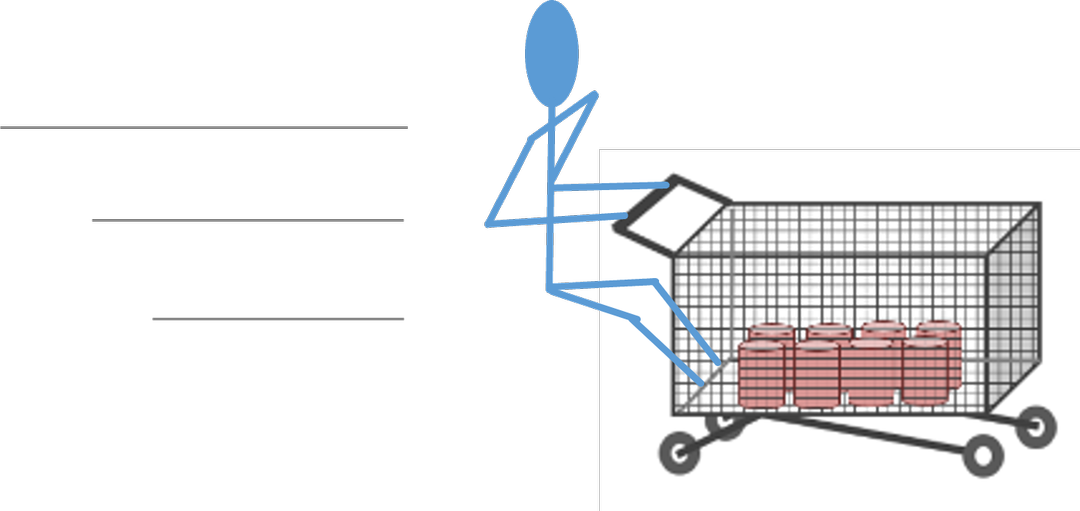
The force of friction will push the trolley forwards.
A push force is still driving the trolley forwards.
Fiction and drag will cause the trolley to immediately stop.
Q6.A child lets go of a bundle of ten large helium balloons, each has a weight of 0.5 N. Each balloon produces an upthrust of 1 N. What is resultant force on the bundle of balloons?
A child lets go of a bundle of ten large helium balloons, each has a weight of 0.5 N. Each balloon produces an upthrust of 1 N. What is resultant force on the bundle of balloons?

0.5 N upwards
1.5 N upwards
5.0 N downwards
0 N
Assessment exit quiz
6 Questions
Q1.Match the key word to the definition.
Match the key word to the definition.

Q2.Which of these is an example of an object that has no propelling (forwards acting) force?
Which of these is an example of an object that has no propelling (forwards acting) force?
A car speeding up as it travels along a road.
A rocket taking off from a launchpad.
A shopping trolley being pushed by a customer.
A sled being dragged by some dogs.
Q3.Which of these are true when there is no resultant force acting on an object?
Which of these are true when there is no resultant force acting on an object?
It cannot be moving.
It must be moving.
If it is moving it must change speed or direction.
Q4.The figure shows two forces acting on a lorry. What is the resultant force on the lorry?
The figure shows two forces acting on a lorry. What is the resultant force on the lorry?
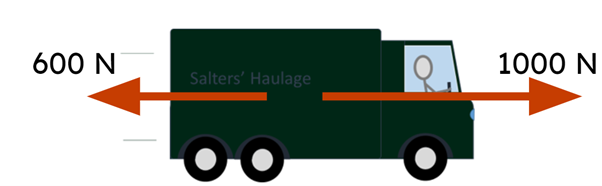
0 N
400 N backwards
1600 N backwards
1600 N forwards
Q5.The figure shows two forces acting on a moving lorry. What will happen to the lorry?
The figure shows two forces acting on a moving lorry. What will happen to the lorry?
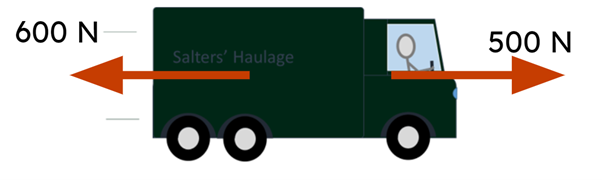
It will stop moving immediately.
It will speed up.
It will start moving backwards.
It will stay at the same speed.
Q6.A bowling ball is launched from a ramp along a bowling alley as shown in the figure. Which of the following statements are true?
A bowling ball is launched from a ramp along a bowling alley as shown in the figure. Which of the following statements are true?
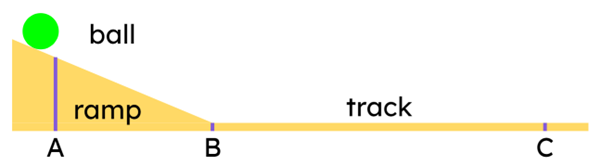
There is no resultant force on the ball between B and C.
The ball speeds up between points B and C.
