


New
New
Predator-prey relationships
I can describe and explain the relationship between predator and prey populations.


Lesson 2 of 9
New
New
- Year 7
Predator-prey relationships
I can describe and explain the relationship between predator and prey populations.
Lesson details
Key learning points
- Predators are hunters and prey are hunted.
- Different factors can affect the population sizes of predators and prey (e.g. disease).
- There is a relationship between the predator and prey population sizes, each is impacted by changes in the other.
Keywords
Predator - An animal that hunts and eats another animal.
Prey - An animal that is caught and eaten by another animal.
Population - A group of organisms of the same type, in the same place, is called a population.
Common misconception
The change in the size of a population will only affect another population if they are predator-prey
Ensure that pupils are given opportunities to see how changes in population size impact all other organisms in the food chain.
Give pupils plenty of opportunities to explore the predators and prey within different food chains. In particular, get pupils to think about those organisms that are only prey, those that are both predators and prey and those that are apex predators.

Teacher tip

Equipment

Licence
This content is © Oak National Academy Limited (2025), licensed on Open Government Licence version 3.0 except where otherwise stated. See Oak's terms & conditions (Collection 2).
Lesson video
Loading...
Prior knowledge starter quiz
6 Questions
Q1.In a food chain diagram, animals can be:
In a food chain diagram, animals can be:
only producers
both producers and consumers
Q2.A food chain diagram is an example of a . These help us to understand difficult things more simply.
A food chain diagram is an example of a . These help us to understand difficult things more simply.
Q3.Look at the food chain diagram. It shows four organisms. Match the organism with the word that describes its position in the food chain.
Look at the food chain diagram. It shows four organisms. Match the organism with the word that describes its position in the food chain.


Q4.What is wrong with this food chain?
What is wrong with this food chain?

The arrows are facing the wrong direction.
The sun is missing.
There is no producer.
Q5.What is wrong with this food chain?
What is wrong with this food chain?

The organisms are in the wrong order.
The sun is missing.
There is no producer.
Q6.Look at the picture of this food chain diagram. Choose the correct statement.
Look at the picture of this food chain diagram. Choose the correct statement.

The food chain shows us the size of the populations.
There are three organisms in the food chain.
There are three consumers in this food chain.
Assessment exit quiz
6 Questions
Q1.A is the number of organisms of one type that lives in a given area.
A is the number of organisms of one type that lives in a given area.
Q2.Births, deaths and migration can all impact the size of a population. Match the words with how they are most likely to change the size of a population.
Births, deaths and migration can all impact the size of a population. Match the words with how they are most likely to change the size of a population.
Q3.In this food chain diagram, which organism is the predator of the cod?
In this food chain diagram, which organism is the predator of the cod?

algae
shrimp
cod
polar bear
Q4.The graph shows the size of a population of rabbits. Which of the following is most likely to explain the shape of the graph?
The graph shows the size of a population of rabbits. Which of the following is most likely to explain the shape of the graph?
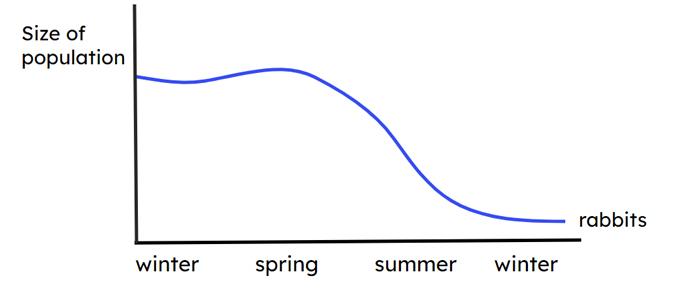
There is lots of food available for the rabbits.
There has been a natural disaster, for example a flood.
Q5.Which graph represents a predator-prey model?
Which graph represents a predator-prey model?
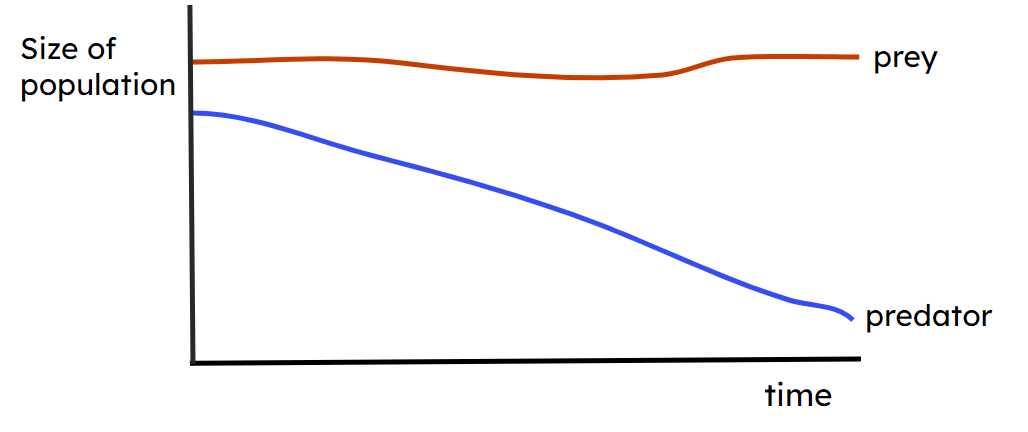
Graph A
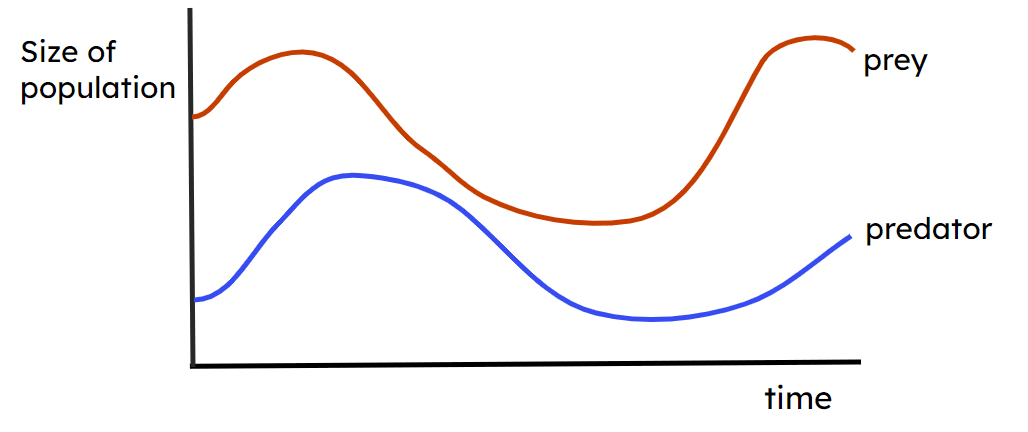
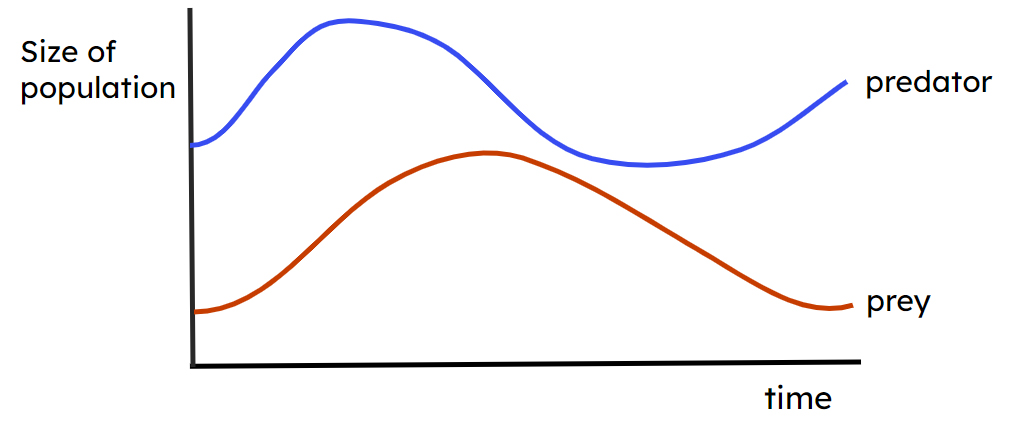
Graph C
Q6.Arctic foxes are predators of arctic hares. The population of arctic hares increases. What will happen to the population of arctic foxes and why?
Arctic foxes are predators of arctic hares. The population of arctic hares increases. What will happen to the population of arctic foxes and why?
The arctic fox population will decrease because there is less food to eat.
The arctic fox population will decrease because there is more food to eat.
The arctic fox population will increase because there is less food to eat.
