


- Year 10
Problem solving with bearings
I can use my knowledge of bearings to solve problems.
Lesson details
Key learning points
- Right-angled trigonometry may be useful when dealing with bearings.
- Right-angled trigonometry can help you calculate more information.
- Angle facts can be a simpler way of deducing information.
Keywords
Transversal - A transversal is a line, line segment, or ray that intersects through two or more lines at distinct (different) points.
Corresponding - Corresponding angles are a pair of angles at different vertices on the same side of a transversal in equivalent positions.
Alternate - Alternate angles are a pair of angles, both between or both outside two line segments, that are on opposite sides of the transversal that cuts them.
Co-interior - Co-interior angles are on the same side of the transversal line and in between the two other lines.
Bearing - A bearing is an angle measured in degrees from North in the clockwise direction and written with three figures.
Common misconception
Pupils do not measure the angle from North and simply measure the angle between two line segments.
Reiterate bearings are always measured from North, in a clockwise direction and stated as 3 figures. Encourage pupils to draw North on the correct position before attempting the question.


Licence
Lesson video
Loading...
Prior knowledge starter quiz
6 Questions
Q1.Knowing all North indicators are (North is the same direction) allows us to use a range of angle facts to work out bearings.

Q2.The bearing from a plane to the ship is 083°. Work out the bearing from the ship to the plane.
Q3.The bearing from Oak City to Acorn Town is 138°. Work out the bearing from Acorn Town to Oak City.
Q4.Match the interior angle for each of the following regular polygons.
Equilateral triangle - 60°
Square - 90°
Pentagon - 108°
Hexagon - 120°
Q5.Which of these is a correct formula for using the tangent function?
Q6.Given a right-angled triangle, the opposite length is 2 cm and the adjacent length is 3 cm, work out the angle formed between the adjacent and the hypotenuse. Give your answer to 1 d.p.
Assessment exit quiz
6 Questions
Q1.Match the bearing with the statements.
Due South - has a bearing of 180°
Due West - has a bearing of 270°
Due East - has a bearing of 090°
Due North-East - has a bearing of 045°
Due South-East - has a bearing of 135°
Due South-West - has a bearing of 225°
Q2.Three towns form an equilateral triangle; X, Y and Z. Z is due East from X.
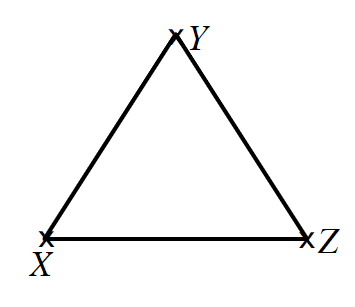
Bearing from X to Y - 030°
Bearing from Y to X - 210°
Bearing from X to Z - 090°
Bearing from Z to X - 270°
Q3.B is 7 km due East from A. C is 4 km due North from B. D is 3 km due West from C. Using squares, where the length of 1 square is 1 km work out the bearing from A to D.
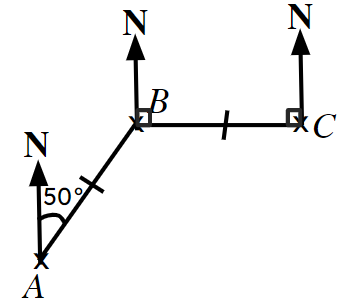
Q4.Using the diagram, work out the bearing from C to A.
Q5.Identify which of the following are always true, sometimes true or never true.
Always true - The sum of co-interior angles is always 180°
Never true - Angles around a point sum to 180°
Sometimes true - If the bearing from A to B is $$x$$° then B to A is 180°+ $$x$$°
Q6.A boat travels due South from port A for 5 km. It then travels due West and arrives at port B . The straight line distance from A to B is 15 km. What is the bearing from B to A?
