


New
New
Problem solving with estimation and rounding
I can use my knowledge of estimation and rounding to solve problems.


Lesson 16 of 16
New
New
- Year 8
Problem solving with estimation and rounding
I can use my knowledge of estimation and rounding to solve problems.
Lesson details
Key learning points
- It may be helpful to estimate an answer to check the magnitude is correct.
- It can be useful to use rounding to significant figures when dealing with very big or very small numbers in context.
- Estimates can help when making decisions about maximum or minimum possible answers in real life contexts.
- You can use Fermi estimation to find approximate solutions to problems.
Keywords
Estimate - A quick estimate for a calculation is obtained from using approximate values, often rounded to 1 significant figure.
Common misconception
Using the wrong limits when dividing or subtracting in order to find the upper limit of a calculation or lower limit of a calculation.
Drawing a number line to show with subtraction will help students see how to achieve an upper or lower limits of an error interval calculation. When using division, reiterating the division of number is the same as multiplying by its reciprocal.
Fermi problems allow pupils to be explorative and creative when getting initial data. Some nice in class examples: How many oranges would it take to fill the classroom? How many hours would it take a teacher to mark every full maths exercise book of every pupil in the school?

Teacher tip

Licence
This content is © Oak National Academy Limited (2026), licensed on Open Government Licence version 3.0 except where otherwise stated. See Oak's terms & conditions (Collection 2).
Lesson video
Loading...
Prior knowledge starter quiz
6 Questions
Q1.A degree of accuracy shows how precise a or measurement is. For example, to the nearest cm, nearest 10, 1 s.f. and so on.
A degree of accuracy shows how precise a or measurement is. For example, to the nearest cm, nearest 10, 1 s.f. and so on.
Correct Answer: number, value

number, value
Q2.Alex buys paper £4.95, USB £$$\square$$, stamps £5.20, crisps £0.95, staples £1.10 and plug £1.99. He pays with a £20 note and receives about £2 back in change. Estimate the cost of the USB.
Alex buys paper £4.95, USB £$$\square$$, stamps £5.20, crisps £0.95, staples £1.10 and plug £1.99. He pays with a £20 note and receives about £2 back in change. Estimate the cost of the USB.
£1
£2
Correct answer: £4
£4
£6
£12
Q3.An error interval for a number $$y$$ shows the range of possible values of $$y$$. It is written as:
An error interval for a number $$y$$ shows the range of possible values of $$y$$. It is written as:
$$ a< y < b$$
$$ a> y < b$$
$$a \geq y <b$$
Correct answer: $$ a\leq y < b$$
$$ a\leq y < b$$
Q4.When a number, $$x$$, is rounded to the nearest integer the result is 88. Identify the error interval.
When a number, $$x$$, is rounded to the nearest integer the result is 88. Identify the error interval.
$$ 87.5< x < 88.4 \dot 9$$
$$ 87.5> x < 88.4 \dot 9$$
$$ 87.5\leq x < 88.4 \dot 9$$
Correct answer: $$87.5\leq x< 88.5$$
$$87.5\leq x< 88.5$$
$$87.5 \geq x <88.4 \dot 9$$
Q5.A triangle has lengths 3.5 cm (2 s.f), 4.1 cm (2 s.f) and 4.8 cm (2 s.f). Write the error interval for the perimeter $$p$$ of the triangle.
A triangle has lengths 3.5 cm (2 s.f), 4.1 cm (2 s.f) and 4.8 cm (2 s.f). Write the error interval for the perimeter $$p$$ of the triangle.
Correct answer: $$ 12.25 \leq p < 12.55 $$
$$ 12.25 \leq p < 12.55 $$
$$ 12.2 \leq p < 12.5 $$
$$ 12.25 \leq p < 12.5599 $$
$$ 12.45 \leq p < 12.65 $$
Q6.A square has lengths in centimetres to 1 decimal place. The error interval of the area of the square is $$17.2225 \leq x <18.0625 $$. Work out the length of the square to 1 d.p.
A square has lengths in centimetres to 1 decimal place. The error interval of the area of the square is $$17.2225 \leq x <18.0625 $$. Work out the length of the square to 1 d.p.
3.8 cm
4.0 cm
Correct answer: 4.2 cm
4.2 cm
4.4 cm
4.6 cm
Assessment exit quiz
6 Questions
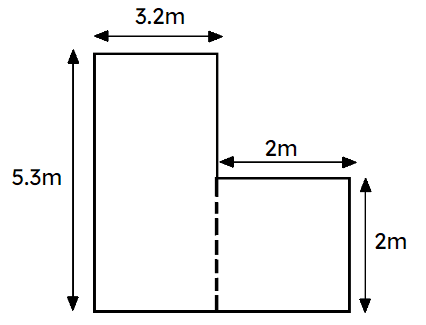
Q1.Work out an estimate for the area of the shape.
Work out an estimate for the area of the shape.
5 m²
10 m²
12 m²
Correct answer: 19 m²
19 m²
25 m²
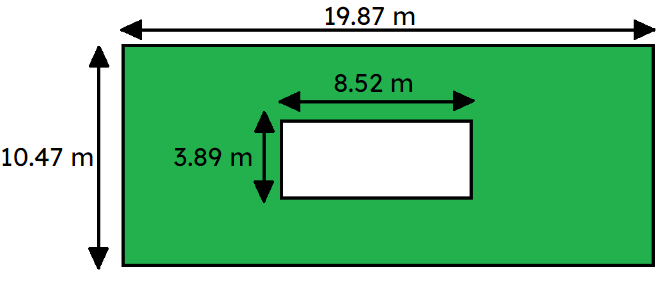
Q2.Here is a grassed garden with a summer house in the centre. Using estimation and rounding, estimate the area of the grass.
Here is a grassed garden with a summer house in the centre. Using estimation and rounding, estimate the area of the grass.
50 m²
90 m²
100 m²
Correct answer: 164 m²
164 m²
800 m²
Q3.A piece of string was 32 cm measured to the nearest cm. A length of 5.6 cm (to 1 d.p) was cut off. What is the error interval for the remaining length $$x$$ cm?
A piece of string was 32 cm measured to the nearest cm. A length of 5.6 cm (to 1 d.p) was cut off. What is the error interval for the remaining length $$x$$ cm?
Correct answer: $$25.85<x<26.95$$
$$25.85<x<26.95$$
$$25.85\leq x<26.95$$
$$25.95<x<26.85$$
$$25.95\leq x<26.85$$
Q4.Complete the statement. Fermi problems encourage:
Complete the statement. Fermi problems encourage:
Correct answer: critical thinking and well calculated estimates using data or information
critical thinking and well calculated estimates using data or information
Correct answer: openness of answers and flexibility so answers can be achieved in different ways
openness of answers and flexibility so answers can be achieved in different ways
Correct answer: an appreciation there are a range of answers, the focus is on the working out
an appreciation there are a range of answers, the focus is on the working out
random guesses but use estimation and or rounding
Q5.Fermi problem : How long will it take to count to 1 million (without breaks, sleep, etc)?
Fermi problem : How long will it take to count to 1 million (without breaks, sleep, etc)?
50 days
40 days
Correct answer: 16 days
16 days
5 days
3 days
Q6.Fermi problem : If you put 1 million pound coins in a box, what is the volume of the box in m³ ?
Fermi problem : If you put 1 million pound coins in a box, what is the volume of the box in m³ ?
0.5 m³
Correct answer: 1.2 m³
1.2 m³
5 m³
8 m³
12 m³
