


Problem solving with graph transformations
I can use my knowledge of graph transformations to solve problems.


- Year 11
Problem solving with graph transformations
I can use my knowledge of graph transformations to solve problems.
Lesson details
Key learning points
- Your knowledge of identifying transformations of shapes can be applied to graphs
- This allows you to identify what transformations have taken place
- Once the transformations have been identified, you can write this in function notation
Keywords
Transformation - A transformation is a process that may change the size, orientation or position of a shape or graph.
Common misconception
Pupils may not see the link between transformations and manipulating algebraic expressions.
Be explicit in highlighting that the graph of $$y=x^2+10x+22$$ is the graph of $$y=(x+5)^2-3$$ which is the graph of $$y=x^2$$ transformed by the translation, "$$5$$ units left, $$3$$ units down".


Licence
Lesson video
Loading...
Prior knowledge starter quiz
6 Questions
Q1.Match the transformed functions of $$ \text {f}(x)$$ to their descriptions.

$$ \text {f}(x) + 5$$ - Translation of 5 in the positive $$y$$ direction
$$ \text {f}(x+5) $$ - Translation of 5 in the negative $$x$$ direction
$$ \text {f}(5x)$$ - Stretch of $$1 \over 5$$ in the $$x$$ direction
$$5 \text {f}(x) $$ - Stretch of 5 in the $$y$$ direction
$$ -\text {f}(x) $$ - Reflection in the $$x$$ axis
$$ \text {f}(-x) $$ - Reflection in the $$y$$ axis
Q2.The graph of $$y= \text{f}(x)$$ is labelled. What other function of $$x$$ has been graphed?
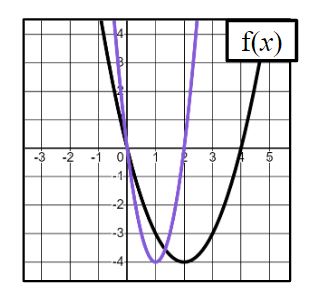
Q3.The graph of $$y= \text{f}(x)$$ is labelled. What other function of $$x$$ has been graphed?
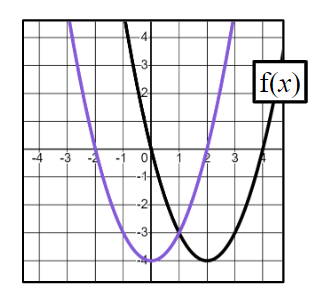
Q4.The graph of $$y= \text{g} (x)$$ is labelled. What other function of $$x$$ has been graphed?
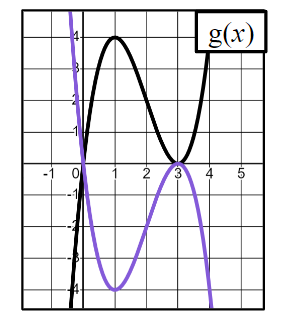
Q5.An __________ is a line which a curve approaches but never touches.
Q6.Which of these is equivalent to $$x^2 - 4x + 6$$?
Assessment exit quiz
6 Questions
Q1.The graph of $$y=x^2$$ has been transformed to get a new graph. What is the equation of this new graph?
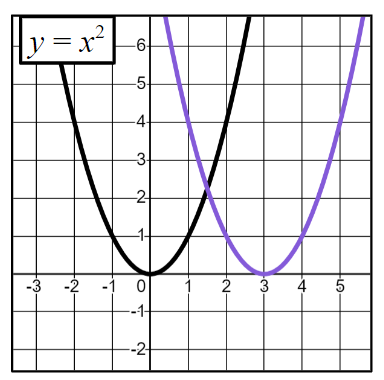
Q2.The graph of $$y=x^2$$ has been transformed to get a new graph. What is the equation of this new graph?
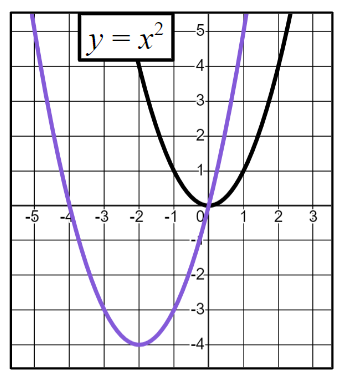
Q3.The graph of $$y=x^2$$ has been transformed to get a new graph. What is the equation of this new graph?
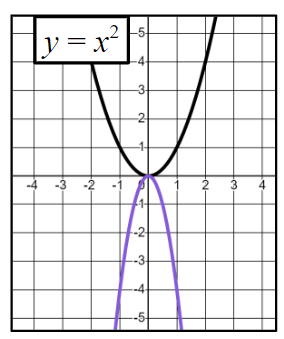
Q4.The graph of $$y=x^2-2x$$ has been transformed to get a new graph. What is the equation of this new graph?
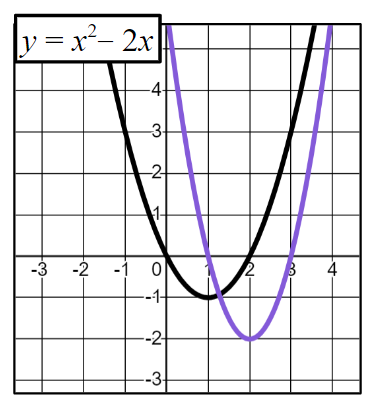
Q5.The graph of $$\text{f}(x)=2^x + 1$$ has an asymptote at $$y=1$$. Match up the transformations with the equation of the asymptote after the transformation.
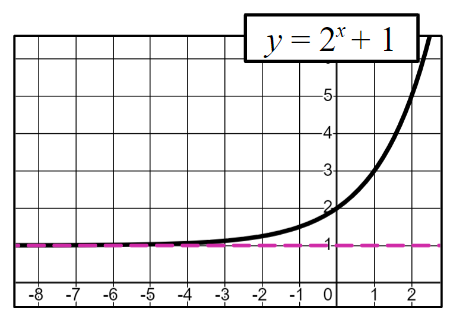
$$\text {f}(x+3)$$ - $$y=1$$
$$\text {f}(x)+3$$ - $$y=4$$
$$3\text {f}(x)$$ - $$y=3$$
$$-\text {f}(x)$$ - $$y=-1$$
Q6.The graph of $$\text{f}(x)= \text{tan}(x)$$ where $$-90 \le x \le 90$$ has asymptotes at $$x=-90$$ and $$x=90$$, which of these transformations will not change the position of the asymptotes ?
