Choose exam board for KS4 Computer Science (GCSE)
Choose exam board for KS4 English
Choose exam board for KS4 French
Choose exam board for KS4 Geography
Choose exam board for KS4 German
Choose exam board for KS4 History
Choose tier for KS4 Maths
Choose exam board for KS4 Music
Choose exam board for KS4 Physical education (GCSE)
Choose exam board for KS4 Religious education (GCSE)
Choose exam board for KS4 Spanish
      New
      New

      Problem solving with linear inequalities

      I can use my knowledge of inequalities to solve problems.

      Lesson 7 of 7
      New
      New
      • Year 11

      Problem solving with linear inequalities

      I can use my knowledge of inequalities to solve problems.

      Lesson details

      Key learning points

      1. When handling a project, there are often constraints
      2. Constraints exist for a variety of reasons, such as cost or supply limitations
      3. Finding a set of possible solutions allows you to work within the constraints

      Keywords

      • Inequality - An inequality is used to show that one expression may not be equal to another.

      Common misconception

      We are only interested in points that are in the region satisfied by all inequalities.

      With practical contexts, such as project management, it is useful to know when one constraint is not being met as it can suggest where additional resources (if available) should be allocated.

      Consider having pupils investigate what additional capacity would mean by changing the constraints. What options are available if the constraints still existed but had less restrictive values?
      Teacher tip

      Licence

      This content is © Oak National Academy Limited (2025), licensed on Open Government Licence version 3.0 except where otherwise stated. See Oak's terms & conditions (Collection 2).

      Lesson video

      Loading...

      Prior knowledge starter quiz

      6 Questions

      Q1.
      $$15x+25y=1500$$ is an equation whereas $$15x+25y<1500$$ is an .

      Correct Answer: inequality

      Q2.
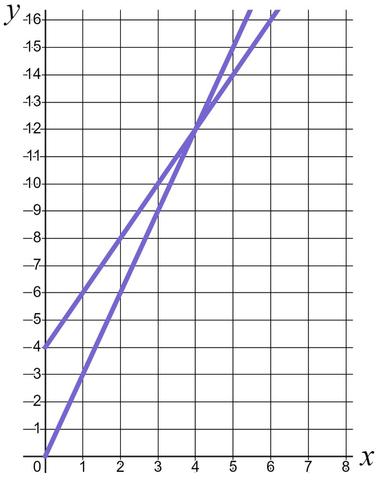
      Which of these is the point of intersection of these two linear equations?

      An image in a quiz
      $$(0, 0)$$
      $$(0, 4)$$
      $$(4, 0)$$
      Correct answer: $$(4, 12)$$
      $$(12, 4)$$

      Q3.
      For the equation $$c=10+6m$$ what is the value of $$c$$ when $$m=9$$? $$c=$$ .

      Correct Answer: 64

      Q4.
      Solve $$5x<x+28$$.

      $$x>7$$
      Correct answer: $$x<7$$
      $$x<28$$
      $$x<5$$
      $$x>5$$

      Q5.
      Which of these values satisfy this inequality? $${3x+6y}\le{450}$$

      Correct answer: $$(60,30)$$
      Correct answer: $$(30,60)$$
      Correct answer: $$(70,20)$$
      $$(20,70)$$
      $$(60,50)$$

      Q6.
      A taxi firm charge a fixed rate of $$£4$$ per journey plus $$£1.50$$ per mile travelled. The cost of your journey cannot exceed $$£16$$. Which inequality models this scenario?

      $$4m+1.5<16$$
      $$4+1.5m<16m$$
      $$4+1.5m<16$$
      Correct answer: $${4+1.5m}\le16$$
      $${4m+1.5}\le16$$

      Assessment exit quiz

      6 Questions

      Q1.
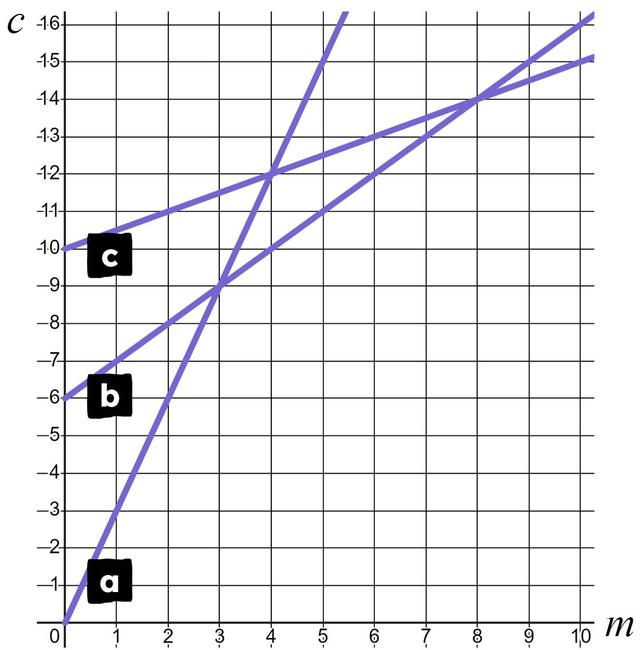
      The graph shows the charges of three taxi firms. The coordinate pair $$(3,9)$$ is the point of __________ of the graphs of taxi firms 'a' and 'b'.

      An image in a quiz
      Correct answer: intersection
      intercept
      inequality

      Q2.
      In what region does taxi firm 'a' charge less than taxi firm 'b'?

      An image in a quiz
      Correct answer: $$m<3$$
      $$m>3$$
      $$m\le3$$
      $$m<4$$
      $$m>4$$

      Q3.
      In what region does taxi firm 'c' charge less than taxi firm 'a'?

      An image in a quiz
      $$m<4$$
      Correct answer: $$m>4$$
      $$m\geq4$$
      $$m<8$$
      $$m>8$$

      Q4.
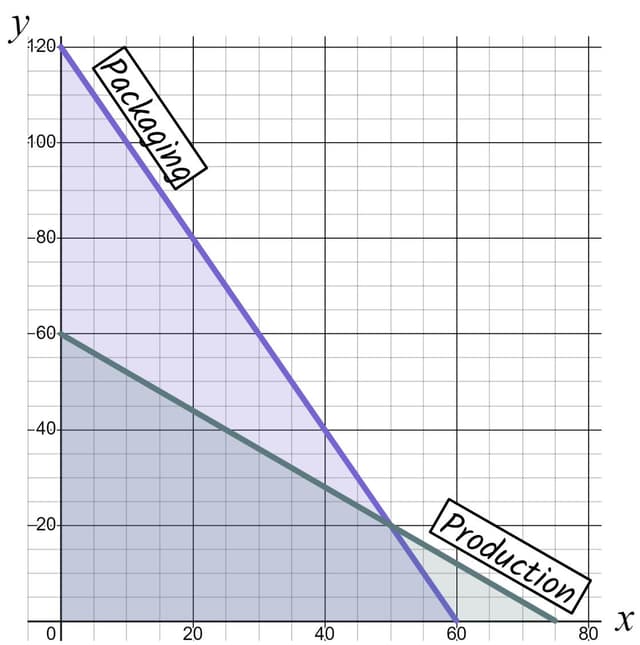
      These inequalities model a company's packaging and production constraints. Which of these points satisfies the production constraint but not the packaging constraint?

      An image in a quiz
      $$(10, 80)$$
      $$(60, 80)$$
      Correct answer: $$(60, 10)$$
      $$(10, 10)$$

      Q5.
      These inequalities model a company's packaging and production constraints. Which of these points satisfy both the production and the packaging constraints?

      An image in a quiz
      Correct answer: $$(50,15)$$
      $$(15,50)$$
      $$(40,30)$$
      $$(30,40)$$
      Correct answer: $$(60,0)$$

      Q6.
      These inequalities model a company's packaging and production constraints. Which coordinate pair is the point where both production and packaging are optimised?

      An image in a quiz
      Correct Answer: (50,20), (50, 20)

      Lesson appears in

      UnitMaths / Inequalities