


New
New
Producers, photosynthesis and consumers
I can explain why the survival of consumers depends upon photosynthesis in producers.


Lesson 1 of 2
New
New
- Year 10
- AQA
Producers, photosynthesis and consumers
I can explain why the survival of consumers depends upon photosynthesis in producers.
Lesson details
Key learning points
- Producers use photosynthesis to make their own food in the form of glucose (a simple carbohydrate).
- Consumers can only get food by eating producers or other consumers; producers are the source of food for food chains.
- Consumers cannot use carbon and nitrogen from the environment to make biomass; they get them by eating producers.
- Producers and consumers use the carbohydrate from photosynthesis to make biomass for growth and as fuel for respiration.
- Consumers also depend upon producers to add oxygen to the atmosphere, which they use for aerobic cellular respiration.
Keywords
Producer - an organism that makes its own food
Photosynthesis - the process used by producers to make their own food via a series of chemical reactions
Biomass - the mass of biological material in one or more organisms
Cellular respiration - a chemical process that transfers energy for life processes, using glucose as a fuel
Consumer - an organism that eats other organisms for food
Common misconception
It is a common misconception that consumers (including humans) could survive without producers.
The dependence of consumers on photosynthesis in producers in explored in depth.
Try to avoid teleology in pupils' thinking. Plants make food to keep themselves alive, not with any intention of feeding consumers. And they make oxygen as a waste product of photosynthesis, not with any intention of helping consumers to respire. But we evolved to make good use of these products!

Teacher tip

Licence
This content is © Oak National Academy Limited (2026), licensed on Open Government Licence version 3.0 except where otherwise stated. See Oak's terms & conditions (Collection 2).
Lesson video
Loading...
Prior knowledge starter quiz
6 Questions
Q1.Which word describes an organism that makes its own food?
Which word describes an organism that makes its own food?
herbivore
omnivore
prey
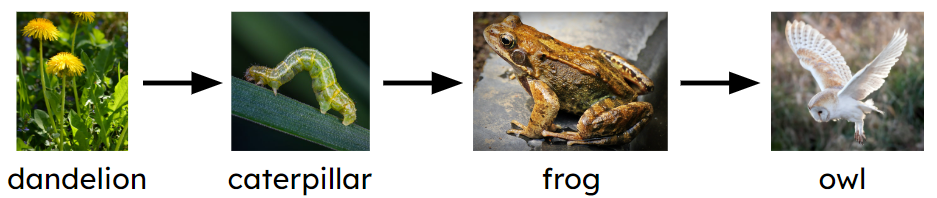
Q2.Which organism in the food chain makes its own food?
Which organism in the food chain makes its own food?
caterpillar
frog
owl
Q3.Which organisms in the food chain are carnivores?
Which organisms in the food chain are carnivores?
dandelion
caterpillar
Q4.Which organism in the food chain is a primary consumer?
Which organism in the food chain is a primary consumer?
dandelion
frog
owl
Q5.Starting with the organism that makes its own food, put these organisms into the order they would appear in a food chain diagram.
Starting with the organism that makes its own food, put these organisms into the order they would appear in a food chain diagram.

Q6.What is the name of the chemical process that makes food in the cells of a producer?
What is the name of the chemical process that makes food in the cells of a producer?
Assessment exit quiz
6 Questions
Q1.Match each term to its correct meaning.
Match each term to its correct meaning.

Q2.Photosynthesis in producers makes a sugar called glucose, which is a type of …
Photosynthesis in producers makes a sugar called glucose, which is a type of …
fat
lipid
mineral ion
Q3.How do producers use the glucose they make?
How do producers use the glucose they make?
They use is it in photosynthesis.
It is excreted.
Q4.Oxygen is added to the atmosphere by the process of in producers.
Oxygen is added to the atmosphere by the process of in producers.
Q5.Humans are consumers. Where do consumers get the carbon they need to build biomass?
Humans are consumers. Where do consumers get the carbon they need to build biomass?
They get it from the air.
They get it from water.
They get it from photosynthesis in their cells.
Q6.Plants are producers. Where do producers get the carbon they need to build biomass?
Plants are producers. Where do producers get the carbon they need to build biomass?

They get it by eating other organisms.
They get it from food in the soil.
They get it from mineral ions.
