Resistance of a wire at a constant temperature
I can describe how to investigate the resistance of a wire at a constant temperature and make scientific conclusions.


- Year 10
- AQA
Resistance of a wire at a constant temperature
I can describe how to investigate the resistance of a wire at a constant temperature and make scientific conclusions.
Lesson details
Key learning points
- A wire heats up when a current flows and its temperature will vary over time.
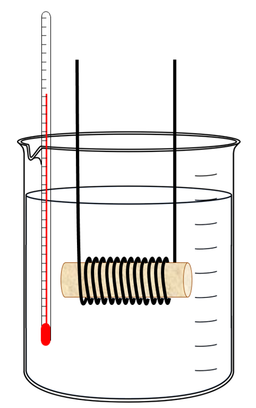
- A water bath helps to keep the temperature of a wire constant.
- Turning a circuit on for a very short time reduces the heating effect in a wire.
- In electricity investigations, it is often easy to take lots of readings rather than a few, repeated readings.
- The resistance of a wire is directly proportional to its length, at a constant temperature.
Keywords
Independent variable - the variable that the person doing the experiment changes
Dependent variable - the variable that is measured; it changes as a result of varying the independent variable
Control variable - a variable that needs to be kept the same to allow a fair test to be carried out
Random error - a type of error that affects results in an unpredictable way
Directly proportional - describes the relationship between two variables if both increase in the same proportion as each other
Common misconception
Pupils may not realise that the resistance of a wire varies with temperature.
Ensure pupils are aware that the temperature of a metal wire does affect resistance and that precautions should be taken to avoid a temperature change.


Equipment
Nichrome wire, crocodile clips, electrical leads, metre ruler, voltmeter and ammeter.

Content guidance
- Risk assessment required - equipment

Supervision
Adult supervision required

Licence
Lesson video
Loading...
Prior knowledge starter quiz
6 Questions
Q1.Match the following quantities to its unit symbol.

Q2.Which of the following can be used to calculate resistance?
Q3.Match each of the following types of variable to its definition.
Q4.When a current flows in a wire, which of the following moves through the wire?
Q5.In a graph showing the results of an experiment, where does each type of variable usually appear?
Q6.When there is an error in an experimental measurement, which of the following must be true?
Assessment exit quiz
6 Questions
Q1.A type of error that can affect results in an unpredictable way is called a error.
Q2.A pupil investigates the relationship between the length of a wire and the resistance of the wire. Which of the following are control variables in this investigation?
Q3.Which of the following statements describes how to connect a voltmeter and ammeter to measure the resistance of a piece of wire in a circuit?
Q4.The diagram shows some of the apparatus for investigating the effect of length of a wire on its resistance. Which of the following will help keep the temperature of the wire constant?