


- Year 11
Signs of a solution
I can deduce why a change of sign may indicate a solution.
Lesson details
Key learning points
- If the value is a solution, then substituting it into the equation should mean the equation evaluates to 0
- Since the solution is an approximation, it is unlikely to be exactly 0
- By substituting the upper and lower bonds of the estimated value into the equation, you can tell if the estimate is good
- If the two values produce one positive and one negative value, this implies the graph would cross the x axis
- The x intercept would be a solution to the equation
Keywords
Iteration - Iteration is the repeated application of a function or process in which the output of each iteration is used as the input for the next iteration.
Lower bound - The lower bound for a rounded number is the smallest value that the number could have taken prior to being rounded.
Upper bound - The upper bound for a rounded number is the smallest value that would round up to the next rounded value.
Common misconception
A change in sign always indicates a solution. No change in sign means no solution.
A change in sign only indicates a solution if the equation is equal to zero and if the graph of the equation crosses the $$x$$ axis between those points. Where there is a repeated root or two solutions between them there may be no change in sign.


Licence
Lesson video
Loading...
Prior knowledge starter quiz
6 Questions
Q1.A value has been rounded to 2.8 to 2 significant figures. What is the lower bound of this value?

Q2.A value has been rounded to 2.8 to 2 significant figures. What is the upper bound of this value?
Q3.What is the value of $$x^3-2x+5$$ when $$x=2$$?
Q4.What is the value of $$x^3-2x+5$$ when $$x=-2$$?
Q5.Match the letter representing each graph to the equation of the graph.
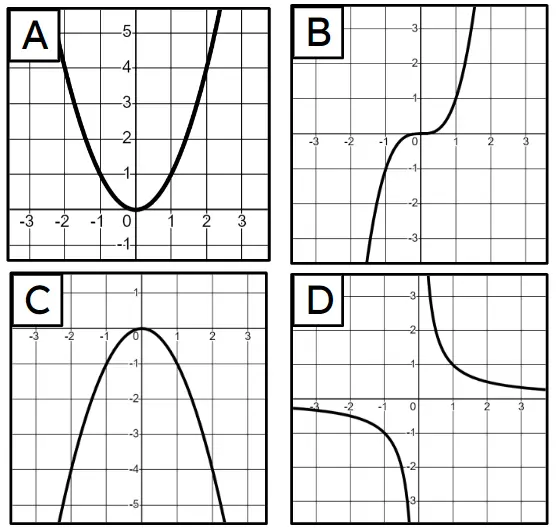
A - $$y=x^2$$
B - $$y=x^3$$
C - $$y=-x^2$$
D - $$y=\frac{1}{x}$$
Q6.Using the iterative formula $$x_{n+1}=\sqrt[3]{4(x_n)^2-1}$$ and $$x_0=5$$ there is a solution to $$x^3-4x^2+1=0$$ correct to 2 significant figures when $$x=$$ .
Assessment exit quiz
6 Questions
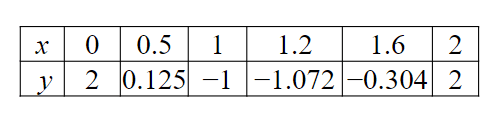
Q1.Using the table of values shown for the equation $$y=x^3-4x+2$$ which of these statements are definitely true?
Q2.Between which sets of values is there definitely a solution to $$x^3-5x-1=0$$ ?
Q3.When might a change in sign not indicate there is a solution between two values?
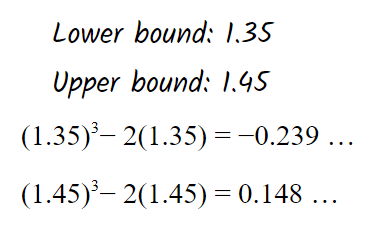
Q4.The image shows Jacob's workings to test his approximate solution to the equation $$x^3-2x=0$$. What do you think his solution was?
Q5.To see if $$x=-1.4$$ is a solution to the equation $$x^3-2x=0$$ to 2 significant figures which values should we test to see if there is a change in sign?
Q6.Which of these are solutions to $$-x^2+3x-1=0$$ correct to the stated degree of accuracy?
