Sine and cosine ratios
I can derive the sine and cosine ratios from the sides of a right-angled triangle.


- Year 9
Sine and cosine ratios
I can derive the sine and cosine ratios from the sides of a right-angled triangle.
Lesson details
Key learning points
- When the hypotenuse has a length of one, the opposite side has length sin(θ)
- When the hypotenuse has a length of one, the adjacent side has length cos(θ)
- Any right-angled triangle is a scaled version of this triangle.
Keywords
Hypotenuse - The hypotenuse is the side of a right-angled triangle which is opposite the right angle.
Adjacent - The adjacent side of a right-angled triangle is the side which is next to both the right angle and the marked angle.
Opposite - The opposite side of a right-angled triangle is the side which is opposite the marked angle.
Trigonometric ratios - The trigonometric ratios are ratios between each pair of lengths in a right-angled triangle.
Common misconception
sin(60°) is double sin(30°).
The values of the sine or cosine of an angle do not scale linearly. We can see from the unit circle that an angle of 30° meets the circle at a height of 0.5 units, whilst an angle of 60° meets the circle at a height of approximately 0.87 units.


Licence
Lesson video
Loading...
Prior knowledge starter quiz
6 Questions
Q1.In a right triangle, if the hypotenuse is 25 cm and a second side is 15 cm, what is the length of the third side? (Use a calculator to help you.)

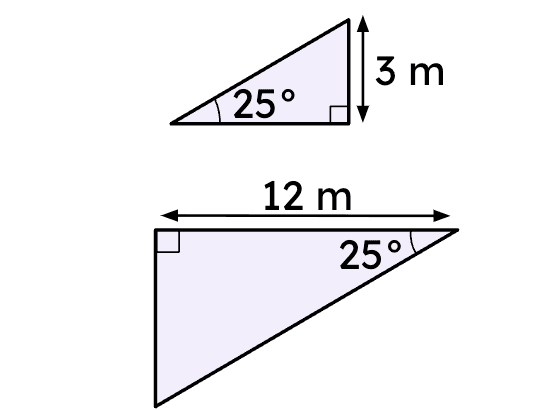
Q2.For this pair of triangles, can you determine whether they are similar without using side lengths?
Q3.What is cos(60ᵒ)?
Q4.In a right triangle, if the shortest sides are 40 cm and 96 cm, what is the length of the hypotenuse? (Use a calculator to help you.)
Q5.Which of the following statements is true for these triangles?

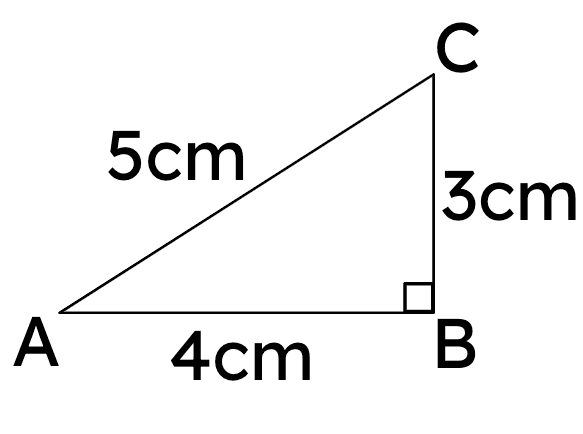
Q6.Would a triangle ABC with sides AB = 32cm, BC = 24cm, AC = 40cm be similar to the one shown in the diagram?
Assessment exit quiz
6 Questions
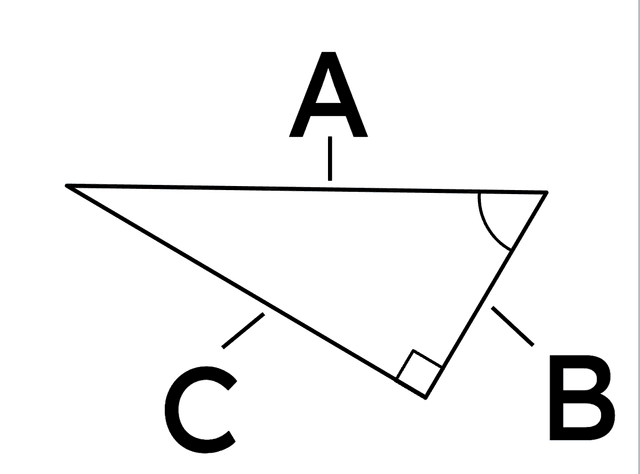
Q1.Which side would we label as 'adjacent' to the non-right angle shown?