


New
New
Solve problems using knowledge of addition and subtraction of multiples of 10
I can solve problems by applying different strategies for adding and subtracting multiples of 10


Lesson 10 of 10
New
New
- Year 3
Solve problems using knowledge of addition and subtraction of multiples of 10
I can solve problems by applying different strategies for adding and subtracting multiples of 10
Lesson details
Key learning points
- Representations help to identify the calculation needed to solve a problem.
- Different strategies can be applied to solve different problems.
- Evaluating or discussing strategies helps to find the most efficient one.
Keywords
Add - Bringing two or more numbers or things together to make a new total.
Subtract - Taking one number from another.
Strategy - A way to solve a problem.
Part - A piece or section of a whole.
Whole - All of a group or number.
Common misconception
Pupils not understanding what the problem is asking them to find out and identifying the operation.
Model the use of bar models and manipulatives to represent the problem and how to identify the operation and calculations needed.
This lesson separates the identification of the structure of the problem, its representation and the calculation from the solving of the problem. Encourage pupils to see this discussion and representation of the problem as a key part of the process.

Teacher tip

Licence
This content is © Oak National Academy Limited (2025), licensed on Open Government Licence version 3.0 except where otherwise stated. See Oak's terms & conditions (Collection 2).
Lesson video
Loading...
Prior knowledge starter quiz
6 Questions
Q1.140 - 60 = 80. Which number is the minuend in this equation?
140 - 60 = 80. Which number is the minuend in this equation?
60
80
Q2.140 - 60 = 80. 60 in this equation is the .
140 - 60 = 80. 60 in this equation is the .
minuend
difference
Q3.Which is the best way to partition the subtrahend in this equation? 150 - 70 = 80
Which is the best way to partition the subtrahend in this equation? 150 - 70 = 80
Partition 70 into 10 and 60
Partition 70 into 30 and 40
Q4.What number is missing from this calculation? 120 − 70 = 120 − 20 − .
What number is missing from this calculation? 120 − 70 = 120 − 20 − .
Q5.Which partitioned subtrahend will help you to bridge 100?
Which partitioned subtrahend will help you to bridge 100?

Q6.Match the missing subtrahends.
Match the missing subtrahends.
Assessment exit quiz
6 Questions
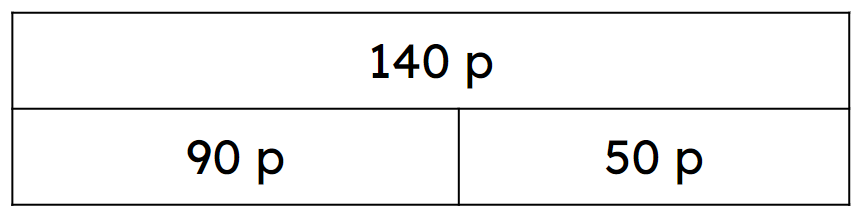
Q1.Look at the bar model. Which value represents the whole?
Look at the bar model. Which value represents the whole?
90 p
50 p
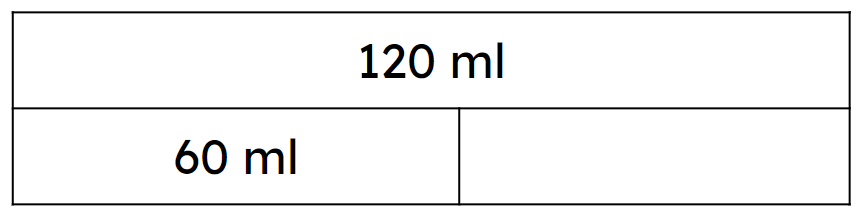
Q2.Look at the bar model. How is the missing number calculated?
Look at the bar model. How is the missing number calculated?
120 ml + 60 ml
60 ml + 120 ml
60 ml - 120 ml
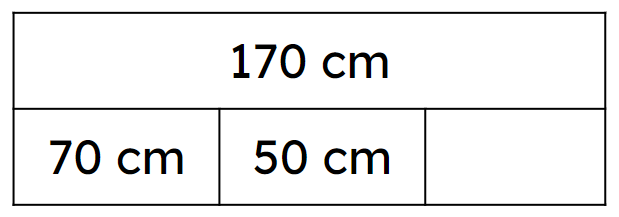
Q3.Read the word problem. Jacob has 170 cm of ribbon. Andeep cuts 70 cm from the ribbon. Izzy cuts 50 cm from the ribbon. How is the missing part calculated?
Read the word problem. Jacob has 170 cm of ribbon. Andeep cuts 70 cm from the ribbon. Izzy cuts 50 cm from the ribbon. How is the missing part calculated?
70 cm + 50 cm
170 cm + 70 cm + 50 cm
170 cm - 70cm
170 cm - 50 cm
Q4.Read the word problem. Andeep needs 150 grams of flour to bake a cake. There are 60 grams in one bag of flour and 80 grams in another bag. How much more flour does Andeep need? grams.
Read the word problem. Andeep needs 150 grams of flour to bake a cake. There are 60 grams in one bag of flour and 80 grams in another bag. How much more flour does Andeep need? grams.
Q5.Jacob used partition and bridge through 100 as his strategy to solve 150 p - 70 p. Order the steps using his strategy.
Jacob used partition and bridge through 100 as his strategy to solve 150 p - 70 p. Order the steps using his strategy.
Q6.Izzy collected rainwater outside in a jug. In week 1, there was 60ml of rain. In week 2, there was 10ml more than in week 1. How much rainwater did Izzy collect? ml.
Izzy collected rainwater outside in a jug. In week 1, there was 60ml of rain. In week 2, there was 10ml more than in week 1. How much rainwater did Izzy collect? ml.
