New
New
Solve problems with 4-digit dividends using factors and long division
I can solve problems with 4-digit dividends using factors and long division.


Lesson 11 of 15
New
New
- Year 6
Solve problems with 4-digit dividends using factors and long division
I can solve problems with 4-digit dividends using factors and long division.
Lesson details
Key learning points
- Factors of a divisor can be used to divide a dividend.
- Listing multiples of the divisor improves efficiency and accuracy with written division methods.
- Listing multiples helps to reduce the number of steps in the long division.
Keywords
Factor - Factors are numbers that multiply together to equal another number.
Long division - Long division is a method used for dividing large numbers by breaking the number down into smaller groups.
Prime number - A prime number is a number with exactly 2 factors.
Remainder - A remainder is an amount left after a division.
Common misconception
Pupils may be overwhelmed by the long division algorithm, especially with using multiples of the divisor and subsequent subtraction calculations.
Encourage pupils to complete and make use of the multiplication facts tables to support them in their calculation.
In this lesson, pupils explore strategies for calculating 4-digit numbers divided by a 2-digit number. Pupils should have some familiarity with factors before the session, including describing numbers using 3 or 4 factors. They should also have some experience of using the long division algorithm.

Teacher tip

Equipment

Licence
This content is © Oak National Academy Limited (2025), licensed on Open Government Licence version 3.0 except where otherwise stated. See Oak's terms & conditions (Collection 2).
Lesson video
Loading...
Prior knowledge starter quiz
6 Questions
Q1.The factor pairs of 20 are:
The factor pairs of 20 are:
18 and 2
200 and 10
Q2.Match the multiplication equations to related division facts.
Match the multiplication equations to related division facts.

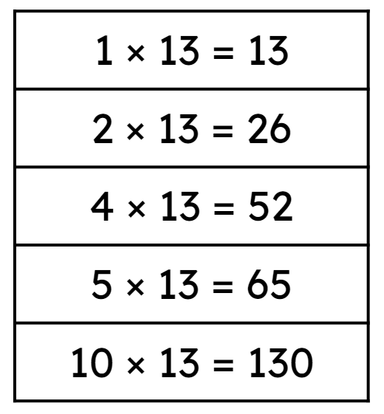
Q3.Use the multiplication facts to derive 14 × 13 =
Use the multiplication facts to derive 14 × 13 =
Q4.Match the equations to their products.
Match the equations to their products.
Q5.Which of the following is a reasonable estimate for the following equation. 414 ÷ 18 =
Which of the following is a reasonable estimate for the following equation. 414 ÷ 18 =
15
20
30
35
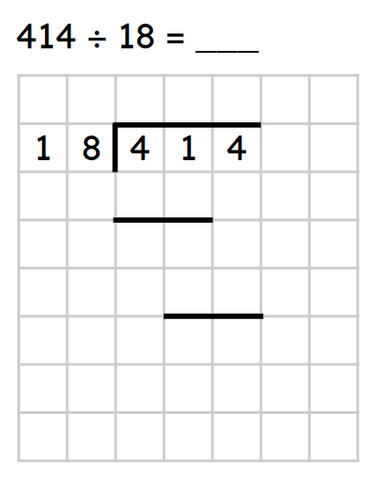
Q6.Calculate the equation using long division. 414 ÷ 18 =
Calculate the equation using long division. 414 ÷ 18 =
Assessment exit quiz
6 Questions
Q1.Select equivalent expressions with a product of 24
Select equivalent expressions with a product of 24
2 × 2 × 7
Q2.How could 2,120 be divided by 24?
How could 2,120 be divided by 24?
Divide 2,120 by 2 then divide by 3 then divide by 3
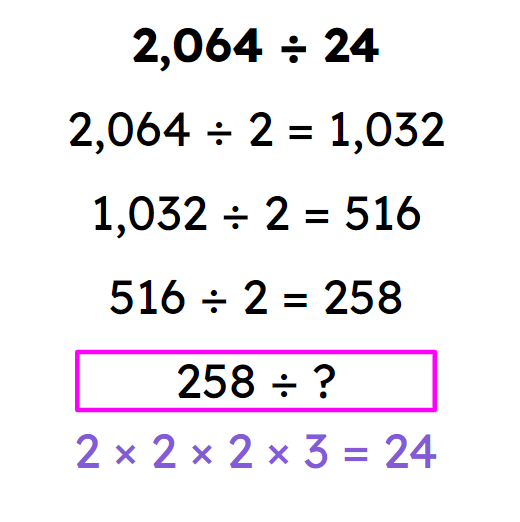
Q3.Complete the missing expression from the box below.
Complete the missing expression from the box below.
Q4.Which partition pair is missing from the part-part-whole model to show efficient division?
Which partition pair is missing from the part-part-whole model to show efficient division?
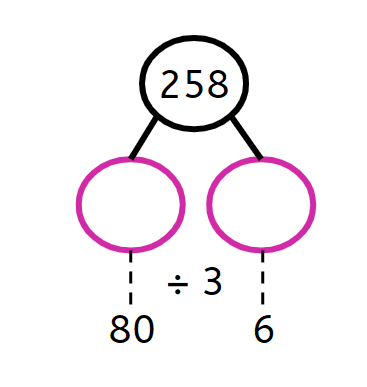
250 and 8
230 and 28
220 and 38
255 and 3
Q5.Which of the following is a reasonable estimate for the following equation: 5,405 ÷ 23 =
Which of the following is a reasonable estimate for the following equation: 5,405 ÷ 23 =
100
200
350
500
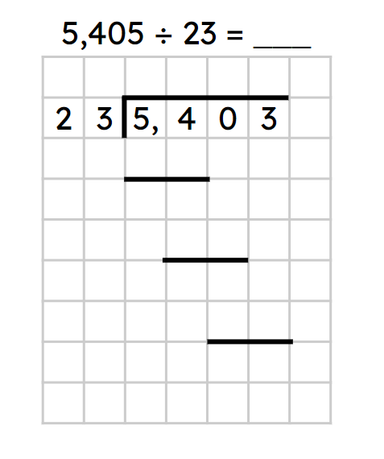
Q6.Calculate the equation using long division.
Calculate the equation using long division.