Solve problems with numbers with up to 3 decimal places
I can solve problems with numbers with up to 3 decimal places


- Year 5
Solve problems with numbers with up to 3 decimal places
I can solve problems with numbers with up to 3 decimal places
Lesson details
Key learning points
- Apply known facts and place value to solve problems involving up to 3 decimal places.
- Extend column addition and subtraction to include numbers with up to 3 decimal places.
- Use number facts to 10 to bridge through ones, tenths and hundredths.
Keywords
Represent - A representation is a way of showing a mathematical idea. Concrete objects, pictures and symbols can all be used to represent mathematics.
Operation - A mathematical process such as addition, subtraction, multiplication or division can be described as an operation.
Efficient - An efficient strategy is a way of solving a problem that is accurate and can be done more quickly than others.
Common misconception
Pupils may look to adopt a formal written strategy straight away when this is not necessary.
Share different strategies utilised by pupils within the lesson and compare these to expand pupils' understanding of efficiency.


Licence
Lesson video
Loading...
Prior knowledge starter quiz
6 Questions
Q1.How many mm are there in 1 cm?

Q2.How many mm are there in 0.025 m?
Q3.How many mm are there in 0.5 m?
Q4.0.008 + 0.003 =
Q5.What is the difference between 0.524 and 0.529?
Q6.What operation is required to find the missing value?
Assessment exit quiz
6 Questions
Q1.Tick the known fact that could help you to solve: 0.004 + 0.005 = ?
Q2.The centre of the net should be 0.914 m tall. At the moment, the height of the net is 0.921 m tall. How much should the net be lowered by? mm
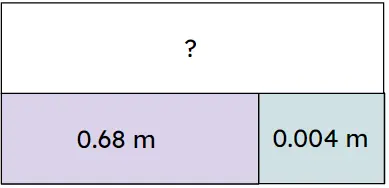
Q3.Which bar model represents the equation? 200 mm + 70 mm = ?