


Stretching a spring analysis (F=ke)
I can describe and calculate the properties of a spring using Hooke’s law.


- Year 10•
- AQA
Stretching a spring analysis (F=ke)
I can describe and calculate the properties of a spring using Hooke’s law.
Lesson details
Key learning points
- A spring is elastically deformed if it returns to its original shape after the applied force is removed
- A spring is inelastically deformed if it does not return to its original shape after the applied force is removed
- Elastic deformation is proportional to the force applied to stretch or compress a spring
- The spring constant (k) is the force needed to extend or compress an elastic object by one metre
- Force on a spring = spring constant × extension
Keywords
Directly proportional - A variable is directly proportional to another if it doubles or triples when the other one does the same.
Elastic deformation - The stretch of a spring that returns to its original shape when the stretching force is removed.
Inelastic deformation - The stretch of a spring as it is permanently stretched out of shape.
Spring constant - A measure of how stiff a spring is and how hard it is to stretch or compress.
Hooke’s Law - For elastic deformations, extension (or compression) is directly proportional to the force applied.
Common misconception
Pupils often think the bigger the spring constant, the more a spring stretches for a given force.
Provide opportunities for pupils to apply understanding that the spring constant describes the stiffness of a spring. The bigger the spring constant, the harder it is to stretch (or compress) the spring.


Licence
Lesson video
Loading...
Prior knowledge starter quiz
6 Questions
Q1.Which of the following is the unit of force?

Q2.An object is stretched by a force, but returns to its original shape when the force is removed. This type of deformation is called deformation.
Q3.An object is stretched by a force and does not return to its original shape when the force is removed. This type of deformation is called deformation.
Q4.Which of the following describes the extension of a spring?
Q5.Which of the following describes a variable in an experiment?
Q6.Rearrange the formula a = b ÷ c to make b the subject.
Assessment exit quiz
6 Questions
Q1.If two variables are directly proportional, which of the following statements are correct?
Q2.Which of the following statements about the spring constant is correct?
Q3.Each of the following graphs shows extension against force for three springs. The scales are the same on all of the graphs. Which graph represents the spring with the smallest spring constant?
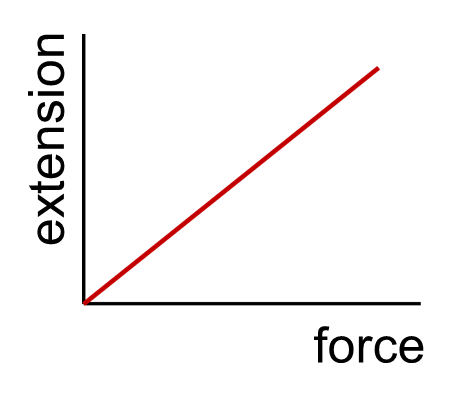
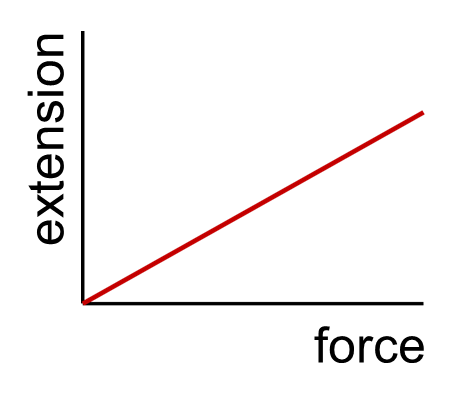
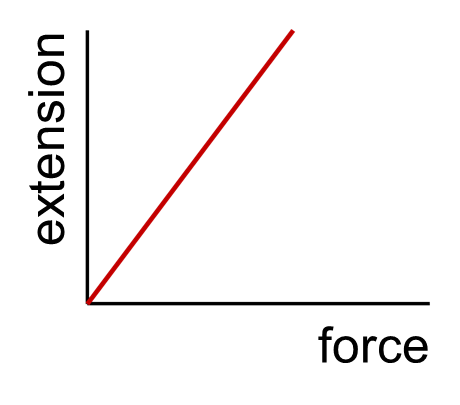
Q4.For elastic deformation, extension (or compression) is directly proportional to the force applied.
What is the name of this law, and how is it expressed as an equation?
Q5.Cars have stiff suspension springs to ensure a smoother ride. If the spring constant of one of these springs is 60,000 N/m, the force needed to compress the spring by 2.0 cm is N.
Q6.A spring has an unstretched length of 0.6 m. When a force of 200 N is applied, it stretches to a length of 1.0 m.
What is the spring constant of the spring?
