


Subtract a mixed number from a mixed number
I can subtract a mixed number from a mixed number explaining which strategy is most efficient.


- Year 4
Subtract a mixed number from a mixed number
I can subtract a mixed number from a mixed number explaining which strategy is most efficient.
Lesson details
Key learning points
- To subtract mixed numbers, we need to use our fraction-sense to determine the most appropriate strategy to use.
- Mixed numbers can be subtracted by counting back using a number line or by converting them to improper fractions.
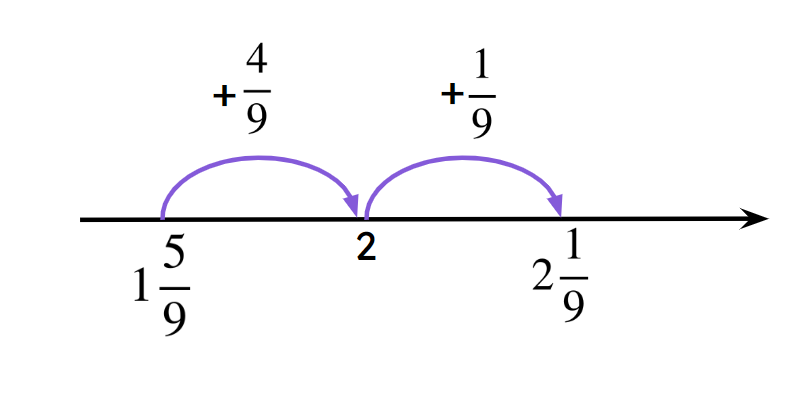
- If mixed numbers are close, it is more efficient to ‘find the difference’ by counting forwards from part to whole.
Keywords
Mixed number - A mixed number is a whole number and a fraction combined.
Improper fraction - An improper fraction is a fraction where the numerator is greater than or equal to the denominator.
Common misconception
Children may believe that a smaller mixed number cannot be subtracted from a greater one if its fractional part is greater. E.g. five and three-quarters cannot be subtracted from six and one-quarter.
If the mixed numbers are close to each other, try to ‘find the difference’ by counting forwards on a number line from the part to the whole.


Licence
Lesson video
Loading...
Prior knowledge starter quiz
6 Questions
Q1.$$ {8} \over {12}$$ − $$ {6} \over {12}$$ =

Q2.Match the equations to the correct difference.
$$ {7} \over {4}$$ − $$ {1} \over {4}$$ - $$ {6} \over {4}$$
$$ {9} \over {4}$$ − $$ {2} \over {4}$$ - $$ {7} \over {4}$$
$$ {9} \over {4}$$ − $$ {7} \over {4}$$ - $$ {2} \over {4}$$
$$ {14} \over {4}$$ − $$ {2} \over {4}$$ - $$ {12} \over {4}$$
$$ {6} \over {4}$$ − $$ {3} \over {4}$$ - $$ {3} \over {4}$$
Q3.Match the improper fractions to their equivalent mixed number.
$$ {11} \over {10}$$ - $$1{{1} \over {10}}$$
$$ {18} \over {10}$$ - $$1{{8} \over {10}}$$
$$ {29} \over {10}$$ - $$2{{9} \over {10}}$$
$$ {34} \over {10}$$ - $$3{{4} \over {10}}$$
$$ {46} \over {10}$$ - $$4{{6} \over {10}}$$
Q4.Match the mixed number to their equivalent improper fraction.
$$2{{4} \over {10}}$$ - $$ {24} \over {10}$$
$$3{{4} \over {10}}$$ - $$ {34} \over {10}$$
$$1{{6} \over {10}}$$ - $$ {16} \over {10}$$
$$2{{1} \over {10}}$$ - $$ {21} \over {10}$$
$$5{{3} \over {10}}$$ - $$ {53} \over {10}$$
Q5.Calculate this. $$6{{1} \over {8}}$$ − $$ {3} \over {8}$$ =
Q6.Match the equation to its difference.
$$2{{7} \over {9}}$$ - $$3{{1} \over {9}}$$ − $$ {3} \over {9}$$
$$1{{5} \over {9}}$$ - $$2{{2} \over {9}}$$ − $$ {6} \over {9}$$
$$1{{6} \over {9}}$$ - $$2{{1} \over {9}}$$ − $$ {4} \over {9}$$
$$3{{7} \over {9}}$$ - $$4{{3} \over {9}}$$ − $$ {5} \over {9}$$
Assessment exit quiz
6 Questions
Q1.Use the number line to complete the sentence: the difference between $$2{{1} \over {9}}$$ and $$1{{5} \over {9}}$$ is ninths
Q2.Calculate this $$3{{1} \over {5}}$$ − $$ 2{{3} \over {5}}$$ = ?
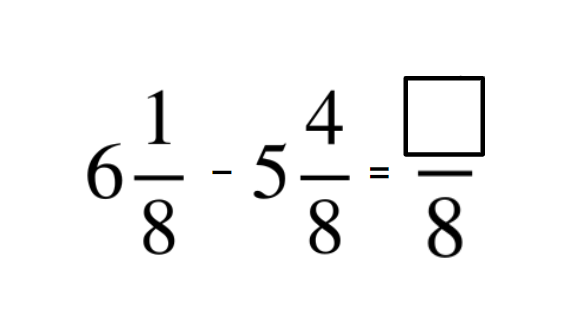
Q3.Complete the missing box.
Q4.Match the equations to the difference.
$$ {4} \over {6}$$ - $$3{{1} \over {6}}$$ − $$2{{3} \over {6}}$$
$$ {3} \over {6}$$ - $$4{{2} \over {6}}$$ − $$3{{5} \over {6}}$$
$$ {5} \over {6}$$ - $$4{{3} \over {6}}$$ − $$3{{4} \over {6}}$$
$$ {2} \over {6}$$ - $$5{{1} \over {6}}$$ − $$4{{5} \over {6}}$$
Q5.Andeep spends two and a quarter hours doing his homework. Izzy spends one and three-quarter hours doing her homework. How much more time did Andeep spend?
Q6.Izzy walks three and one-tenth kilometres on Saturday. On Sunday she walks one and four-tenth kilometres less than this. How far does she walk on Sunday?
