


- Year 11
The area of any triangle
I can derive the formula for the area of any triangle.
Lesson details
Key learning points
- The formula for the area of a right-angled triangle is 0.5 x base x perpendicular height
- With an equilateral or isosceles triangle, you can use Pythagoras' theorem to find the height
- If you know one of the base angles, you can use the sine ratio to find the perpendicular height
- Doing this leads to the formula 0.5absinC
Keywords
Area - The area is the size of the surface and states the number of unit squares needed to completely cover that surface.
Sine function - The sine of an angle (sin(θ°)) is the y-coordinate of point P on the triangle formed inside the unit circle.
Common misconception
Using any two side lengths for the sine formula.
It must be two side lengths and the angle between them. So any two side lengths of the triangle can be used so long as you also use the angle between them.


Licence
Lesson video
Loading...
Prior knowledge starter quiz
6 Questions
Q1.Match the polygon with the formula for calculating its area.

Square - Area = $$l^2$$
Triangle - Area = $$\frac{bh}{2}$$
Parallelogram - Area = $$b\times h$$
Trapezium - Area = $$\frac{1}{2}(a + b)h$$
Circle - Area = $$\pi\times r^2$$
Q2.Match the areas of these triangles with their dimensions.
Area = 15 cm$$^2$$ - A triangle with perpendicular height = 5 cm and base = 6 cm
Area = 40 cm$$^2$$ - A triangle with perpendicular height = 10 cm and base = 8 cm
Area = 6 cm$$^2$$ - A triangle with perpendicular height = 3 cm and base = 4 cm
Area = 2 cm$$^2$$ - A triangle with perpendicular height = 2 cm and base = 2 cm
Q3.A regular hexagon is made up of 6 equilateral triangles. The total area of the regular hexagon is 120 cm$$^2$$. The area of one triangle is cm$$^2$$.
Q4.A right-angled triangle has a height of 8 cm and a base of 5 cm. Work out the length of the hypotenuse to 1 decimal place.
Q5.A right-angled triangle has a height of 4 cm and a hypotenuse of 15 cm. Work out the length of the base to 1 decimal place.
Q6.A rectangle has a width of 5 cm and a diagonal length of 13 cm. The area of the rectangle is cm$$^2$$.
Assessment exit quiz
6 Questions
Q1.Match the areas of these triangles with their dimensions.
Area = 45 cm$$^2$$ - A triangle with perpendicular height = 10 cm and base = 9 cm
Area = 9 cm$$^2$$ - A triangle with perpendicular height = 6 cm and base = 3 cm
Area = 1 cm$$^2$$ - A triangle with perpendicular height = 1 cm and base = 2 cm
Area = 2 cm$$^2$$ - A triangle with perpendicular height = 2 cm and base = 2 cm
Q2.A right-angled triangle has a height of 13 cm and a hypotenuse of 20 cm. The area of the triangle to 1 decimal place is cm$$^2$$.
Q3.A triangle has two adjacent lengths of 8 cm and 9 cm with an angle in between of 53°. The area of the triangle to 1 decimal place is cm$$^2$$.
Q4.Area = $$\frac{1}{2}ab\text{sin}C$$, despite a, b and C being explicit in the formula, they just mean two adjacent sides and the angle between them. Select other formulas for the area.
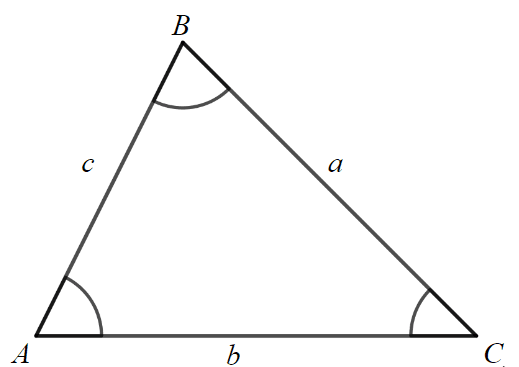
Q5.Match the areas with the dimensions of the triangle.
23.0 cm$$^2$$ - The adjacent lengths are 7 cm and 9 cm with a 47° angle in between.
26.3 cm$$^2$$ - The adjacent lengths are 12 cm and 6 cm with a 47° angle in between.
6 cm$$^2$$ - The adjacent lengths are 3 cm and 4 cm with a 90° angle in between.
2.4 cm$$^2$$ - The adjacent lengths are 1 cm and 6 cm with a 53° angle in between.
$$9\sqrt{3} \;$$ cm$$^2$$ - The adjacent lengths are 6 cm and 6 cm with a 60° angle in between.
Q6.Six equilateral triangles are put together to make a regular hexagon. The length of each triangle is 6 cm. Work out the exact area of the regular hexagon.
